I confirm tote bag dimensions by first asking what the bag must carry, because width and height alone can hide important fit problems. An incomplete brief leaves both the buyer and factory interpreting the intended shape. I recommend defining the packaged contents, construction, and measurement points before moving into sampling.
I recommend that retail buyers specify tote bag dimensions around the intended products and packaging, then document body width, body height, bottom depth or gusset construction, and handle measurements on a labeled drawing. I treat those dimensions as a sampling brief, not proof of fit; the filled sample still needs approval.
I handle dimension-confirmation inquiries at CoraggioBag, and I have received briefs that included width and height but left the bottom unclear. My next question is about the contents. That conversation helps me turn a size request into something our development team can interpret.
Which Products and Uses Determine Tote Bag Size?
I find that a familiar-looking tote can still be the wrong starting point for a retail project. If I do not know which packaged products must fit together, I cannot tell whether the requested shape supports the buyer’s intended use.
I start by asking for the dimensions of each packaged product, the required quantity, and the intended arrangement. I also ask whether the tote serves as shopping packaging, a gift set carrier, or a separately sold accessory. Those details guide the size brief without implying a universal best size.
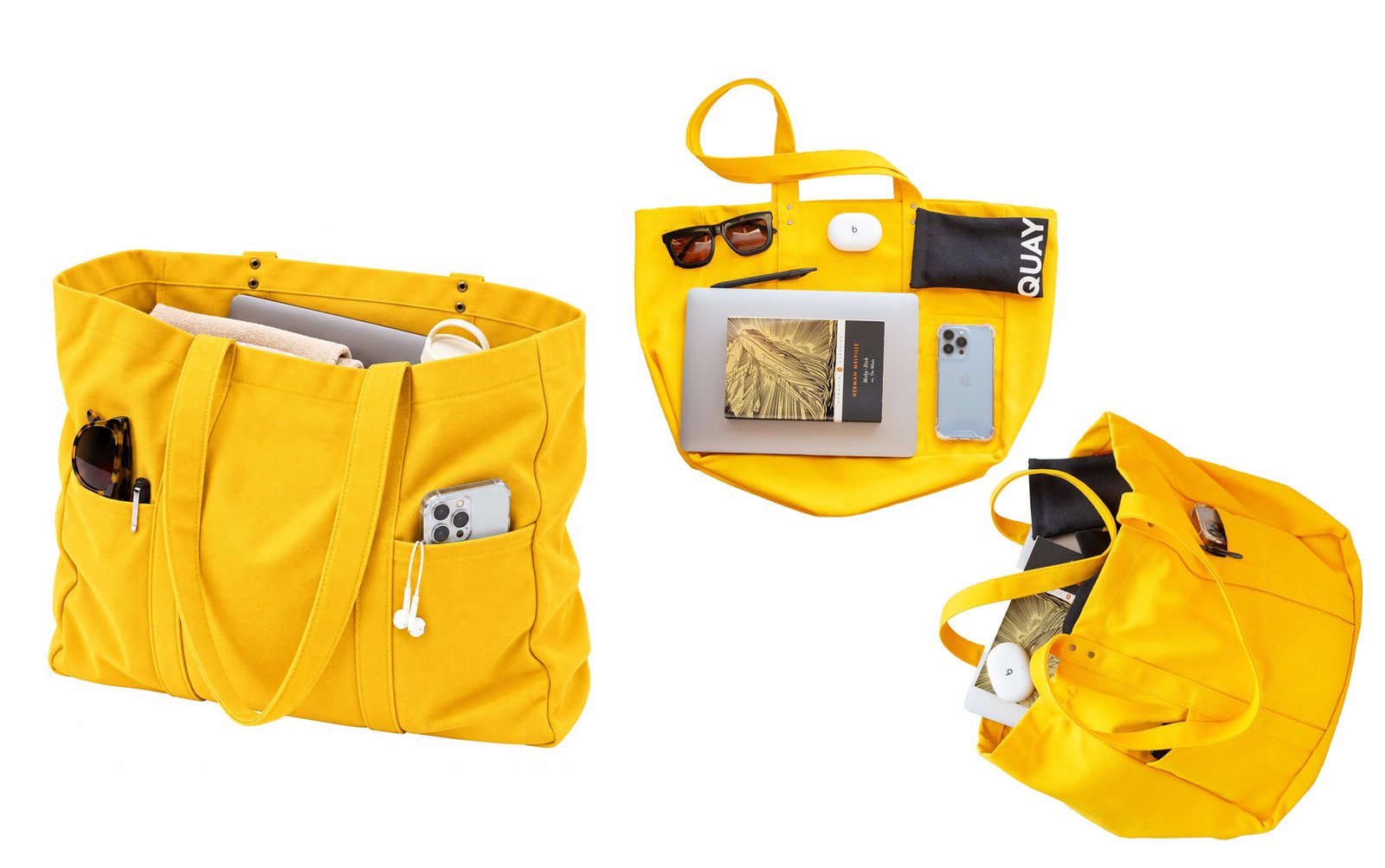
I define the complete load before discussing the outline
When I review tote bag dimensions, I want to understand the complete load, not just the largest individual item. Several products may fit separately but require a different footprint when packed together.1
I usually ask buyers to confirm:
- Which products must the bag carry at the same time?
- Does each product have a retail box, sleeve, protective wrap, or outer carton?
- Must certain products remain upright?
- Will the bag contain tissue, inserts, dividers, or promotional materials?
- Does the customer need room to reach inside and remove an item?
- Must the bag close while it holds the intended load?
I ask for packaged dimensions, rather than relying on product dimensions alone. A bottle’s shipping or presentation box may determine the required space more than the bottle itself.
I separate the essential load from optional uses
I also distinguish between the bag’s main purpose and possible secondary uses. A tote developed to carry a specific gift set has a clearer fit requirement than a general lifestyle accessory.
For a mixed-use brief, I suggest listing:
| Requirement | What I ask the buyer to define |
|---|---|
| Essential contents | The products that must fit together |
| Packing arrangement | The intended orientation and grouping |
| Opening access | The space needed for loading and removal |
| Closure condition | Whether the filled bag must close |
| Secondary use | Other uses that matter to the design |
I do not use this list to promise fit from a drawing. I use it to establish the requirements that the sample must later demonstrate.
If the brief begins with a competitor reference, I treat that reference as a design direction. I still ask for the actual contents before recommending that we reproduce its proportions.
How Should Width, Height, Gussets and Handles Be Measured?
I often see size requests that look complete because they contain several measurements. The uncertainty appears when the buyer and factory measure different locations. Without a shared method, even an accurately recorded number can describe the wrong part of the tote.2
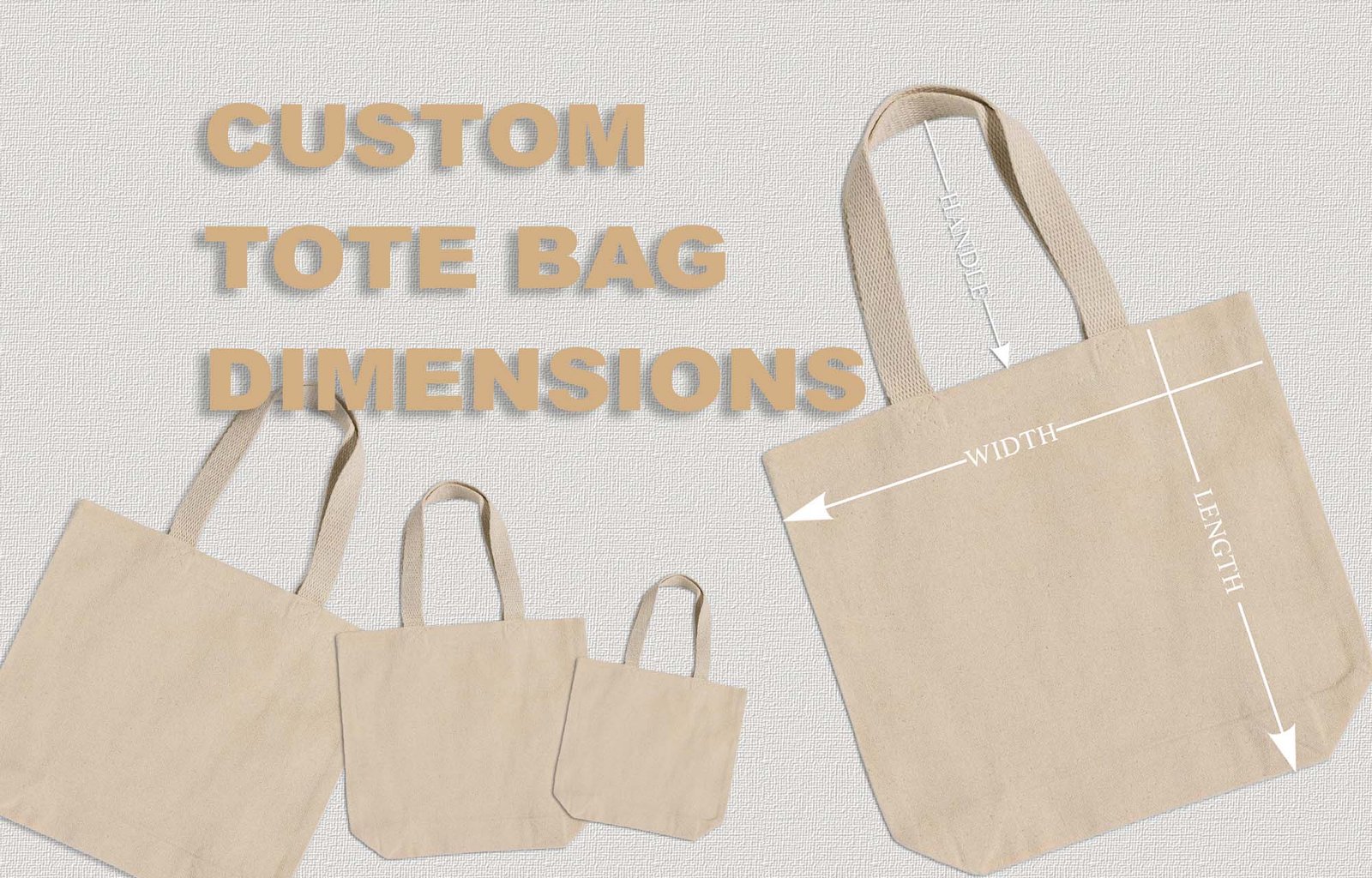
I recommend a labeled drawing that identifies body width, body height, opening width where relevant, bottom construction, and handle measurements. I ask both sides to confirm whether each measurement is external or internal, how the bag is positioned, and which seam or edge marks each measurement endpoint.
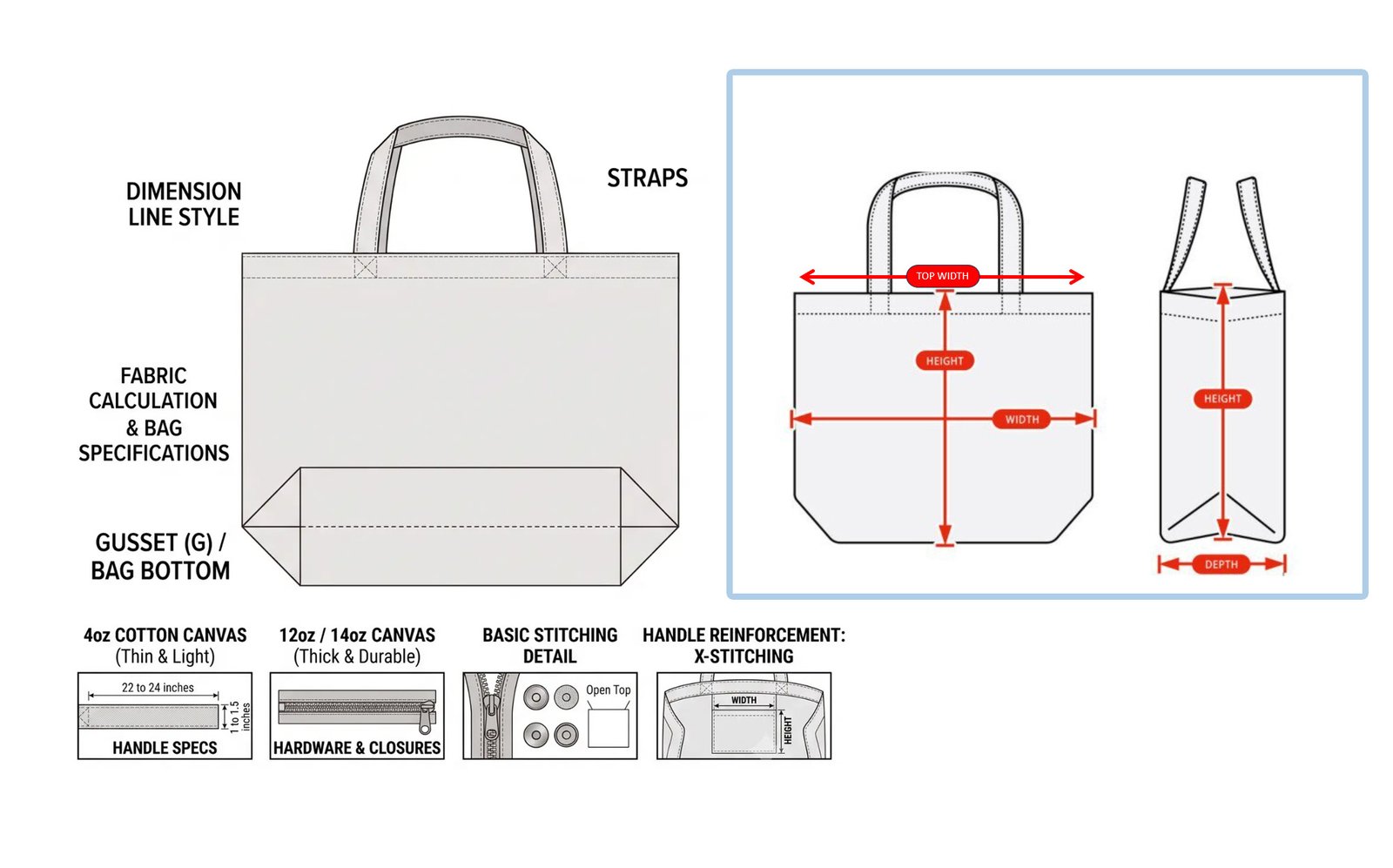
I define measurement locations rather than relying on notation
I do not assume that a sequence such as “width × height × depth” means the same thing to every supplier. A diagram gives those labels a physical location.
For tote bag dimensions, I use the following checklist:
| Measurement | What I clarify |
|---|---|
| Body width | Whether it refers to the top, base, or another identified location |
| Body height | The upper and lower endpoints, excluding handles unless stated otherwise |
| Opening width | Whether the opening is measured flat, expanded, or in another agreed condition |
| Bottom depth | The direction and endpoints across the constructed base |
| Gusset dimension | Which panel or fold is measured and in what condition |
| Handle drop | The agreed relationship between the bag’s upper edge and handle apex |
| Handle length | The defined endpoints along the handle |
| Handle width | The location where the strap width is checked |
I keep handle drop and handle length separate. They describe different things, and attachment position or handle shape can change their relationship. I also ask whether handle length includes any portion sewn into the body.
I identify the measurement condition
A soft tote does not hold one fixed shape in every condition.3 I therefore ask whether we will measure the bag laid flat, opened without contents, or filled using an agreed arrangement.
I also separate external body dimensions from usable internal space. Seams, lining, pockets, binding, and closures can affect the space available to the products.4 I do not calculate internal clearance by assuming that the external measurements transfer directly inside.
For a tapered tote, I may need both top and base widths. For a lined or structured design, I may need additional internal checks. My aim is not to collect unnecessary measurements; it is to make each fit-critical dimension interpretable.
How Do Gusset Designs Change Usable Space and Access?
I cannot fully understand a tote’s carrying space from its front outline. Two bags can have similar apparent width and height yet open differently. When the brief leaves the base construction undefined, I ask how the buyer expects the bag to expand.
I distinguish a flat tote, a tote with a shaped bottom, and a design with defined side panels or gussets. I confirm the intended construction with sketches because bottom depth and side gussets are not interchangeable specifications5. I also review how the opening, seams, and lining affect access.
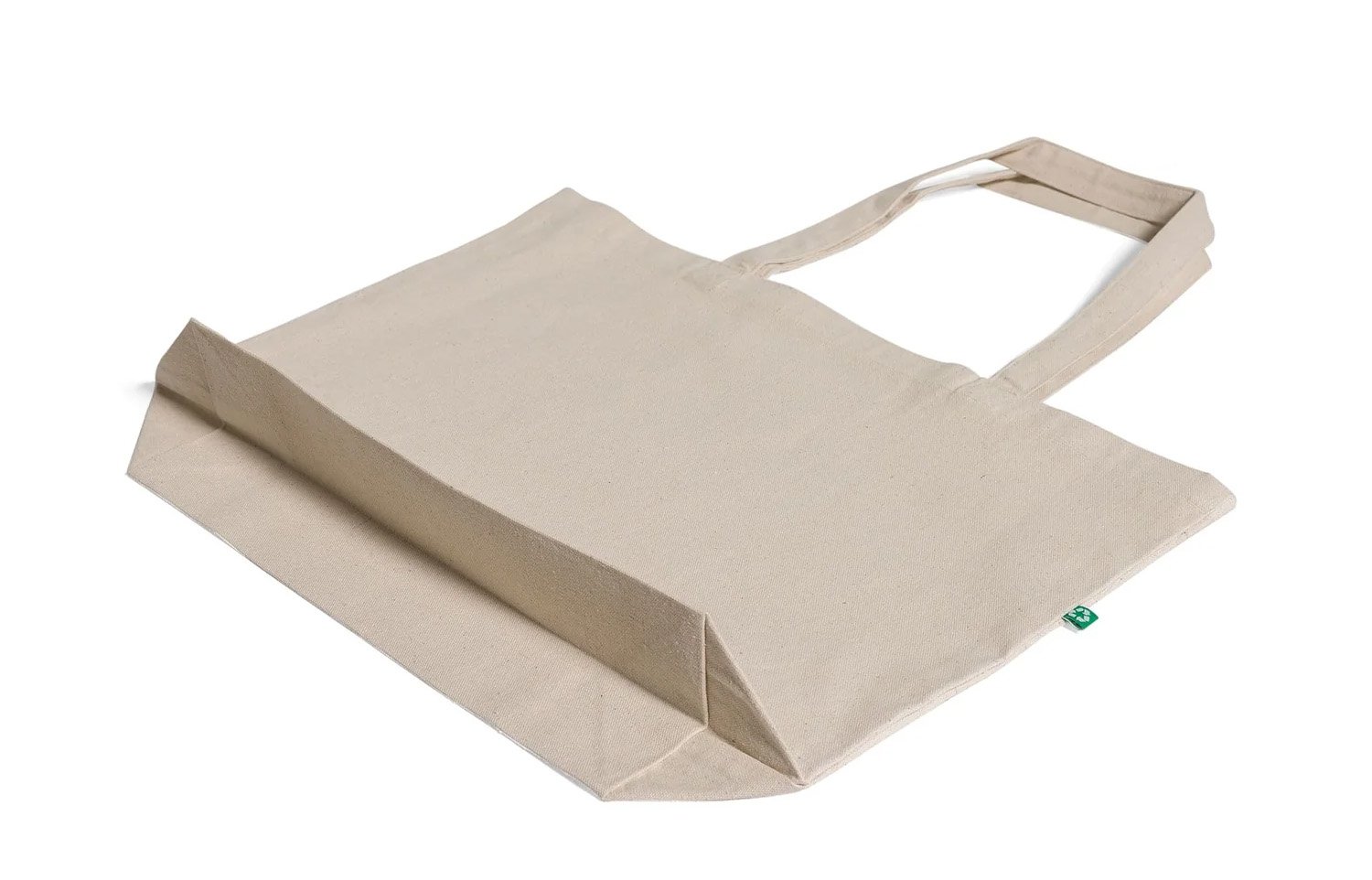
I discuss construction before comparing capacity
When a buyer asks for “a gusset,” I ask which part of the bag should expand. The term alone does not tell me enough about the intended pattern or finished shape.
I use a construction comparison like this to guide the discussion:
| Construction description | What I ask the buyer to confirm |
|---|---|
| Flat tote without a defined gusset | How the contents should sit and how the body may bulge |
| Bottom-gusset construction | How the base opens and how its depth will be measured |
| Boxed-corner base | The intended finished base shape and corner construction |
| Separate base and side panels | The dimensions and connection of each panel |
| Folded side-gusset design | The fold arrangement and expanded shape |
I treat these descriptions as discussion aids, not universal naming conventions. The agreed drawing remains more useful than the construction name alone.
I check access as well as space
A tote may have enough room around its contents after loading but still present an awkward opening. I therefore ask how products will enter and leave the bag.
A zipper, magnetic closure, reinforced upper edge, or internal divider may affect that process. I also consider whether the buyer expects staff to pack the bag at a checkout or customers to load it themselves.
I avoid estimating capacity by multiplying flat external width, height, and an assumed depth. That calculation can misrepresent a flexible or tapered bag, especially when its cross-section changes after filling.6
Instead, I connect the construction drawing to a proposed packing arrangement. If the arrangement remains uncertain, I flag it for the sample review. That keeps construction intent separate from a claim about usable capacity.
How Can Filled Samples Confirm the Final Dimensions?
I see a clear difference between completing a dimension brief and confirming fit. A drawing can resolve missing information, but it cannot demonstrate how real packaging moves through the opening or sits against seams.7 I reserve that judgment for the physical sample.
I recommend checking the sample with the intended products, packaging, inserts, and closure condition. I record whether the contents load, sit, and come out as required, then compare the sample with the agreed drawing. I treat any change as a documented revision before bulk production approval.
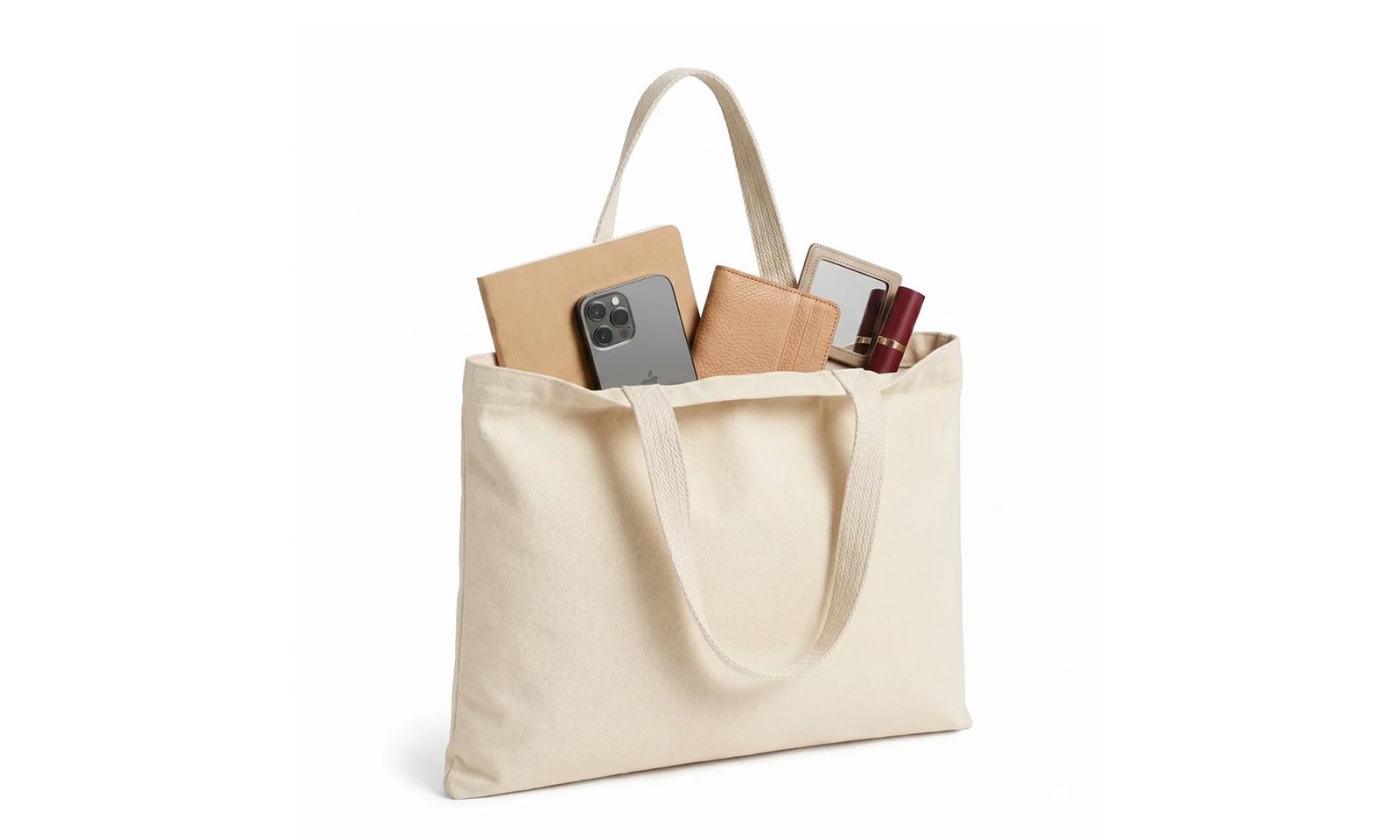
I make the sample review repeatable
I prefer a written review sequence so the buyer and factory can discuss the same observations. A photograph of a filled tote helps, but it rarely explains the entire loading process.
My suggested fit review includes these steps:
- I identify the sample revision. I connect it to the drawing and specification under review.
- I confirm the contents. I use the intended packaging, not an unpackaged substitute unless that limitation is recorded.
- I check loading. I observe whether the products enter in the required orientation without unintended force or distortion.
- I check the packed arrangement. I review positioning, interference with pockets, and contact with the closure.
- I check removal. I confirm whether the intended user can access the products as required.
- I record the decision. I distinguish approval, conditional approval, and required changes.
If the actual products are unavailable, I may discuss representative mock-ups with the buyer. I clearly identify what those mock-ups do not reproduce, such as surface friction, rigidity, or weight.8
I keep fit approval separate from performance approval
A successful fit check does not establish a safe carrying load, long-term durability, or suitability for every use.9 I treat those as separate evaluation questions.
Where load-bearing performance matters, I recommend that the buyer agree on appropriate testing with the supplier and a qualified testing professional. The evaluation should reflect the construction, materials, intended contents, and market requirements.
I also avoid silently changing tote bag dimensions after the buyer approves a sample. If a change affects the base, opening, lining, or handles, I ask whether it requires another fit review. The approved sample only remains a useful reference when the written specification matches it.10
What Size Tolerances and Diagrams Belong in the Purchase Order?
I do not want the purchase order to depend on an email thread that different teams interpret differently. If measurement locations, revisions, or tolerances remain unclear, the production and inspection teams may lack a shared basis for checking the finished bags.
I recommend attaching an approved dimension drawing, construction notes, measurement methods, and agreed tolerances to the purchase order. I identify the approved sample and revision, then distinguish fit-critical measurements from other dimensions. I agree on numerical tolerances with the supplier rather than borrowing an unsupported universal allowance.
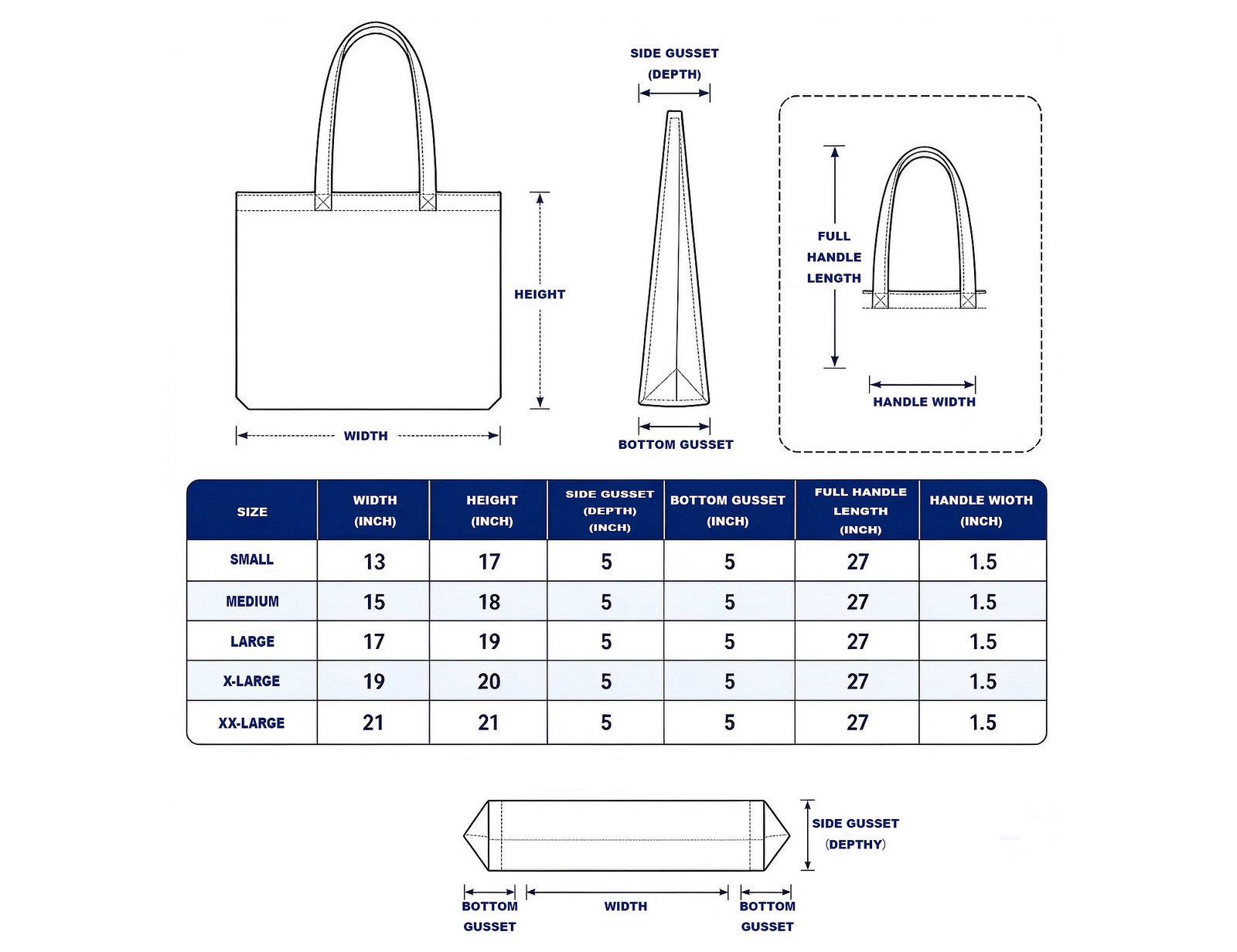
I give each drawing a clear reference
I want the purchase order to point to one controlled set of documents. A drawing should identify the bag style, revision, units, and relevant measurement conditions.
For a typical dimensional brief, I include or request:
- A front view with clearly located width and height measurements.
- A side or base view that explains the bottom construction.
- An opening view when access or closure geometry matters.
- Handle attachment locations and agreed handle measurements.
- Internal features that may restrict the intended contents.
- Notes identifying external and internal dimensions.
- The approved sample reference and any recorded exceptions.
I avoid treating an unscaled illustration as a measurement source. I ask the team to follow the written dimensions rather than estimate proportions from the image.
I agree on tolerances around the actual requirement
I do not recommend a single tolerance for every tote material and construction. The appropriate agreement depends on the measurement method, production process, and fit requirement.11
I use a specification table with fields such as:
| Specification field | What I record |
|---|---|
| Dimension identifier | The matching label on the drawing |
| Target measurement | The agreed nominal dimension and unit |
| Acceptance limits | The supplier-confirmed allowable variation |
| Measurement method | The bag condition, endpoints, and procedure |
| Fit relevance | Whether variation could affect loading or closure |
| Inspection reference | The agreed document or sample revision |
If a packaged product requires close clearance, I flag that issue before approving the specification. I ask the supplier to assess whether the requested limits are practical, and I recommend qualified technical review when the application requires it.
I also keep dimensional tolerances separate from an inspection sampling plan. One defines the acceptable measurement range; the other defines how the order will be checked.12 Both need agreement, but neither replaces a filled-sample fit review.
Frequently Asked Questions
Is there a standard tote size that works for most retail products?
I do not treat any standard size as a reliable fit guarantee. I start with the products, their packaging, and the intended arrangement. A common size may provide a reference, but I still confirm construction, measurement locations, and filled-sample fit before recommending approval.
Should I specify internal or external tote bag dimensions?
I specify which type each measurement represents. External dimensions help define the finished body, while internal requirements help communicate the space the contents need. I do not assume they are equivalent. When fit is important, I document both the relevant construction measurements and the required contents.
Are bottom depth and side gussets the same measurement?
I do not use those terms interchangeably. Bottom depth describes a defined base dimension, while a side gusset refers to a particular expansion construction. I ask for a sketch that shows the panels, folds, and measurement points so the factory can confirm the intended interpretation.
Can I approve a tote using photographs of the filled sample?
I use photographs to support the review, but I prefer a physical sample check with the intended contents. Images may not reveal loading difficulty, closure interference, or removal problems. If remote approval is necessary, I request a documented packing sequence, measurements, and clear records of any limitations.
What should I send CoraggioBag before requesting a sample?
I ask for the intended products and packaged dimensions, required quantities per bag, packing arrangement, reference design, material preferences, closure details, and branding requirements. If the width, height, or base construction is incomplete, I help clarify the brief before our team proceeds with sample development.
Conclusion
I approach tote bag dimensions as a contents-and-construction decision, not a choice between popular sizes. I first define the packaged load, then document the body, base, opening, and handles with clear measurement points. I use a filled sample to validate fit and an agreed specification to guide production checks. If you are developing a private-label tote, send CoraggioBag your product details, packaging dimensions, and design references. I can help turn that information into a clearer OEM/ODM sampling brief.
"Packing problems", https://en.wikipedia.org/wiki/Packing_problems. Research on three-dimensional packing treats item dimensions, orientation, and non-overlap constraints as joint determinants of a feasible arrangement; rigid-box models provide geometric context rather than direct proof of fit in a flexible tote. Evidence role: mechanism; source type: paper. Supports: The influence of item dimensions, orientation, and packing arrangement on required container space.. Scope note: Rigid-object packing models do not reproduce flexible bag deformation or loading access. ↩
"NIST TN 1297: Appendix D4. Measurand defined by the ...", https://www.nist.gov/pml/nist-technical-note-1297/nist-tn-1297-appendix-d4-measurand-defined-measurement-method. The International Vocabulary of Metrology distinguishes the measurand from the measurement procedure and identifies specification of the measurand as part of meaningful measurement; these principles support explicitly identifying dimensional endpoints and conditions. Evidence role: definition; source type: institution. Supports: The need to define the quantity being measured and relevant measurement conditions.. Scope note: General metrology terminology does not prescribe tote-specific measurement locations. ↩
"The elements of draping - PMC", https://pmc.ncbi.nlm.nih.gov/articles/PMC357008/. Studies of fabric drape describe shape as a response to bending, shear, gravity, and boundary conditions, providing a physical basis for distinguishing flat, opened, and loaded measurement states. Evidence role: mechanism; source type: paper. Supports: The dependence of fabric shape on material properties, support, and applied forces.. Scope note: Fabric-level studies do not establish dimensional changes for a particular finished tote. ↩
"49 CFR Part 178 -- Specifications for Packagings", https://www.ecfr.gov/current/title-49/subtitle-B/chapter-I/subchapter-C/part-178. Construction and packaging guidance distinguishes outer dimensions from interior clearance because material thickness and construction features occupy space; the effect of individual seams, pockets, and closures remains design-dependent. Evidence role: mechanism; source type: education. Supports: The distinction between external dimensions and interior clearance in constructed containers.. Scope note: General construction guidance does not quantify the usable space lost in this bag design. ↩
"What Is a Gusset? How It Gives a Bag Its Depth and Shape", https://www.facebook.com/carryology/videos/whats-this-strip-of-fabric-forthat-strip-is-called-the-gusset-and-its-the-reason/1094994046469477/. Sewing references describe a gusset as a construction element used to add room or shape, supporting a distinction between an expansion feature and a specified base dimension; bag-making terminology is not fully uniform. Evidence role: definition; source type: encyclopedia. Supports: The meaning of a gusset as a construction feature rather than simply a base-depth measurement.. Scope note: A general definition does not establish a universal supplier naming convention for side or bottom gussets. ↩
"More Volume Problems - Calculus I", https://tutorial.math.lamar.edu/classes/calci/morevolume.aspx. For solids with varying cross-sectional area, volume is obtained by integrating that area along the relevant axis rather than assuming a rectangular prism; this explains why nominal external dimensions may not represent a tapered bag's volume. Evidence role: mechanism; source type: education. Supports: The geometric assumptions required for a width-times-height-times-depth volume calculation.. Scope note: Geometric volume alone does not establish usable packing capacity or loading access. ↩
"NASA Systems Engineering Handbook", https://www.nasa.gov/wp-content/uploads/2018/09/nasa_systems_engineering_handbook_0.pdf. Systems engineering guidance distinguishes verification against specified requirements from validation of intended use, providing a framework for separating drawing review from evaluation of loading, fit, and removal with representative contents. Evidence role: general_support; source type: government. Supports: The distinction between documenting design requirements and validating performance in intended use.. Scope note: General engineering guidance does not mandate a particular tote sampling procedure or exclude other validated assessment methods. ↩
"- TESTING PAVEMENT FRICTION -", https://idot.illinois.gov/content/dam/soi/en/web/idot/documents/transportation-system/research/pavement-technology-advisories/testing-and-data-collection-series/ptat3.pdf. Prototyping research treats fidelity as specific to the properties and questions being evaluated; dimensional resemblance alone does not establish that a mock-up reproduces the mechanical interactions of the intended product. Evidence role: general_support; source type: paper. Supports: The dependence of prototype-test conclusions on the properties represented by the prototype.. Scope note: This principle does not quantify how friction, stiffness, or weight would affect a particular tote fit check. ↩
"Influence of Shopping Bags Carrying on Human Responses ...", https://pmc.ncbi.nlm.nih.gov/articles/PMC6040247/. Carrier-bag performance testing evaluates load-bearing behavior through defined loading and handling procedures, supporting the distinction between accommodating contents and demonstrating resistance to carrying stresses. Evidence role: general_support; source type: institution. Supports: The need for performance-specific tests to evaluate carrying capacity and durability.. Scope note: Applicability depends on bag material, construction, intended use, and the scope of the selected test; no safe load is established here. ↩
"6.5 Configuration Management", https://www.nasa.gov/reference/6-5-configuration-management/. Configuration-management guidance uses controlled baselines and documented changes to maintain consistency between a product and its defining information, providing a general basis for linking sample approvals to specification revisions. Evidence role: general_support; source type: government. Supports: Maintaining consistency between an approved product configuration and its controlled documentation.. Scope note: This is a general configuration-control principle rather than a tote-industry approval standard. ↩
"Measurement Uncertainty", https://www.nist.gov/itl/sed/topic-areas/measurement-uncertainty. Metrology and process-capability guidance distinguishes specification limits from process variation and measurement uncertainty, supporting evaluation of whether proposed dimensional limits are both functionally adequate and reliably achievable. Evidence role: general_support; source type: government. Supports: The relationship between dimensional requirements, process capability, and measurement uncertainty.. Scope note: These principles do not supply numerical tolerances for any particular tote material or construction. ↩
"6.2. Test Product for Acceptability: Lot Acceptance Sampling", https://www.itl.nist.gov/div898/handbook/pmc/section2/pmc2.htm. NIST acceptance-sampling guidance describes plans that use sample results and decision rules to accept or reject a lot, whereas dimensional specification limits define conformity for a measured characteristic; neither by itself demonstrates intended-use fit. Evidence role: definition; source type: government. Supports: The difference between item-level dimensional acceptance limits and sample-based lot acceptance decisions.. Scope note: Sampling entails producer and consumer risks and does not guarantee conformity of every unit in an accepted lot. ↩