Many bag buyers1 think they found a factory in China. Then they learn too late that they were talking to a middleman, paying more, and losing control.
A trading company sells products from factories2, while a factory makes the bags itself. For bag buyers1, this difference affects price, lead time, customization, quality control, and how fast problems get solved.
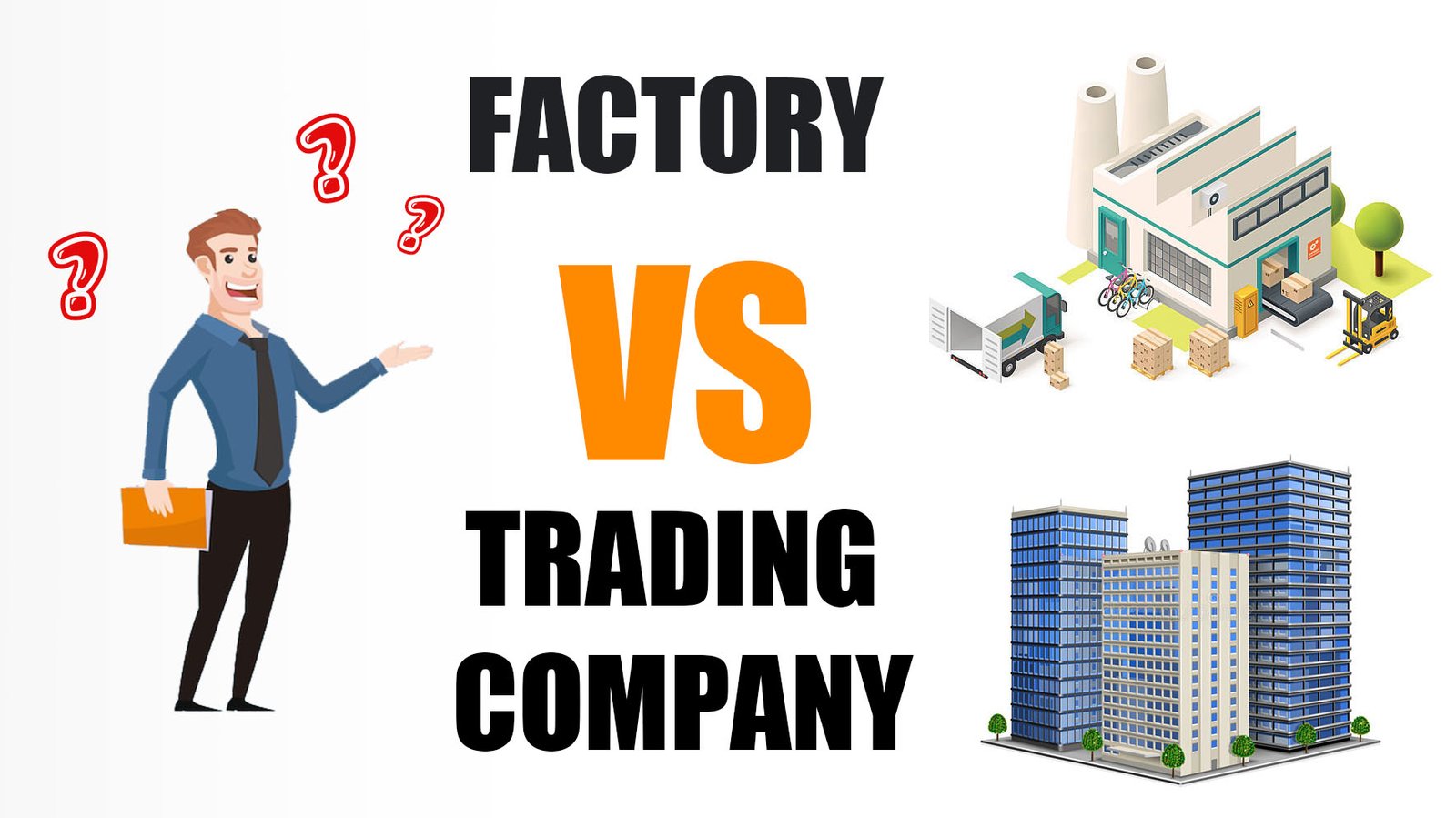
When I talk with buyers, I hear the same problem again and again. They search on Alibaba or Google, find a supplier that looks polished, and assume it is a real factory. The website is clean. The English is smooth. The replies are fast. It all feels safe. But in many cases, that "factory" is a trading company. I do not say this is always bad. A good trading company can still help in some cases. But if I am buying bags for price, quality consistency3, and direct control, I need to know who is really making my order. That is where many sourcing mistakes begin.
What Is the Difference Between a Trading Company and a Factory in China?
Many buyers mix these two business types together. Then they compare quotes the wrong way and choose suppliers without knowing who controls the production4.
A trading company buys from or works with factories and resells to buyers. A factory owns or manages production directly, including workers, machines, lines, quality checks, and delivery planning.
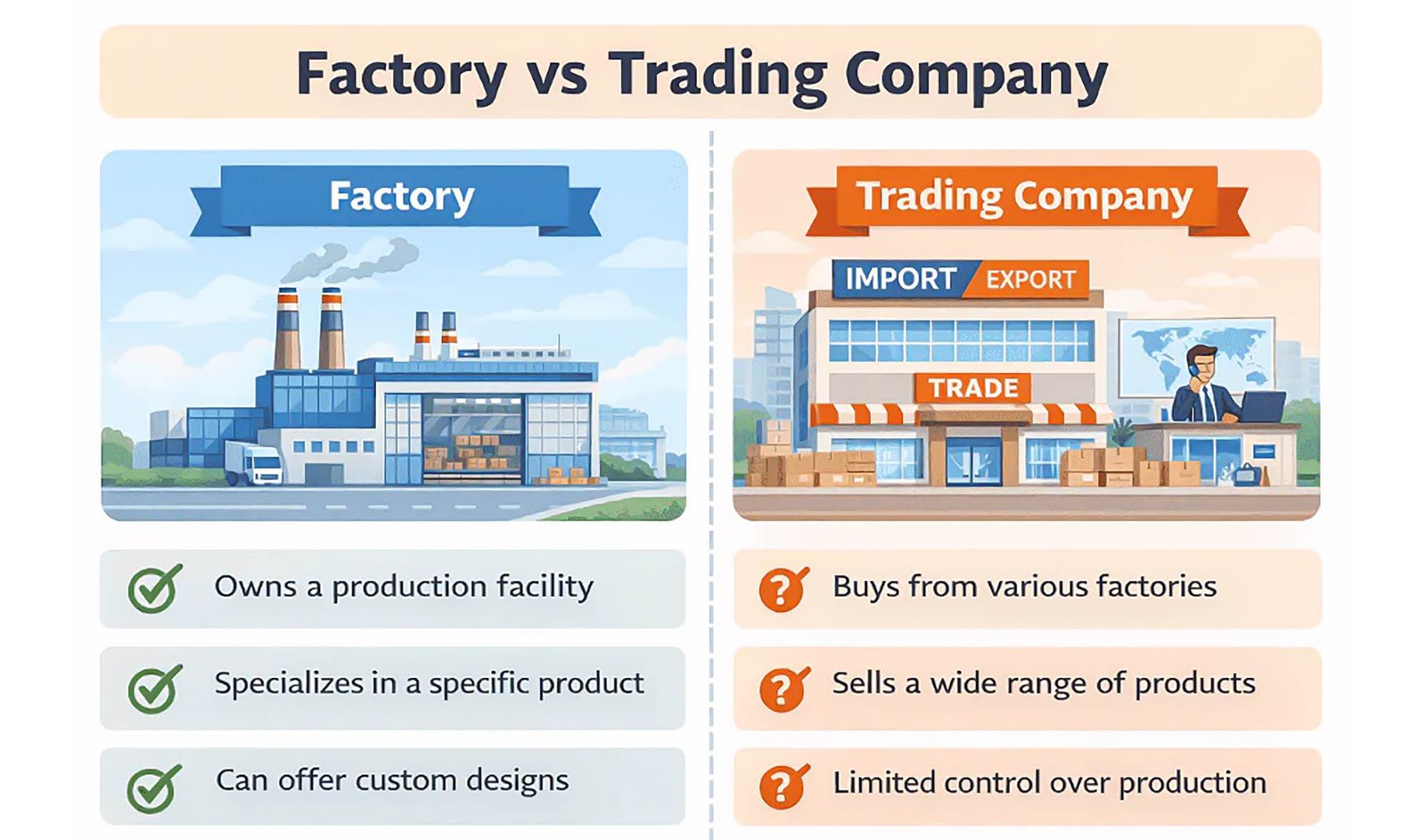
When I explain this to buyers, I keep it simple. A factory makes the bags. A trading company sells the bags. That is the core difference. The factory has workshops, cutting tables, sewing lines, sample teams, QC staff, and production managers. The trading company usually has sales people, sourcing people, and account managers. Some trading companies work with many factories. Some work with only a few. Some are honest about it. Some are not.
I have seen why buyers get confused. Many trading companies look more professional online than real factories5. They invest in websites, SEO, catalogs, and smooth English communication. Real factories often spend their time on production, not on marketing. So when I search online, the company that looks strongest is not always the one that actually makes the bags.
Here is the simple comparison I use:
| Point | Trading Company | Factory |
|---|---|---|
| Main role | Sells and coordinates | Produces and manages manufacturing |
| Own workshop | Usually no | Yes |
| Own workers | Usually no | Yes |
| Price | Higher due to margin | Usually lower |
| Communication | Often smoother at first | Can be direct but less polished |
| Production control | Indirect | Direct |
| Customization depth | Depends on partner factory | Usually stronger |
| Problem solving | Slower if factory is involved behind the scenes | Faster if managed internally |
This difference matters most in B2B bag sourcing6. If I need OEM or ODM work7, custom fabric, logo methods, packaging, and stable repeat orders, direct factory control8 usually gives me more confidence.
How Can Bag Buyers Tell If They're Talking to a Factory or a Middleman?
A supplier can say "we are a factory" in one sentence. Many buyers stop checking at that point. That is where avoidable mistakes happen.
I can usually verify a real factory9 by checking for its workshop, production lines, workers, machines10, business license11, factory videos12, and live proof of manufacturing activity.
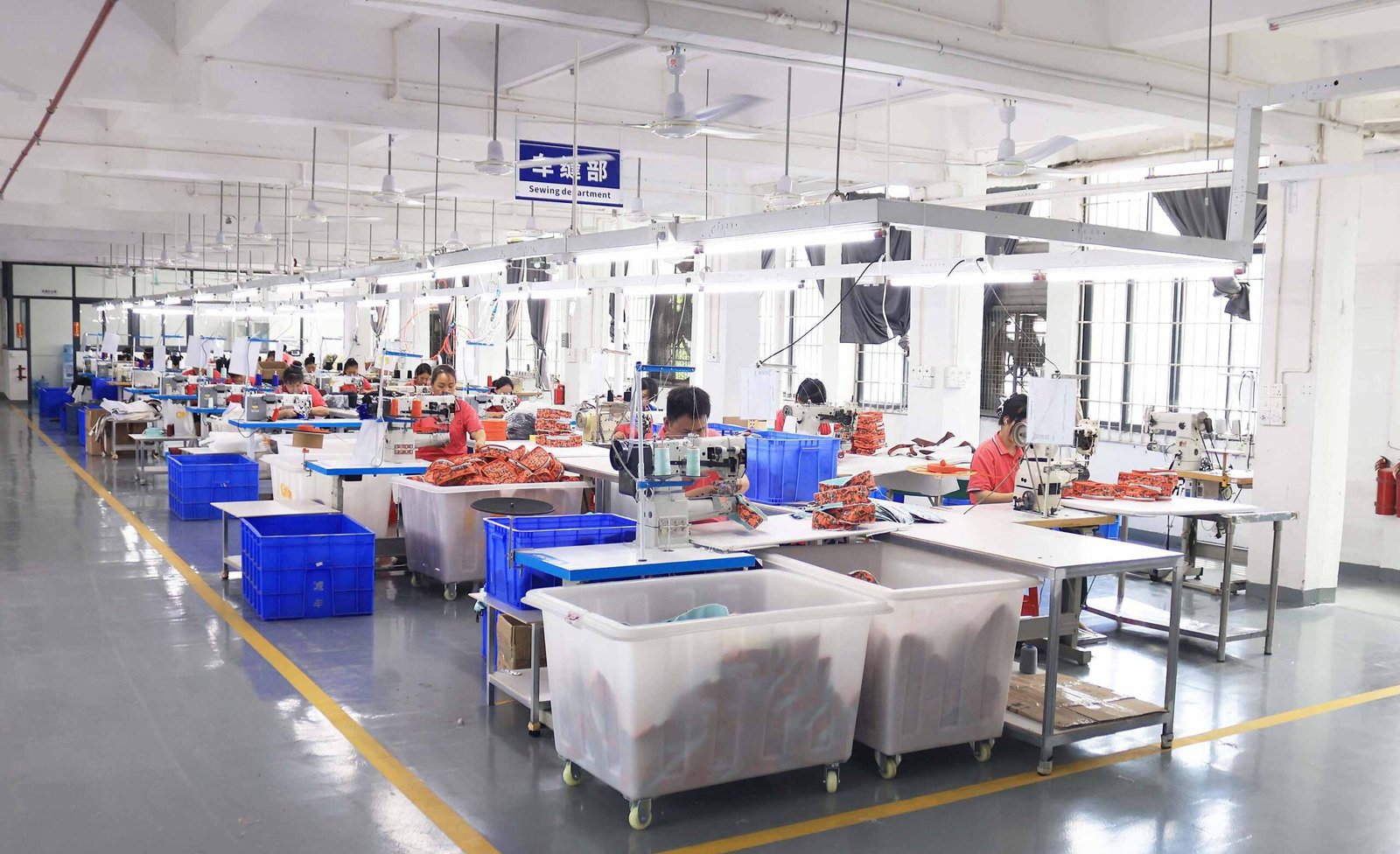
I always tell buyers not to trust labels alone. I need proof. In my own work, I look for the most direct evidence possible. Does the supplier show real production lines? Can they send a video call from the workshop13? Can they show cutting, stitching, inspection, and packing in one place? Can they explain machine types and output clearly? If the answers stay vague, I get careful.
I also ask questions that a real factory should answer without stress. How many workers do you have? How many production lines? What is your monthly capacity? What bag types do you make most often? What part do you produce in-house, and what part do you outsource? A real factory may not use perfect English, but it usually knows the details. A middleman may answer in general words and avoid specifics.
These checks help me a lot:
| What I Check | Why It Matters | Warning Sign |
|---|---|---|
| Factory address | Confirms location and scale | Office address only |
| Workshop video | Shows real production | Only showroom photos |
| Machine details | Proves technical knowledge | Very general answers |
| Worker count | Shows real capacity | Unclear or changing answers |
| Production line photos | Shows actual manufacturing | All photos look like stock images |
| Audit or certification | Adds credibility | Refuses to share basic documents |
| Video call request | Harder to fake live | Avoids live factory tour |
I also compare the supplier's product range14. If one company says it makes tote bags, hard luggage, furniture, electronics, and water bottles, I slow down. That usually means trading activity, not focused manufacturing. A real bag factory often has a more logical product range14.
Do You Pay More When Buying Bags Through a Trading Company?
Many buyers think the price difference is small. Then over a large order, they find they gave away margin that they could have kept.
Yes, in many cases I pay more through a trading company because it adds its own profit margin. For bag orders, that extra cost is often around 10% to 30%15, depending on the product and order structure.
This is one of the biggest reasons buyers care about the topic. If I buy through a trading company, I am usually paying for one more layer. That layer may include sourcing work, communication support, document handling, quality follow-up, and problem coordination. If I need those services, the extra margin may be worth it. But if I thought I was dealing direct with the maker, then I may be overpaying without knowing it.
In bags, the extra cost can hide in many places. It can show up in the unit price. It can show up in sample fees. It can show up in shipping markups or packaging charges. Some buyers only compare the first quote and miss the total landed cost16. I try to look at the full picture.
Here is how I think about it:
| Cost Area | Buying from Trading Company | Buying from Factory |
|---|---|---|
| Unit price | Usually higher | Usually lower |
| Sample cost | May include markup | Often closer to actual cost |
| Custom development | Can include extra coordination fee | Often more direct |
| Negotiation room | Less if margin is fixed | More if order volume is clear |
| Repeat order pricing | Depends on trader strategy | Often more stable |
| Cost transparency | Lower | Higher |
I do not say every factory quote is lower. Some factories quote high too. Some trading companies have strong volume and can get good rates. But in most normal bag projects, direct factory buying gives me a better chance to control cost. If I run large supermarket, retail, or brand programs, even a 10% gap matters a lot.
What Are the Risks of Sourcing Bags from a Trading Company Instead of a Factory?
Some buyers focus only on price. But the bigger problem is often not price. The bigger problem is losing visibility and control once production starts.
The main risks are weaker production control17, slower problem solving, less transparency, quality inconsistency, and confusion about who is really responsible when issues happen.
I have seen buyers accept a smooth sales process at the start, then struggle later when things go wrong. This happens because a trading company is one step away from actual production. If fabric color is off, if stitching fails, if packaging is wrong, or if shipping gets delayed, the trader still has to go back to the factory. That means one more layer in every correction.
This creates risk in several ways. First, information can get distorted. I ask one question, the trader asks the factory, the factory answers, the trader translates it back, and part of the detail gets lost. Second, priority can shift. If the trader manages many suppliers and many buyers, my order may not get direct factory attention. Third, responsibility gets blurred. If there is a defect, the trading company may blame the factory. The factory may say the trader approved it. I am left in the middle.
I think about the risks like this:
| Risk | Why It Happens | Effect on Buyer |
|---|---|---|
| Higher defect rate | Less direct QC control | Returns, claims, lost margin |
| Slower issue fixing | More communication layers | Delays and frustration |
| Hidden outsourcing18 | Trader shifts factory without notice | Inconsistent quality |
| Less technical depth | Sales team knows less production detail | Wrong materials or structure |
| Longer lead time | Coordination between parties | Delivery risk |
| Weak accountability | Responsibility is shared | Harder claims process |
This does not mean every trading company is risky. Some are skilled and honest. But if I want stable OEM bag production, I prefer to know exactly who cuts, sews, checks, and packs my goods.
How Do I Find a Real Bag Factory in China and Skip the Middleman?
Many buyers search hard but still talk to middlemen. The problem is not effort. The problem is that the best marketers are not always the real makers.
To find a real bag factory, I verify workshop proof, ask factory-specific questions, request live video, check documents, review production details, and visit or inspect before large orders.
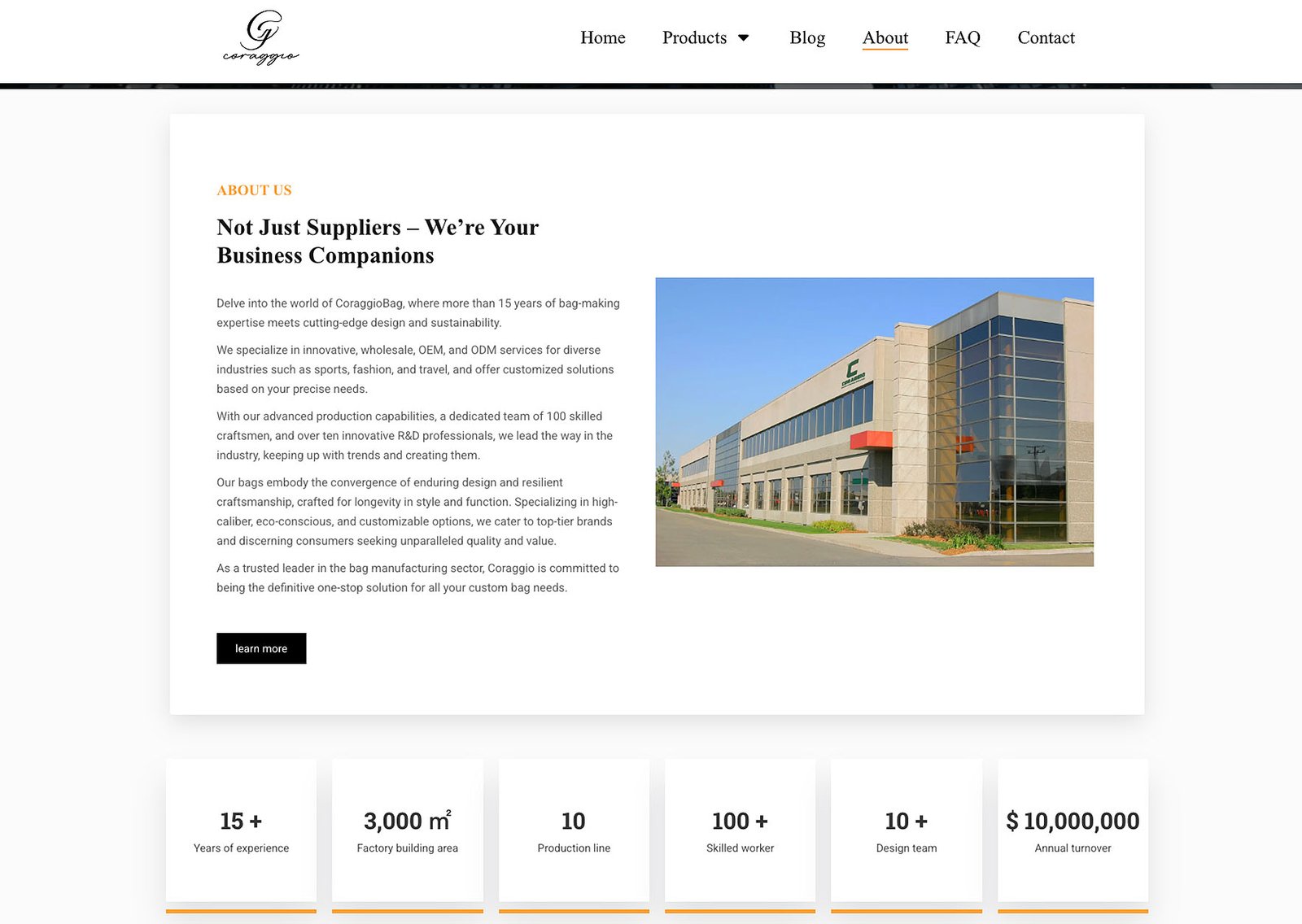
If I want to skip the middleman, I need a process, not just a search. I start with supplier screening19. I look at the website, product focus, company history, and factory photos. Then I go deeper. I ask for the business license11. I ask whether the company is a manufacturer or trading company in registration. I ask for workshop videos with date proof. I ask for raw material storage, cutting area, sewing lines, QC area, and packing area. I ask for a live video meeting in the factory.
Then I test the supplier with details. I send a real bag inquiry with clear specs. I watch how they answer. Do they discuss fabric weight, lining, stitching method, logo process, zipper brand, MOQ, sample lead time, and production risk clearly? A real factory usually answers from production logic. A middleman often answers from sales logic.
This is the process I use:
| Step | What I Do | What I Want to Confirm |
|---|---|---|
| 1 | Search by focused bag type | Supplier is specialized |
| 2 | Review company profile | Years, scale, product match |
| 3 | Ask for license and certifications | Legal identity |
| 4 | Request workshop photos and videos | Real factory environment |
| 5 | Ask for live video call | Real-time proof |
| 6 | Check capacity and worker count | Production ability |
| 7 | Send sample development request | Technical strength |
| 8 | Use third-party audit20 if needed | Independent verification |
| 9 | Start with trial order | Real performance |
| 10 | Review repeat order consistency | Long-term fit |
I also like to ask one simple question: "Can I visit your factory, or can my inspector visit?" A real factory usually says yes. A middleman may delay, redirect, or make excuses.
From my experience, the best factory is not always the loudest online. It is often the one that knows bags deeply, answers directly, shows real production, and stays consistent from sample to bulk order.
Conclusion
If I want lower cost, better control, and stable bag quality, I need to verify I am dealing with a real factory before I place any serious order.
Helps you understand the buyer journey and typical pitfalls so you can avoid common sourcing mistakes and structure better purchasing decisions. ↩
Clarifies how trading companies actually operate so you can judge whether their role adds value or just extra cost to your bag projects. ↩
Guides you to strategies and checks that keep bag quality stable across repeat orders and different production runs. ↩
Shows how real production control impacts quality, delivery, and accountability, helping you reduce risk on critical orders. ↩
Helps you see through polished marketing so you don’t confuse online appearance with actual manufacturing capability. ↩
Provides a structured approach for businesses buying bags in bulk, from supplier research to contracts and quality checks. ↩
Clarifies OEM vs ODM so you choose the right cooperation model for brand, design ownership, and customization depth. ↩
Explains how dealing directly with factories can improve pricing, customization, and reaction speed when issues arise. ↩
Shows concrete verification steps that reduce the risk of being misled by middlemen posing as manufacturers. ↩
Helps you request the right proof so you can visually confirm that a supplier truly has manufacturing capacity. ↩
Shows you how to use legal registration data to confirm whether a supplier is a manufacturer or a trading company. ↩
Teaches you how to use video evidence correctly so you can spot red flags and staged or stock footage early. ↩
Gives you a checklist of what to ask and look for live so you can confirm real production on the spot. ↩
Shows you how to read product focus as a clue to specialization, real expertise, and likely manufacturing depth. ↩
Helps you understand where extra margins hide so you can negotiate better or move closer to the source factory. ↩
Ensures you compare suppliers correctly by including all hidden costs, not just the initial unit price quote. ↩
Explains how indirect control leads to more defects, delays, and miscommunication, so you can design safeguards. ↩
Helps you detect when your order is quietly shifted to another factory, causing surprise quality or delay issues. ↩
Gives you a step-by-step framework to filter out weak or fake suppliers before you invest serious time or money. ↩
Explains how independent audits reduce risk, verify capabilities, and give you objective insight before large orders. ↩