Reusable mesh produce bags often get customized in the wrong order. Many buyers start with logo ideas, color cards, or packaging mockups, but that creates problems later. If the bag size, mesh structure, and load use do not match the retail job, the final product can look good and still fail in stores.
Brands should customize reusable mesh produce bags by starting with use case, not artwork. The right process is to define what produce the bag will carry, the target weight, the needed size, the mesh material, and the retail selling method first. After that, branding, labels, and packaging can be added without creating avoidable durability, sourcing, or cost problems.
When I handle buyer inquiries, I notice the same pattern again and again. The first useful discussion is rarely about logos. The real progress starts when a buyer tells me what the bag needs to do in a supermarket, produce chain, or grocery promotion. That is where smart customization begins.
What Are Reusable Produce Mesh Bags?
Buyers often treat this as a simple category, but that assumption causes mistakes. If a team defines reusable produce mesh bags too loosely, they may compare products that look similar in a quotation sheet but behave very differently in daily grocery use.
Reusable produce mesh bags are lightweight, breathable shopping or produce-handling bags designed for repeated use with fruits and vegetables. They are usually made with open or semi-open mesh structures so shoppers can see contents easily, while air circulation helps keep produce visible and practical for grocery selection and transport1.
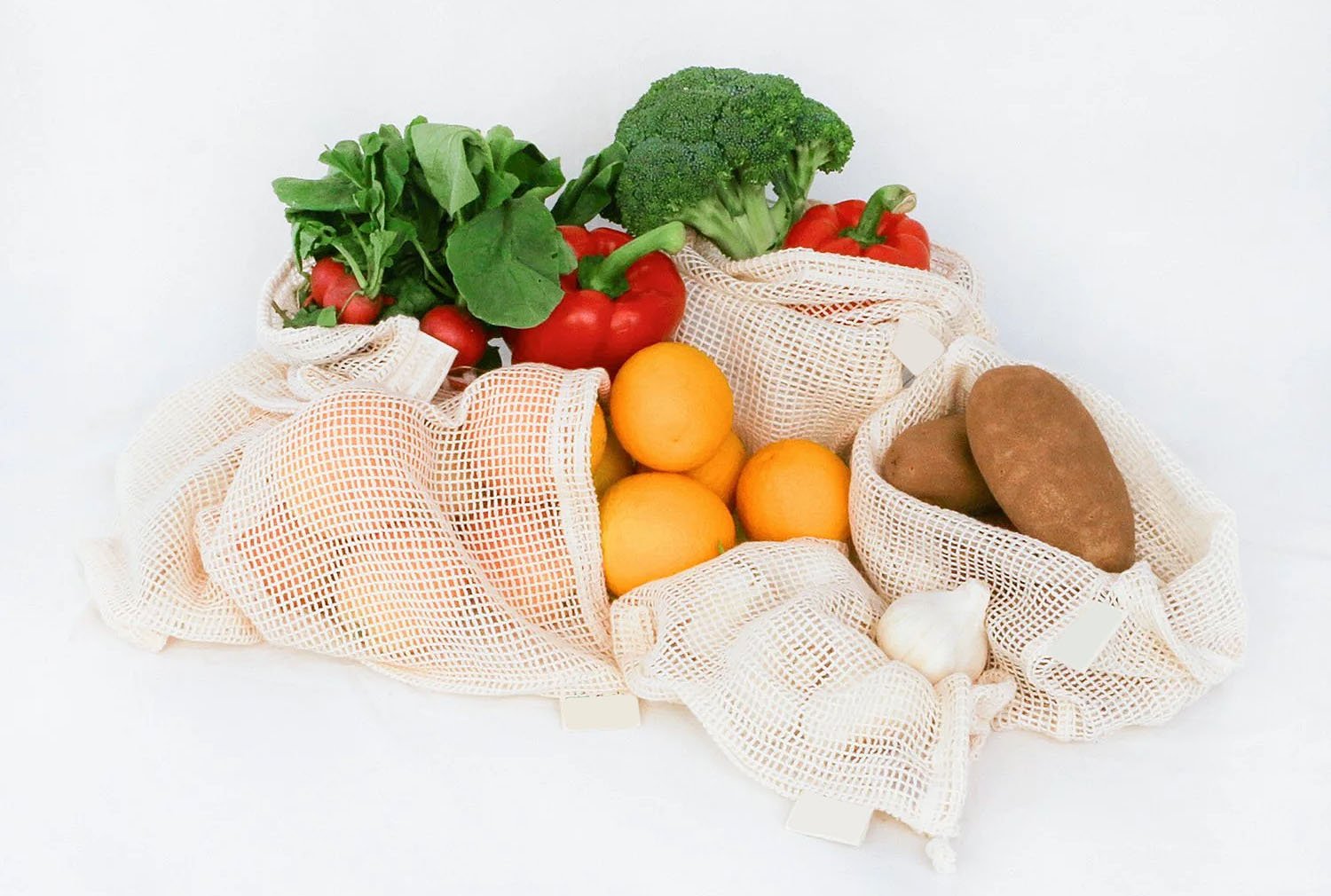
In buyer discussions, the first issue is usually not the name of the product but the retail role. Some buyers mean a consumer shopping set sold in packs. Others mean a store-use produce bag replacement. A few mean a gift-with-purchase eco item. Those are not the same project.
Why the definition matters
A common sampling mistake is to request “reusable produce bags” without clarifying:
- What produce goes inside
- How heavy the bag may become
- Whether the bag is sold empty or used in store
- Whether customers need to see the produce clearly
- Whether the bag must fold small for repeat use
Those details affect the full specification. I have seen buyers approve a sample that looked attractive flat on the table, then realize it was too shallow for root vegetables or too soft for bulk citrus.
Reusable mesh bags are a retail tool
I think of reusable mesh produce bags as a fit-for-use packaging and carrying tool, not only as a branded merchandise item. In retail programs, they usually need to balance four things:
Visibility
Customers want to identify produce fast.Breathability
The open structure supports airflow better than solid fabric.2Portability
The bag must be easy to carry, store, and reuse.Repeatability
The specification should be practical for repeat orders, not just for one attractive sample round.
Not all produce use is the same
Here is a simple way I explain this to buyers:
| Use case | Typical need | Custom focus |
|---|---|---|
| Light produce set | Garlic, lemons, small onions | Small size, soft handfeel, low cost |
| Mixed grocery use | Apples, oranges, snacks | Medium size, balanced durability |
| Heavy produce use | Potatoes, large onions, root vegetables | Strong seams, better load support |
| Retail gift set | Promotional pack | Appearance, packaging, simple branding |
That is why I do not like starting from artwork files. I prefer starting from the retail task. Once the role is clear, the rest of the customization becomes much easier and much safer.
Which Mesh Materials Work for Grocery Use?
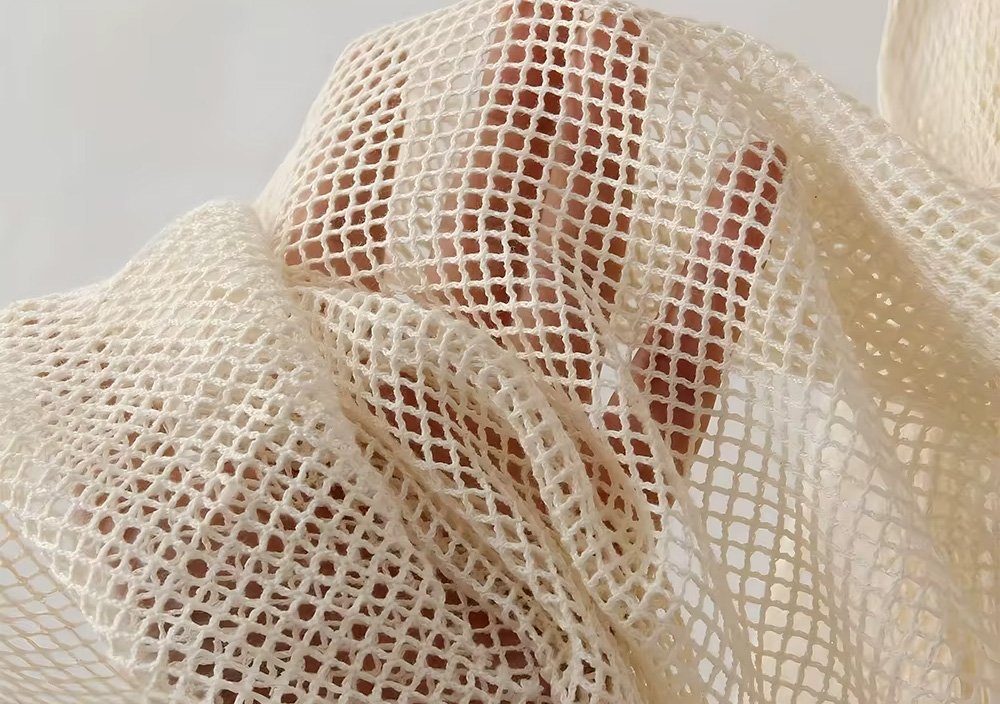
Many buyers ask for “mesh” as if all mesh behaves the same. That creates confusion during quoting and sampling. Material, yarn feel, and mesh density can change the bag’s look, weight, stretch, and customer experience far more than many procurement teams expect.
The best mesh materials for grocery use depend on the produce type, target cost, and retail positioning. Cotton mesh can feel more natural3, polyester mesh can offer stable cost and easy production4, and recycled blends may support sustainability goals5. The right choice depends on function, not on trend alone.
In real inquiry handling, I usually ask one basic question first: What will customers actually put inside the bag? That answer tells me much more than a mood board does.
Common material directions
Here are the material paths buyers usually compare:
1. Cotton mesh
Cotton mesh often appeals to brands that want a natural look and a more eco-conscious presentation. It can feel soft and familiar. It also works well when the brand story matters at shelf level.
But cotton is not automatically the best answer. In some projects, cotton versions cost more, weigh more, or create less consistency than the buyer expected.
2. Polyester mesh
Polyester mesh is common because it is practical and production-friendly. It can support good consistency in bulk production, and it often gives buyers more cost control.
For supermarket buyers, this matters. A program that looks good in sampling but becomes unstable in mass production is not really a good program.
3. Recycled material options
Some buyers want recycled polyester or other eco-positioned material directions. That can be a strong retail story, especially in Europe and parts of North America6. But I always suggest keeping the conversation practical.
A sustainability claim is only useful when the bag still performs well for its actual grocery job.
Mesh density matters too
Material alone is not the full decision. Mesh density changes performance in visible ways:
- More open mesh improves visibility and airflow7
- Tighter mesh may help contain smaller produce8
- Softer structures can feel nicer in hand
- More stable structures may better support repeated handling
A common buying mistake is to assume denser mesh is always better. I do not agree. For some grocery programs, a lighter and simpler structure is the better commercial choice because it balances function, cost, and reorder consistency.
How I usually guide material selection
I often frame the decision like this:
- Choose by produce type
- Check by target load
- Review by retail price point
- Confirm by repeat-order manufacturability
If a buyer wants low price, stable delivery, and large quantity, I usually push for controlled customization, not excessive complexity. That approach reduces sourcing risk. It also helps procurement teams avoid a beautiful sample that becomes hard to reproduce at scale.
How Should Buyers Choose Size and Set Quantity?
This is where many projects go wrong. Buyers often choose size by appearance or by a competitor sample, but size alone means very little. A bag can look correct in dimensions and still perform badly if the actual volume and carrying weight do not match.
Buyers should choose reusable mesh produce bag size and set quantity together by matching dimensions to produce volume, expected load, and how the bags will be sold. A useful size is not just wide or tall enough on paper; it must also carry real grocery weight without creating poor usability.
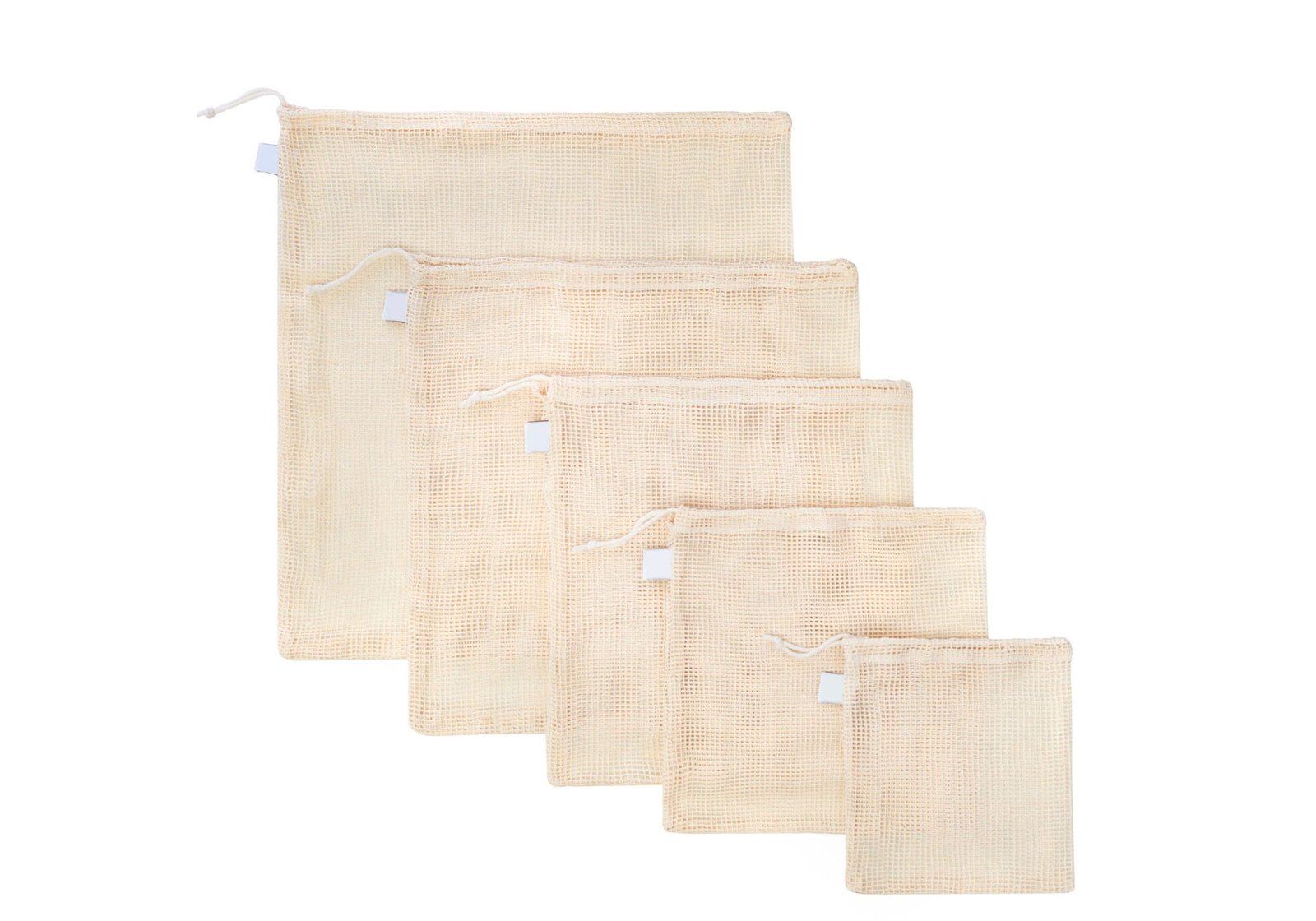
In sample revisions, this is probably the most common issue I see. A buyer asks for a medium set because it looks standard, but after testing with actual apples, onions, or potatoes, the bag either feels too small, too stretched, or awkward to carry.
Size and load capacity must be discussed together
I always suggest buyers define these points at the same time:
- What produce goes inside?
- How many units or kilos are expected?
- Will customers carry one bag or several?
- Will the bag be sold in a 3-pack, 5-pack, or mixed-size set?
A bag that works for lemons may fail for potatoes. A bag that looks premium when empty may sag badly under heavier produce.
A practical size selection framework
Small bags
Best for:
- Garlic
- Ginger
- Lemons
- Small onions
Medium bags
Best for:
- Apples
- Oranges
- Tomatoes
- Mixed produce
Large bags
Best for:
- Potatoes
- Bulk citrus
- Large onions
- Multi-item shopping use
The exact dimensions vary by program, but the decision order should stay the same: produce first, size second, set quantity third.
How set quantity affects the buying result
Set quantity changes both retail value perception and sourcing economics.
| Set type | Retail benefit | Sourcing note |
|---|---|---|
| 3-piece set | Simple and accessible | Easy for entry-level programs |
| 5-piece set | Better value perception | Good for mixed household use |
| Mixed-size set | More practical for shoppers | Requires clearer packing control |
| Single bag retail | Easy promotion item | Less “set value” feeling |
I often tell buyers that the best set is not the biggest one. The best set is the one shoppers actually use repeatedly. If a supermarket program overbuilds the assortment, customers may not understand the value9. Then the extra customization does not create extra sales.
What Branding Options Work on Mesh Bags?
This is the part many teams want to discuss first, but I think it should come later. Branding matters, of course. Still, on reusable mesh produce bags, branding works best when it supports function instead of fighting against the material and use case.
The most effective branding options for reusable mesh produce bags are usually simple ones, such as labels, tags, drawstring details, header cards, or limited print areas. Because mesh is not a flat canvas10, branding should be chosen for clarity, durability, and production practicality rather than maximum visual coverage.
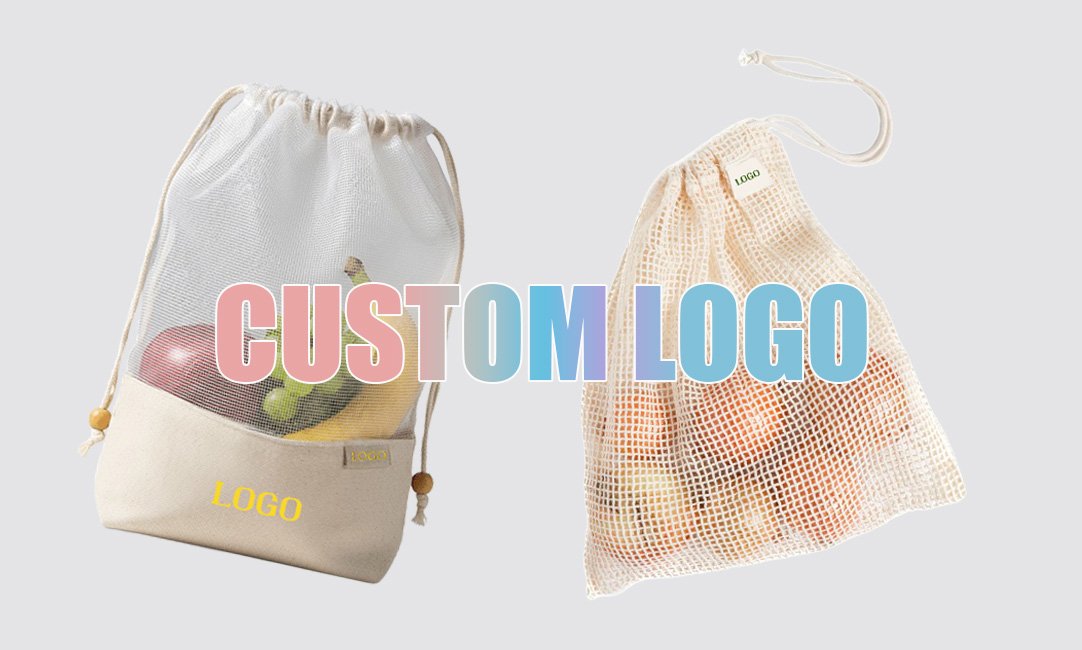
In quoting conversations, I often see buyers imagine branding possibilities based on solid-fabric bags. That creates problems because mesh behaves differently. Open structures limit how and where artwork can be applied cleanly.
Branding that usually works well
Woven or sewn labels
These are often one of the cleanest options. A label can carry the logo, care information, or sustainability message without forcing decoration onto unstable mesh space.
For retail sale, this is one of the most practical methods. It gives the brand room for:
- Logo
- Product story
- Barcode
- Usage instructions
- Material information
Drawstring color matching
This is subtle, but useful. Brand colors on cords or closures can create identity without complicating the bag body too much.
Small print zones
If printing is used, it usually works better in limited, stable areas rather than across the full mesh body.
Why simplicity often wins
A common mistake is over-customization. More print, more panels, and more decorative changes do not always create a better product. They can create:
- Higher defect risk
- Less consistent mass production
- Higher cost
- Longer approval cycles
- More communication errors during sampling
I prefer a simpler spec that a factory can repeat reliably. That is especially true for supermarket and grocery chains that need stable replenishment.
Good customization is controlled simplification.
That idea matters in B2B orders. Buyers like Mark Porter are usually not trying to win an art award. They are trying to secure a bag program that arrives on time, hits the cost target, and works in retail without complaints. Branding should support that goal, not distract from it.
What Should Be Tested Before Retail Launch?
Retail launch problems usually start long before launch day. If a buyer does not test the right things during sampling, the first real product test happens in the hands of customers. That is expensive, and it is avoidable.
Before launching reusable mesh produce bags at retail, buyers should test real produce fit, carrying comfort, seam strength11, closure usability, labeling accuracy, and packaging presentation. The goal is not to over-test every detail, but to confirm that the chosen specification works in daily store and consumer use.
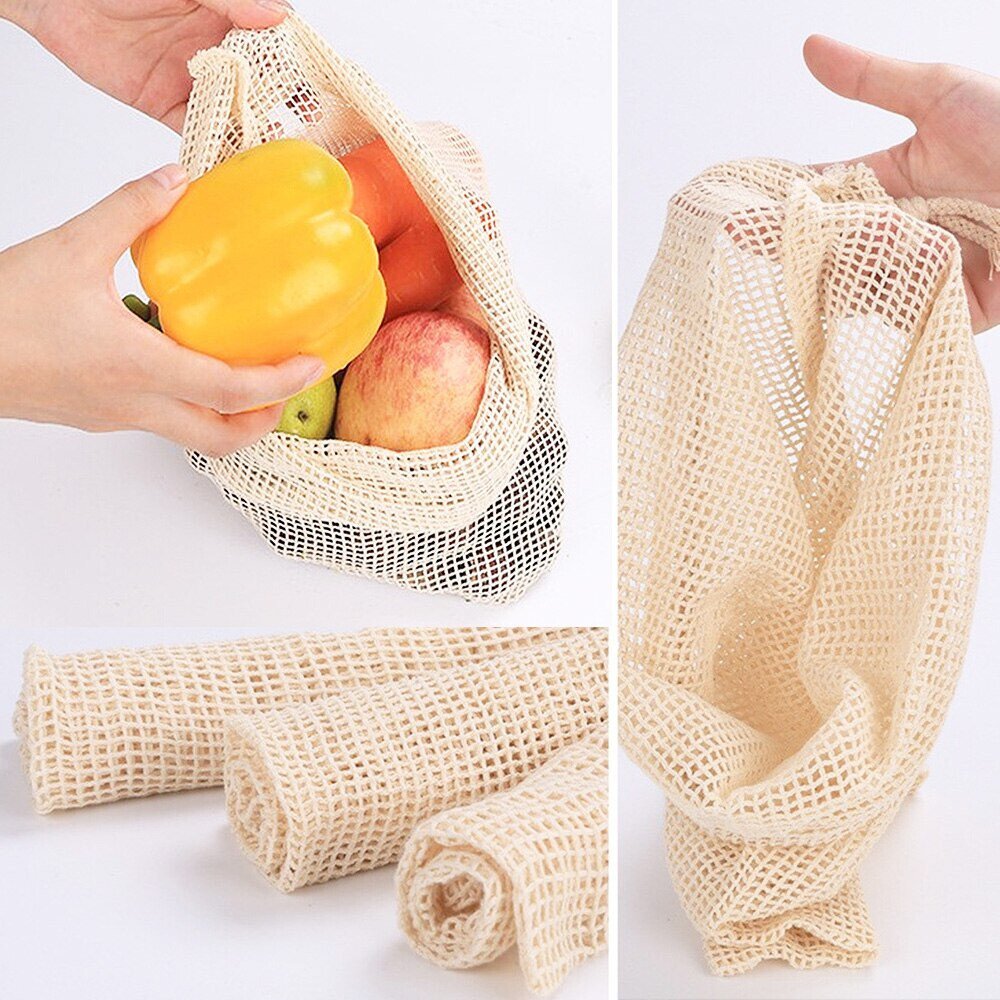
When I review sample feedback, I find that buyers often focus on color and logo placement first. Those details matter, but they are rarely the reason a grocery bag program fails. Functional mismatch is the bigger risk.
The most useful pre-launch checks
1. Real produce loading
Use actual items, not only visual estimation. Test with:
- Apples
- Potatoes
- Onions
- Citrus
- Mixed produce
The bag should feel natural when filled, not overstretched or awkward.
2. Carrying comfort
A bag that holds enough volume but feels uncomfortable in hand is still a bad choice. This issue shows up quickly when the load gets heavier.
3. Seam and closure review
I would not present this as lab certification unless verified, but in practical sourcing reviews, we do check whether stitching and closure construction feel suitable for repeated use.
4. Store presentation
Check how the set looks:
- On peg display
- In folded packaging
- In supermarket presentation trays
- In e-commerce thumbnails if relevant
5. Label and claim accuracy
If the bag carries eco claims, material claims, or care instructions, those details must be reviewed carefully before mass production.
A simple launch-readiness checklist
| Check point | Why it matters |
|---|---|
| Produce fit | Prevents wrong size selection |
| Weight feel | Reduces usability complaints |
| Seam review | Helps spot weak construction risk |
| Closure function | Improves repeat-use convenience |
| Packaging display | Supports retail sell-through |
| Label content | Reduces compliance and communication issues |
I believe buyers should test just enough to reduce predictable risk. That is the smart middle ground. Too little testing creates surprises. Too much complexity delays the project without adding real value.
Frequently Asked Questions
Are reusable mesh produce bags mainly a branding product?
No. They are mainly a fit-for-use retail product. Branding matters, but the first decisions should be produce type, target load, bag size, and material suitability. If those are wrong, strong branding will not fix the product.
What is the most common mistake in customizing reusable mesh produce bags?
The most common mistake is starting with logo placement before defining the real use case. In my experience, buyers get better results when they first clarify what produce the bag will hold, how heavy it may become, and how it will be sold.
Should buyers always choose the strongest or densest mesh?
No. Higher spec is not always better. Denser or heavier mesh can increase cost and may not improve the actual user experience for light grocery tasks. The right choice depends on produce type, retail positioning, and repeat-order practicality.
How many bags should be included in one retail set?
That depends on the shopper use case and price point. A 3-piece set is simple and easy to sell. A 5-piece or mixed-size set can feel more practical. I usually suggest choosing the smallest set that still covers common household use.
What branding method is usually safest for mesh bags?
Simple branding methods are often safest. Woven labels, hangtags, header cards, and controlled color details usually work better than trying to print large artwork directly across unstable mesh surfaces.
Conclusion
Reusable mesh produce bags should be customized from the retail job outward, not from the logo inward. I always recommend starting with produce type, target load, size, and selling format. After that, material, set quantity, and branding become much easier to control. The best result is usually not the most customized one. It is the one that works reliably, reorders smoothly, and fits the shelf. If you are planning a supermarket or grocery bag program, you can contact me at Coraggio and discuss the right OEM or ODM direction for your next order.
"Respiratory system", https://en.wikipedia.org/wiki/Respiratory_system. Postharvest guidance from agricultural and food agencies explains that fresh fruits and vegetables continue to respire after harvest and that ventilation affects heat, moisture, and gas exchange during handling and storage, providing context for the practical use of breathable bag structures. Evidence role: mechanism; source type: government. Supports: That ventilation and airflow are relevant factors in handling and short-term storage of fresh produce because fruits and vegetables continue to respire after harvest.. Scope note: Such sources usually address produce handling and storage broadly rather than testing reusable mesh shopping bags specifically. ↩
"Investigation of the air permeability of fabric weaves to increase the ... - PMC", https://pmc.ncbi.nlm.nih.gov/articles/PMC12062212/. Textile air-permeability studies show that open-structure mesh fabrics permit substantially greater airflow than more closed woven or knitted constructions, supporting the claim that mesh improves ventilation relative to solid fabric. Evidence role: mechanism; source type: paper. Supports: That open mesh textile constructions generally have higher air permeability than denser solid fabrics.. Scope note: The evidence concerns textile permeability in general and does not by itself establish superior retail performance for every bag design. ↩
"Textile Design | Wilson College of Textiles - NC State University", https://textiles.ncsu.edu/academics/undergraduate/textile-design/. Textile education sources commonly characterize cotton as a natural cellulosic fiber with a soft hand and familiar appearance, which supports the article’s description of cotton mesh as having a more natural feel. Evidence role: general_support; source type: education. Supports: That cotton fiber is commonly described in textile education as soft, absorbent, and natural in appearance and hand.. Scope note: This supports general material characteristics rather than measuring shopper perceptions in a specific produce-bag market. ↩
"Analysis of the polyester clothing value chain to identify key ...", https://pmc.ncbi.nlm.nih.gov/articles/PMC7787125/. Textile reference and educational materials describe polyester as a widely used synthetic fiber valued for dimensional stability, durability, and efficient large-scale processing, which supports the article’s statement that polyester mesh can aid production consistency and cost control. Evidence role: general_support; source type: education. Supports: That polyester is widely used in textiles because of its dimensional stability, durability, and suitability for large-scale manufacturing.. Scope note: These sources provide general manufacturing context rather than direct cost comparisons for reusable produce bags. ↩
"Environmental life cycle assessment of textile bio-recycling – valorizing ...", https://www.academia.edu/110779202/Environmental_life_cycle_assessment_of_textile_bio_recycling_valorizing_cotton_polyester_textile_waste_to_pet_fiber_and_glucose_syrup. Institutional reviews and lifecycle studies on textiles report that recycled fiber pathways, including recycled polyester, often reduce selected environmental impacts compared with virgin production, providing general support for the claim that recycled blends may align with sustainability goals. Evidence role: general_support; source type: institution. Supports: That recycled textile inputs can reduce some environmental burdens relative to virgin materials under many lifecycle assessments.. Scope note: The environmental benefit depends on system boundaries, energy mix, and the specific recycled-content pathway, so the support is contextual rather than universal. ↩
"How do consumers interact with environmental sustainability claims ...", https://www.oecd.org/content/dam/oecd/en/publications/reports/2025/02/how-do-consumers-interact-with-environmental-sustainability-claims-on-food_b07ccf90/0587c663-en.pdf. Cross-regional consumer and policy research commonly finds elevated attention to environmental product attributes in Europe and North America, which contextualizes the article’s statement that recycled-material positioning may resonate in those markets. Evidence role: general_support; source type: research. Supports: That consumers and policymakers in Europe and North America show comparatively high attention to sustainability and environmentally framed product attributes.. Scope note: Such evidence usually addresses sustainability attitudes broadly rather than reusable produce bags specifically. ↩
"Investigation of the air permeability of fabric weaves to increase the ... - PMC", https://pmc.ncbi.nlm.nih.gov/articles/PMC12062212/. Textile and packaging studies relating porosity or open area to material performance show that more open mesh constructions generally increase air permeability and visual openness, supporting the claim that looser mesh can improve airflow and product visibility. Evidence role: mechanism; source type: paper. Supports: That increased mesh openness or porosity is associated with greater air permeability and greater visual openness.. Scope note: The relationship is general and does not determine the optimal openness for every produce type or bag construction. ↩
"The grand blueprint for porous materials - PMC - NIH", https://pmc.ncbi.nlm.nih.gov/articles/PMC12586990/. Engineering and materials references explain that mesh aperture size determines whether smaller objects are retained or pass through, which supports the article’s statement that tighter mesh can better contain small produce items. Evidence role: mechanism; source type: education. Supports: That the size of openings in a mesh or screen governs the passage or retention of smaller objects.. Scope note: This is a general physical principle and does not alone address softness, stretch, or retail usability in finished bags. ↩
"The Positive Effect of Assortment Size on Purchase Likelihood", https://www.gsb.stanford.edu/faculty-research/publications/positive-effect-assortment-size-purchase-likelihood-moderating. Behavioral and marketing research on assortment effects reports that excessive choice can increase decision difficulty and sometimes reduce purchase likelihood, providing context for the article’s claim that overbuilt sets may weaken shoppers’ understanding of value. Evidence role: general_support; source type: paper. Supports: That greater assortment complexity can impede consumer decision-making and weaken perceived value or purchase likelihood in some retail settings.. Scope note: The effect varies by category, shopper familiarity, and presentation, so it contextualizes the claim rather than proving it for reusable produce-bag sets specifically. ↩
"3D Printing onto Textiles: A Systematic Analysis of the Adhesion Studies", https://pmc.ncbi.nlm.nih.gov/articles/PMC11057686/. Textile-printing references note that porous and uneven substrates reduce print continuity and edge definition compared with stable flat fabrics, supporting the article’s explanation that mesh is not ideal for large-area branding graphics. Evidence role: mechanism; source type: education. Supports: That open, uneven, or highly porous textile surfaces present challenges for continuous graphic application and print definition.. Scope note: The extent of the limitation depends on the specific mesh structure and decoration method used. ↩
"The effects of different fabric types and seam designs on the ...", https://commons.emich.edu/cgi/viewcontent.cgi?article=1052&context=honors. Established textile test standards and technical references treat seam strength as a core durability measure for sewn products, supporting its inclusion among the practical checks for reusable produce bags before retail launch. Evidence role: expert_consensus; source type: other. Supports: That seam strength is a recognized textile performance metric relevant to the durability of sewn products.. Scope note: A seam-strength standard identifies how to evaluate a sewn article but does not by itself specify the threshold appropriate for a given bag program. ↩