Custom cosmetic bag sampling costs can seem confusing when a quotation is higher than the expected bulk unit price. I understand why buyers question that difference: an unclear fee makes budgeting difficult. I recommend evaluating the sample as a defined development task, rather than treating it as one unusually expensive finished bag.
Custom cosmetic bag sampling costs depend on the confirmed development scope: what the supplier can reuse, what it must develop, and what the sample needs to validate. I recommend assessing a written quotation against those requirements, with any revision charges, delivery expenses, and bulk-order credits confirmed separately before approval.
In sampling inquiries I have handled at CoraggioBag, the most useful discussion often starts before the price negotiation. I first need to understand whether a buyer wants an existing style adapted or a new design developed. That distinction helps make the quotation understandable.
What Should a Cosmetic Bag Sample Quote Include?
I find it difficult to compare quotations when one supplier describes a development assignment and another simply lists “one sample.” That difference can hide important assumptions. I recommend asking each supplier to describe the work behind the fee before deciding which quotation offers better value.
I look for a sample quotation that identifies the reference design, requested changes, development scope, sample quantity, and approval purpose. I also ask the supplier to state what the price includes, what remains excluded or provisional, and which additional charges require my written approval before work proceeds.
I separate the sample from the development assignment
The first question I hear is understandable: “It is only one bag, so why does it cost more than the bulk unit price?”
My answer starts with scope. A bulk unit price relates to making an agreed product under agreed production conditions.1 A sample quotation may also cover the work needed to establish that product.2
I do not assume that every quotation includes the same activities. Instead, I ask the supplier to identify the actual assignment. A fee described only as “sampling” does not tell me whether the supplier plans to adapt an existing pattern, develop a new one, or resolve design details that remain open.
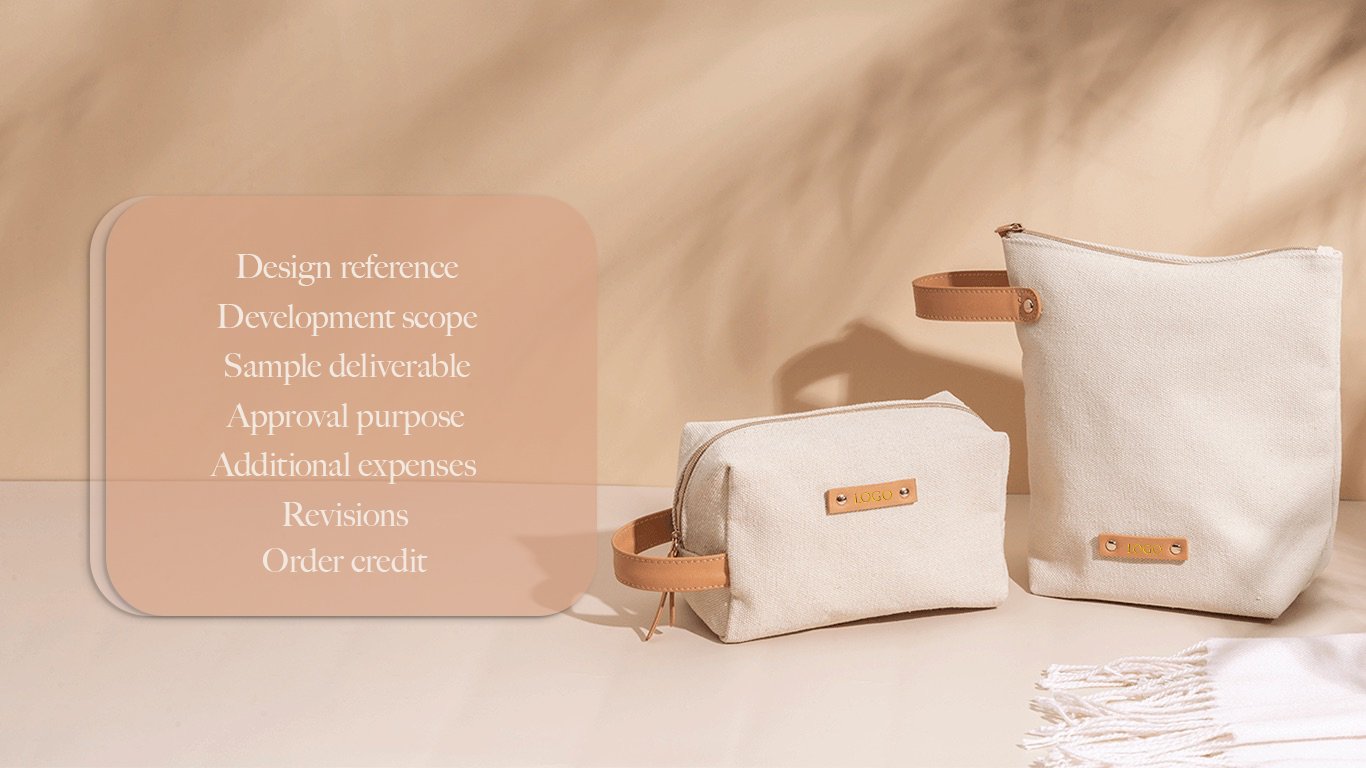
For custom cosmetic bag sampling costs, I use a clarification table like this:
| Quotation topic | What I ask the supplier to confirm |
|---|---|
| Design reference | Which existing style, drawing, or physical sample forms the starting point? |
| Development scope | What can the supplier reuse, and what must it develop? |
| Sample deliverable | How many samples will I receive, and which agreed features will they represent? |
| Approval purpose | Which decisions should this sample help me make? |
| Additional expenses | Are any material procurement, decoration, testing, or shipping expenses applicable and included? |
| Revisions | Which changes, if any, are covered by the quoted scope? |
| Order credit | Does any written credit arrangement apply? |
I treat the last three rows as questions, not assumed charges or benefits. Their treatment needs confirmation for the specific inquiry.
I look for a useful explanation, not merely a longer quotation
A detailed document is not automatically a good quotation. I want enough information to connect the price with an identifiable result.
For example, if I need to assess compartment access, I want the quotation to describe a sample that represents that compartment arrangement. A visually similar bag with a different interior may not answer my question.3
My standard is straightforward: I should understand what I am authorizing and what I will be able to evaluate afterward.
Which Design Choices Change Sample Development Costs?
I often see buyers describe a change as “small” because it looks minor in a reference image. That description does not establish how much existing development work remains usable. I prefer to separate the visible design change from the supplier’s assessment of the work needed to achieve it.
I assess design choices by asking whether the supplier can reuse the existing pattern and construction approach. Changes to shape, proportions, openings, or internal organization deserve a scope review4, but I do not assume that each change requires new development or automatically justifies a higher sample fee.
I start with what can actually be reused
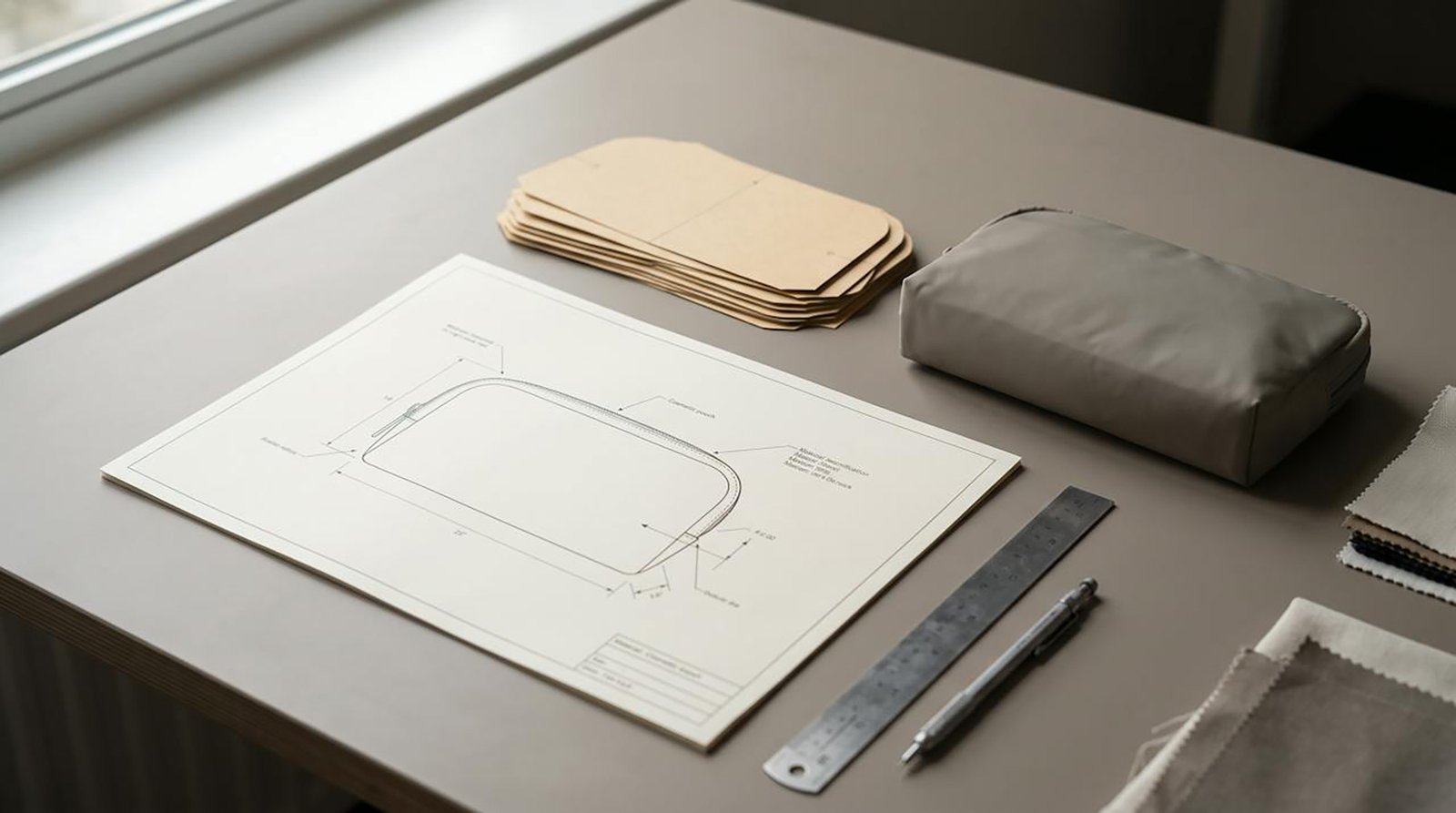
My central distinction is between adapting an existing style and developing a new design.
These are different assignments, even when the final bags look related. However, I do not make the technical judgment from appearance alone. I ask the supplier’s development team to explain which existing elements remain suitable.
I organize that discussion around four questions:
- Which existing style is the reference? I identify the exact model or physical sample rather than relying on a general description.
- Which features must change? I separate required changes from optional ideas.
- Which elements can the supplier reuse? I request confirmation rather than assuming that similarity means compatibility.
- What must the sample prove? I connect the development work to a specific buyer decision.
That sequence gives me a practical basis for evaluating custom cosmetic bag sampling costs.
I have seen a minor-modification assumption obscure the real scope
In one sampling inquiry I handled, a brand buyer treated a new design as a minor modification and underestimated the pattern-development work involved.
The useful step was clarifying the scope. Once we distinguished the proposed design from the existing reference, the quotation became easier to understand. I would not describe that experience as proof that every unfamiliar design deserves a high fee. It showed why the label “small change” is not enough to define a development assignment.
I keep unconfirmed cost explanations separate
Buyers also ask me about fabric choices, decoration methods, and accessory specifications. I record those requirements, but I do not attach an automatic surcharge to each one.
For a particular inquiry, I would ask the relevant team to confirm:
- Whether the requested option is available for the sample.
- Whether it changes the agreed development work.
- Whether the quotation includes it.
- Whether any substitute would limit the sample’s usefulness.
I want the explanation for custom cosmetic bag sampling costs to remain tied to confirmed work, not a generic list of possible cost drivers.
How Should Buyers Agree on Revision Charges?
I know that buyers cannot always finalize every detail before seeing a physical sample. Still, an open-ended request for “adjustments until approved” leaves too much uncertainty. I recommend agreeing on a revision process before sampling begins, so both sides can distinguish corrections from newly requested work.
I recommend documenting the approved starting specification, any included revision allowance, and the process for quoting additional changes. I also distinguish a sample that misses an agreed requirement from a buyer request that changes the requirement. The written agreement should explain how each situation will be reviewed and authorized.
I establish a baseline before discussing revisions
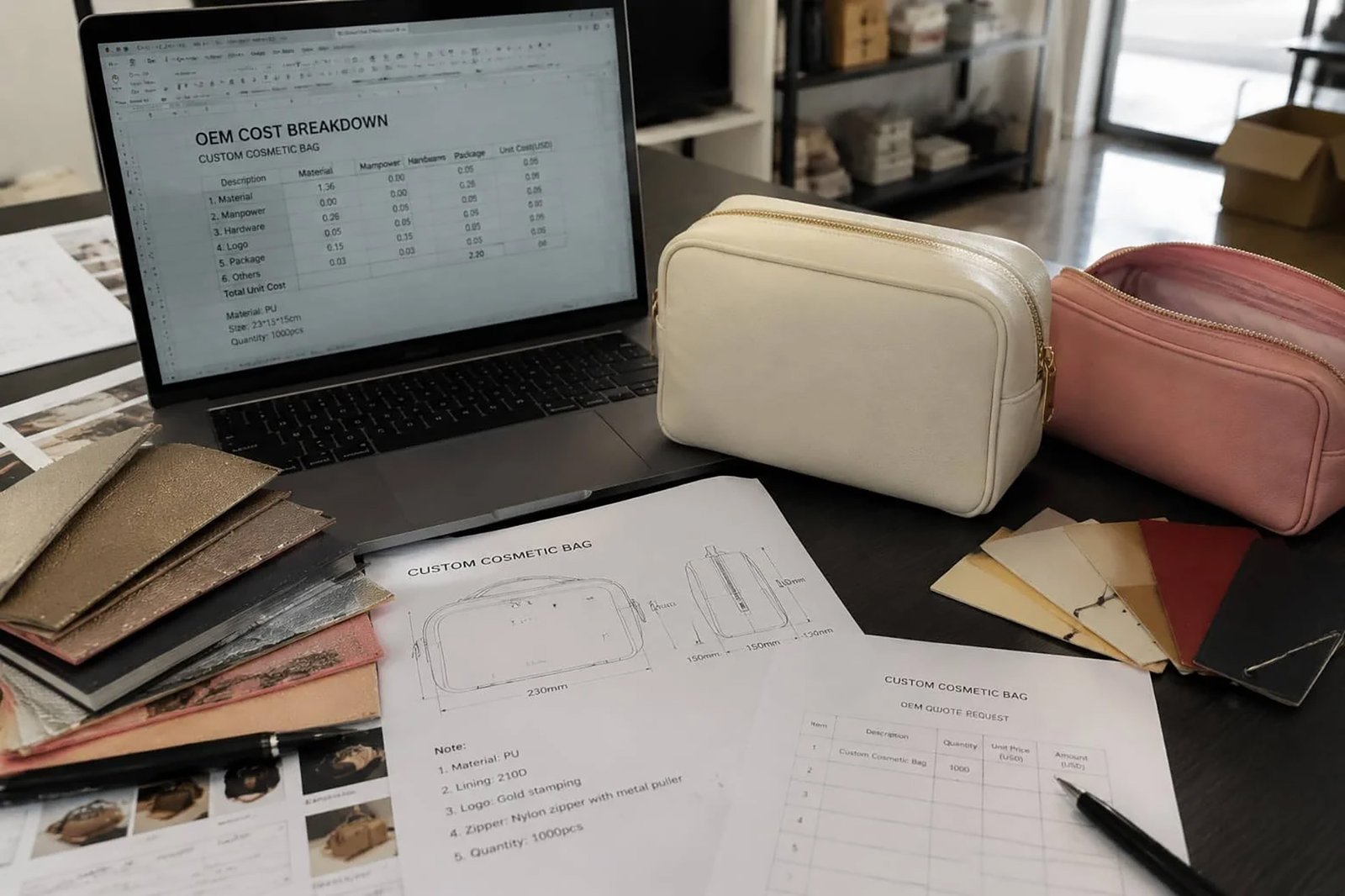
I cannot evaluate a revision fairly if the original requirement is unclear.5 I therefore want an approved specification or written brief that identifies the sample’s intended features.
My baseline normally addresses the information relevant to the project, such as:
- The agreed reference design.
- The requested dimensions and how they will be measured.
- The required internal arrangement.
- The approved logo artwork and placement instructions.
- Any agreed sample-stage substitutions.
- The features that remain unresolved.
I do not treat this list as a claim about what every supplier includes. I use it to identify the decisions that need documenting for a particular assignment.
I distinguish three revision situations
When I review custom cosmetic bag sampling costs, I find the following distinction more useful than a blanket promise about revision rounds:
| Situation | How I recommend handling it |
|---|---|
| The sample differs from an agreed requirement | I ask the supplier to review the discrepancy against the approved brief and agreed remedies. |
| The buyer changes an approved requirement | I request an assessment of the additional scope before authorizing further work.6 |
| The original requirement was ambiguous | I clarify the requirement and agree on the next step in writing. |
I do not assume that all three situations carry the same commercial treatment. I also do not promise free revisions without confirmed terms.
I request consolidated feedback
I prefer to collect comments from the relevant brand, product, and procurement stakeholders before requesting another sample.
A scattered sequence of changes can make it harder to identify the current specification.7 I use one feedback document with marked photographs, a dated revision number, and a clear distinction between required corrections and optional changes.
For custom cosmetic bag sampling costs, this approach improves visibility. It does not guarantee a lower fee, but it helps me avoid authorizing work without understanding its purpose.
I want every revision to answer a defined question, rather than simply produce another version of the bag.
When Can Sample Fees Be Credited Against a Bulk Order?
I understand why buyers ask whether a sample fee will come back through a production order. However, an informal expectation is not a confirmed commercial term. I recommend discussing credits before payment, rather than assuming that placing an order later will automatically cancel the earlier development expense.
I consider a sample fee credit available only when the supplier has confirmed it in writing. I ask which fee is eligible, what order conditions apply, how the credit will be calculated, and where it will appear. I do not assume that every development or sample-related expense qualifies.
I separate development value from credit eligibility
A sample can provide useful development value even when no credit applies. Equally, a promised credit does not make an unsuitable sample a good investment.
I assess those issues separately:
- Development value: Will the sample help me approve or reject the proposed design?
- Commercial treatment: Does the supplier offer an applicable, written credit arrangement?
- Order suitability: Does the eventual bulk order still meet my product, quantity, and timing needs?
I do not want a buyer to approve unnecessary development merely because a fee might be credited later.
I ask for precise conditions
When a supplier offers a credit, I recommend confirming the following details:
| Credit term | What I want documented |
|---|---|
| Eligible payment | Which specific sample or development fee qualifies? |
| Qualifying order | Must the order use the same design or specification? |
| Quantity conditions | Does an order quantity or value requirement apply? |
| Timing conditions | Must the buyer place the order within a stated period? |
| Credit amount | Is the arrangement for a stated amount or another defined calculation? |
| Accounting method | Where will the credit appear in the order paperwork? |
These are questions I would raise, not a statement of CoraggioBag’s standard credit policy. I would confirm the applicable terms for the actual project.
I compare the total commitment
When I compare custom cosmetic bag sampling costs across suppliers, I consider both credited and non-credited scenarios.
If my team has not committed to production, I evaluate the sample fee as an expense that may remain payable in full. If production is likely, I still verify the conditions instead of treating a possible credit as guaranteed.
I also keep the bulk quotation in view. A sample credit is only one commercial detail; it does not replace an assessment of the production specification, quality controls, delivery terms, and overall supplier suitability.
What Should Buyers Send for an Accurate Sample Quote?
I can begin a conversation with a reference image, but I cannot treat every missing detail as settled. If buyers and suppliers fill those gaps differently, the quotation may describe the wrong assignment.8 I recommend sending a focused development brief that makes both requirements and uncertainties visible.
I recommend sending the closest existing reference, a clear list of changes, available specifications, artwork, intended order information, and the sample’s validation goals. I also ask buyers to identify undecided details. This gives the supplier a better basis for explaining what it can reuse and what it must develop.
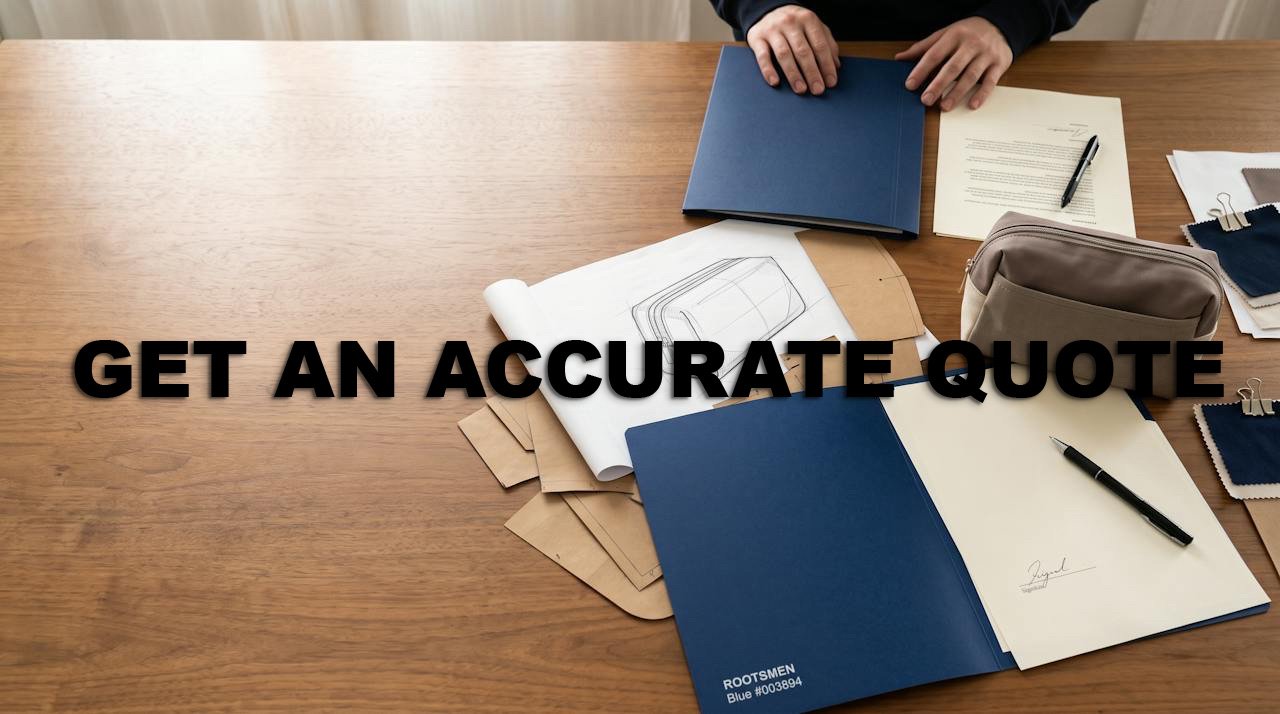
I follow a four-step decision sequence
My preferred sequence keeps the inquiry focused on development scope.
First, I identify an existing reference. A physical sample, a clearly identified supplier style, or a set of reference images can provide a starting point. I explain which features matter rather than expecting the supplier to copy every visible detail.
Second, I specify the required changes. I separate essential requirements from preferences. If my team has not decided on an internal pocket arrangement, I state that openly.
Third, I ask what the supplier can reuse. I do not assume that an existing pattern remains suitable simply because the proposed bag belongs to the same product category.
Fourth, I define what the sample must validate.9 I might need to review the overall appearance, access to the interior, compartment arrangement, or logo presentation. I identify those purposes before judging the quotation.
I provide a brief that supports a clear response
For a custom cosmetic bag inquiry, I recommend a brief with these fields:
| Brief field | What I would provide |
|---|---|
| Reference | Photos, drawings, a physical sample, or an identified existing style |
| Required changes | A marked list of differences from that reference |
| Dimensions | Target measurements and any priorities requiring clarification |
| Materials and components | Known requirements, with undecided items clearly identified |
| Branding | Available artwork, intended placement, and appearance references |
| Sample purpose | The decisions the sample must support |
| Commercial context | Expected bulk quantity, destination market, and target schedule |
I describe a schedule as a target until the supplier confirms feasibility. I also request separate confirmation of any relevant testing or compliance work. I would involve qualified testing or compliance professionals where the destination market and intended application require their evaluation.
I assess the reply against the brief
At CoraggioBag, we support B2B custom bag development from buyer designs, reference images, physical samples, and brand concepts, according to our business scope.
For custom cosmetic bag sampling costs, I encourage buyers to ask us a specific question: “Which parts of this request can you reuse, and which parts need development?” That question creates a more useful discussion than asking only for the lowest sample price.
Frequently Asked Questions
Why can one cosmetic bag sample cost more than one bulk-production unit?
I explain that a sample quotation may cover development work as well as the finished bag. I ask buyers to check the confirmed scope rather than compare the two prices directly. I would also question a fee that the supplier cannot connect to a clear development assignment.
Does changing a cosmetic bag’s size always require a new pattern?
I do not assume that every size adjustment requires a new pattern. I ask the supplier’s development team to assess the requested change against the existing design. I then review its explanation of what remains reusable and what additional work, if any, the quotation includes.
Should I choose the supplier with the lowest sample fee?
I would compare equivalent scopes before choosing. A lower fee may be suitable if the proposed sample validates my requirements. However, I would not favor it if important features remain unrepresented. I assess custom cosmetic bag sampling costs alongside the supplier’s communication, development approach, and production quality-control plans.
Does approving a sample guarantee consistent bulk production?
I treat sample approval as an important reference, not a production guarantee.10 I still recommend documented specifications, agreed quality criteria, and appropriate production inspections. I also keep regulatory compliance separate: I do not treat the appearance or approval of a sample as evidence that all applicable requirements have been met.11
Can I request a sample before every design detail is finalized?
I can request an exploratory sample, but I would state which questions remain open.12 I ask the supplier to define the sample’s limitations and explain any assumptions. That helps me understand whether the quotation covers early design exploration or a more fully specified approval sample.
Conclusion
I evaluate custom cosmetic bag sampling costs by asking what the development work will achieve. I start with a reference, define the changes, confirm what the supplier can reuse, and identify what the sample must validate. I also document revision terms and any order-credit arrangement before approval. A low fee is not enough, and a high fee still needs a clear explanation. If your brand is planning a B2B cosmetic bag project, send CoraggioBag your reference, required changes, and sample goals so we can clarify the scope before quoting.
"Costs and Cost Effectiveness of Additive Manufacturing", https://www.nist.gov/publications/costs-and-cost-effectiveness-additive-manufacturing. Cost theory explains that fixed costs are distributed over output and that average production costs can vary with production scale; this provides economic context for distinguishing bulk unit prices from one-off sample prices. Evidence role: mechanism; source type: education. Supports: Production volume and the allocation of fixed or setup costs affect average unit cost.. Scope note: Economies of scale alone do not explain a specific price difference, which may also reflect materials, labor, development scope, and commercial terms. ↩
"The Manufacturing Cost Guide: A Primer - Version 1.0", https://www.nist.gov/publications/manufacturing-cost-guide-primer-version-10. Manufacturing cost frameworks distinguish product-development and other nonrecurring activities from recurring production costs, providing a basis for understanding why a prototype quotation may include more than fabrication of the item itself. Evidence role: general_support; source type: education. Supports: Product development and prototyping can involve costs separate from recurring unit-production costs.. Scope note: General cost frameworks do not establish which activities a particular cosmetic bag supplier includes or whether its quoted fee is reasonable. ↩
"What do Prototypes Prototype?", https://hci.stanford.edu/courses/cs247/2012/readings/WhatDoPrototypesPrototype.pdf. Research on prototyping distinguishes the aspects of a design represented by a prototype and emphasizes matching that representation to the question being investigated; visual resemblance alone does not establish suitability for functional evaluation. Evidence role: mechanism; source type: paper. Supports: A prototype's usefulness depends on whether it represents the features relevant to the evaluation question.. Scope note: This is a general prototyping principle rather than direct evidence about cosmetic bag compartment testing. ↩
"Sewing Construction and Textiles 1 Strands and Standards", https://www.schools.utah.gov/cte/_cte/strands/SewingConstructionTextiles1.pdf. Pattern-making instruction describes the relationship between component geometry, dimensions, seams, and assembly, supporting technical review when a sewn product's shape or construction details change. Evidence role: general_support; source type: education. Supports: Pattern development translates geometry and construction requirements into coordinated component shapes and dimensions.. Scope note: These principles do not demonstrate that every design change requires a new pattern or warrants an additional fee. ↩
"NASA Systems Engineering Handbook", https://www.nasa.gov/wp-content/uploads/2018/09/nasa_systems_engineering_handbook_0.pdf. Systems-engineering guidance uses approved requirements baselines as references for verification and change control, supporting the distinction between a discrepancy against an existing requirement and a modification to that requirement. Evidence role: mechanism; source type: government. Supports: An approved requirements baseline provides a reference for verification and assessment of proposed changes.. Scope note: Engineering baseline practices do not determine contractual responsibility or payment obligations in a particular sampling agreement. ↩
"6.5 Configuration Management", https://www.nasa.gov/reference/6-5-configuration-management/. Configuration-management guidance calls for evaluating proposed changes and their technical, cost, and schedule consequences before authorization, providing a procedural basis for assessing additional development scope. Evidence role: general_support; source type: government. Supports: Formal change control evaluates the consequences of proposed changes before approval and implementation.. Scope note: This supports the review process, not a presumption that every buyer-requested change creates a chargeable expense. ↩
"6.5 Configuration Management", https://www.nasa.gov/reference/6-5-configuration-management/. Configuration-management guidance links revision identification, controlled changes, and status accounting to maintaining an accurate record of the approved product configuration. Evidence role: mechanism; source type: government. Supports: Revision identification and change-status records help maintain an identifiable current configuration.. Scope note: The guidance supports document control in principle but does not quantify the effects of scattered feedback on cosmetic bag sampling costs. ↩
"4.1 Stakeholder Expectations Definition", https://www.nasa.gov/reference/4-1-stakeholder-expectations-definition/. Requirements-engineering guidance emphasizes clarity, completeness, and unambiguous wording so that stakeholders can interpret requirements consistently and verify the intended deliverable. Evidence role: general_support; source type: government. Supports: Clear, complete, and unambiguous requirements help establish a shared understanding of deliverables.. Scope note: This supports the risk of divergent interpretations but does not establish how frequently incomplete briefs cause inaccurate sample quotations. ↩
"Design prototyping methods: state of the art in strategies ...", https://scholarworks.sjsu.edu/cgi/viewcontent.cgi?article=1015&context=mech_eng_pub. Reviews of design-prototyping methods describe prototypes as tools for investigating particular design questions and connect prototyping strategy to the objectives of the evaluation. Evidence role: general_support; source type: paper. Supports: Prototype planning should align prototype characteristics with specific learning and evaluation objectives.. Scope note: The research provides a general design framework rather than a validated quotation procedure for cosmetic bag suppliers. ↩
"NIST/SEMATECH e-Handbook of Statistical Methods", https://www.itl.nist.gov/div898/handbook/. Statistical quality-control guidance treats manufacturing variation and lot acceptance as matters requiring process or sampling evidence, rather than inferring consistent output from one conforming specimen. Evidence role: mechanism; source type: government. Supports: Manufacturing output varies, and evidence of ongoing conformity requires evaluation beyond an individual approved specimen.. Scope note: This does not prescribe a particular inspection plan or quantify the risk associated with a specific supplier. ↩
"Children's Product Certificate", https://www.cpsc.gov/Business--Manufacturing/Testing-Certification/Childrens-Product-Certificate. Product-compliance guidance identifies obligations such as chemical restrictions and, where applicable, testing or documentation requirements that cannot be established solely by approving a product's appearance. Evidence role: general_support; source type: institution. Supports: Some product obligations concern restricted substances, testing, or documentation that visual inspection cannot establish.. Scope note: Applicable obligations depend on the destination market, materials, intended users, and product classification; the cited guidance would not itself establish this bag's compliance. ↩
"Design prototyping methods: state of the art in strategies ...", https://scholarworks.sjsu.edu/cgi/viewcontent.cgi?article=1015&context=mech_eng_pub. Prototyping research describes exploratory models as tools for investigating selected design questions, rather than necessarily complete representations of the final product. Evidence role: general_support; source type: paper. Supports: Exploratory prototypes can investigate unresolved design questions without representing a complete final specification.. Scope note: An exploratory prototype's usefulness does not establish its suitability for final approval or determine the commercial terms of subsequent development. ↩