
I plan split deliveries for custom tote bags around the event deadline, not just the shipping schedule. When quantities, destinations, or approvals stay open too long, the first event allocation can become difficult to protect. I reduce that risk by agreeing on a batch release plan and change process before the order is placed.
I plan split deliveries by confirming the quantity needed for each event, separating required arrival dates from proposed factory dispatch dates, and documenting every batch in a release table. Before ordering, I also agree on production, storage, shipment costs, release approvals, and how later changes will be assessed.

I have coordinated split deliveries for event and promotional orders, including changes after packing that required rework. That experience shapes my approach: I make the first event requirement clear, then check whether every batch has enough confirmed information to move forward.
Which Dates and Quantities Belong in a Release Plan for Custom Tote Bags?
I start with the question that matters most: how many bags must be ready for the first event? If I only record a shipment date, I can miss the receiving deadline, venue restrictions, or preparation time that determines whether the bags are actually usable.
I use a release plan that records each batch’s quantity, destination, receiving contact, required arrival date, and proposed dispatch date. I also record the event-ready date and approval status. I keep unconfirmed details visible because an incomplete delivery instruction is a planning risk, not a harmless blank.
I work backward from the event-ready date1
I distinguish three milestones when planning custom tote bags:
- The event-ready date is when the buyer needs the bags available for use.
- The required arrival date is when the receiving location needs to accept them.
- The proposed dispatch date is when the factory expects to hand them over for transport.
These dates serve different purposes. A buyer may need time after receipt to count cartons, prepare attendee packs, or distribute bags to several teams. I ask about that work before I treat the event date as the delivery deadline.
I then ask the relevant transport provider to confirm the proposed transit assumptions and available services. My backward-planned schedule is a coordination tool, not a guaranteed arrival commitment.2
I give every batch its own row
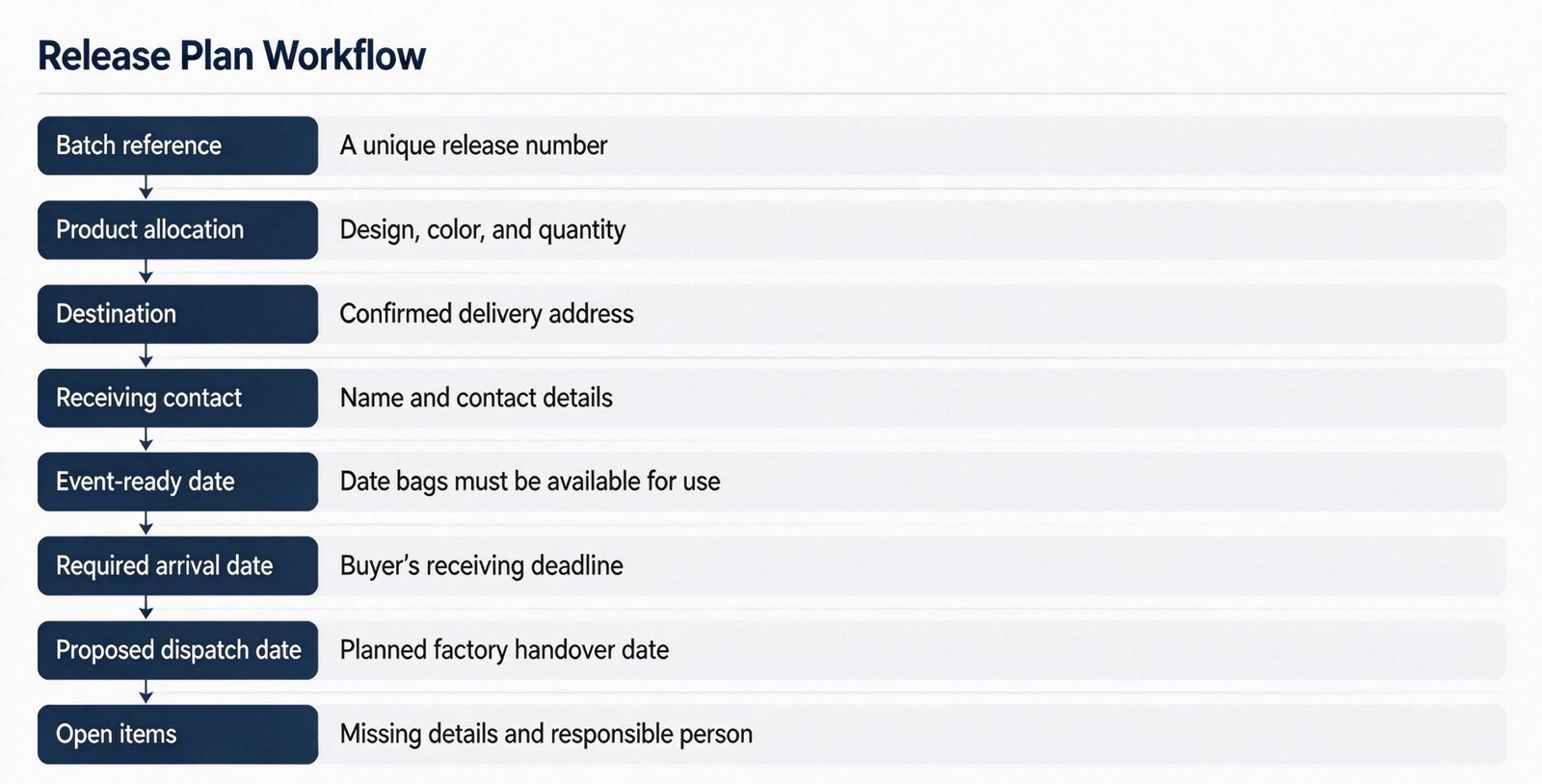
I use a table like this before confirming the order:
| Release-plan field | What I record | Why I need it |
|---|---|---|
| Batch reference | A unique release number | I can connect approvals and packing records |
| Product allocation | Design, color, and quantity | I can prevent the wrong assortment from being released |
| Destination | Confirmed delivery address | I can check the delivery plan with the provider |
| Receiving contact | Name and contact details | I can resolve receiving questions |
| Event-ready date | Date bags must be available for use | I can protect the actual business need |
| Required arrival date | Buyer’s receiving deadline | I can account for preparation after receipt |
| Proposed dispatch date | Planned factory handover date | I can coordinate production and packing |
| Open items | Missing details and responsible person | I can prevent assumptions from becoming instructions |
For example, I might discuss an illustrative order of 3,000 custom tote bags, with 1,000 allocated to the first event and 2,000 reserved for a later campaign. I would still confirm whether those first 1,000 bags need one destination or several.
I also reconcile all batch quantities against the purchase order. If the total changes, I treat that as an order revision rather than quietly adjusting the delivery table.
How Should Production and Storage Be Coordinated for Custom Tote Bags?
I do not assume that split deliveries require split production.3 A buyer may want one production run with later releases, while another order may need separate manufacturing stages. If I leave that distinction unclear, storage, packing, and material availability can become unresolved responsibilities.
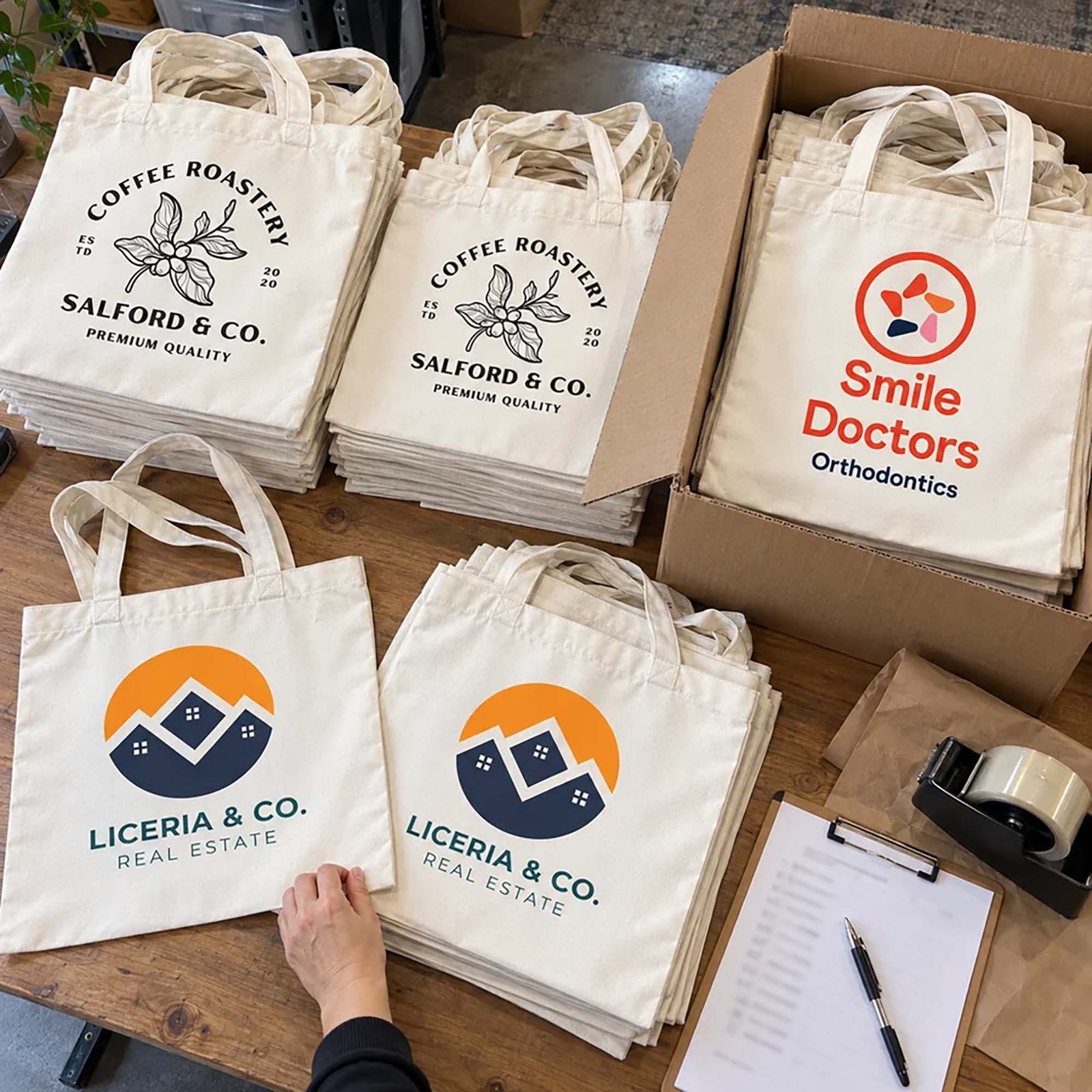
I agree separately on when the bags will be manufactured, when each batch will be packed, and where unreleased stock will remain. I confirm identification, storage duration, inspection arrangements, and responsibility for release instructions. I choose the approach around the order requirements rather than assuming one method suits every project.
I separate manufacturing decisions from release decisions
When I discuss custom tote bags with an event buyer, I compare the practical implications of different arrangements.
| Arrangement | What I evaluate | What I confirm before agreement |
|---|---|---|
| One production run with staged dispatch | Consistency across the full order and finished-stock holding needs | Storage terms, batch identification, and release responsibilities |
| Separate production runs | Flexibility for later requirements and possible material variation | Material availability, repeat setup requirements, and sample references |
| One production run with staged packing | Ability to finalize later packing instructions separately | Stock identification, packing capacity, and confirmation points |
I do not present any option as automatically cheaper or safer. The answer depends on the materials, customization, quantities, holding period, and supplier’s actual operating arrangements.4
At CoraggioBag, our supplied business information describes OEM/ODM customization across fabrics, dimensions, printing, embroidery, labels, and packaging. I therefore treat the approved product specification and the batch delivery instruction as connected but separate documents. A later release should not become an opportunity for an unnoticed specification change.
I make stored quantities traceable5
For unreleased stock, I want a record that identifies:
- The purchase order and approved product version.
- The quantity assigned to each batch.
- The packing status of that quantity.
- The intended destination, where confirmed.
- The inspection status and any unresolved issues.
- The person authorized to request release.
I also confirm the agreed holding period and what happens if the buyer postpones a release. I do not assume that storage is unlimited or included without conditions.
My experience with changes after packing is particularly relevant here. I have coordinated revisions that required packing rework. That is why I ask whether later batches should be fully packed immediately or remain at an agreed earlier stage until their instructions are confirmed.
The right answer is order-specific. I confirm it with production and packing colleagues before accepting it as part of the plan.
Which Costs Should Be Confirmed for Each Shipment of Custom Tote Bags?
I treat the product price and the split-delivery arrangement as separate commercial questions. A unit price alone does not tell me what each release will cost.6 If I overlook packing, storage, or shipment-specific services, the buyer cannot compare the full procurement commitment clearly.
I confirm which costs are included, which are quoted separately, and which depend on final batch details. My review covers packing, storage, handling, transport, and any applicable destination or import-related charges. I ask the responsible provider to confirm external charges rather than treating a factory estimate as authoritative.
I separate confirmed prices from assumptions
For custom tote bags, I want the quotation to explain what the supplier has priced. I also want it to identify assumptions that may change when the delivery instructions become final.
My cost checklist includes:
| Cost area | What I ask |
|---|---|
| Product price | Does the price depend on producing the full order together? |
| Batch packing | Are separate carton marks, assortments, or packing lists included? |
| Storage | Is any holding period included, and what terms apply afterward? |
| Release handling | Does each release create a separately quoted handling requirement? |
| Transport | What batch details and service assumptions support the quote? |
| Destination services | Which charges require confirmation from the provider or receiving party? |
| Change-related work | How will any necessary rework be assessed and approved? |
I avoid assuming that two shipments will cost exactly twice as much as one. I also avoid assuming that splitting the order has no cost effect. Each release has its own quantity, packed dimensions, destination, and service requirements.7
I check whether the first allocation protects the event economically
I sometimes find that the buyer’s most useful decision is identifying the minimum event-ready quantity. That quantity should reflect a real operational need, not an arbitrary percentage of the order.
I would ask whether the first event needs bags for confirmed attendees, staff, or a separately agreed reserve. The buyer should approve that allocation. I would then request appropriate transport options from the provider for that defined batch.
For international deliveries, I confirm the agreed trade term, named place, and allocation of responsibilities.8 I refer customs, tax, and destination-specific questions to the relevant qualified provider or adviser.
Finally, I document the quotation’s validity and unresolved assumptions. If a destination or quantity changes, I ask for the affected costs to be checked again before I confirm the revised release.
Who Approves Each Batch for Release?
I do not treat “the bags are finished” as complete permission to dispatch.9 A batch can be manufactured correctly while its destination, receiving contact, or packing instruction remains unresolved. If I combine these decisions into one informal approval, I can release the right product under the wrong instructions.
I define who approves product quality, batch allocation, packing details, and dispatch authorization. One person may hold several responsibilities, but I record each decision separately. I release a batch only when the agreed checks are complete and any exceptions have been resolved or expressly accepted by an authorized person.

I separate product acceptance from dispatch authorization
For custom tote bags, my quality review starts with the approved sample and written specification. Depending on the order, I check agreed characteristics such as:
- Fabric, color, dimensions, and construction.
- Stitching and handle attachment.
- Logo position and print or embroidery appearance.
- Accessories, internal details, and labels.
- Quantity, assortment, and packaging.
I agree on inspection methods, sampling arrangements, and acceptance criteria before production where possible. I do not describe an inspection as proof that every individual bag is defect-free.10
My dispatch review asks a different set of questions. I check whether the batch quantity matches the latest approved release table, whether the destination is confirmed, and whether the carton markings and packing list match that release.
I give each decision an owner
I use a simple responsibility table rather than relying on a long email chain:
| Decision | Typical responsible party | Record I retain |
|---|---|---|
| Product specification approval | Buyer’s authorized product contact | Approved sample or specification |
| Inspection review | Agreed quality representative | Inspection record and issue disposition |
| Event quantity approval | Buyer’s procurement or event contact | Approved batch allocation |
| Packing instruction approval | Authorized buyer contact | Confirmed packing requirements |
| Factory readiness confirmation | Supplier coordinator | Batch readiness record |
| Dispatch authorization | Designated release approver | Written release approval |
The exact roles depend on the buyer’s organization. I confirm names and backup contacts rather than assuming that a job title gives someone authority.
I also make unresolved issues visible. If a buyer accepts an exception, I record what was accepted, who accepted it, and which batch it affects. Silence does not become approval in my release process.
For a deadline-sensitive event, I ask the buyer to agree on a response process if the main approver is unavailable. I do not invent an automatic-release rule simply because the planned dispatch date is approaching.
How Should Changes to the Delivery Plan Be Recorded?
I expect event plans to evolve, but I do not treat every revision as a simple spreadsheet edit. A quantity or address change can affect allocation, carton contents, labels, documents, and shipment arrangements.11 Once packing has started, I need to check the physical consequences as well as the revised instruction.
I record each requested change against the latest approved release plan, assess its production, packing, cost, and timing implications, and obtain written approval before implementation. I then issue a new version and identify the superseded one. I agree on confirmation points per order rather than promising unlimited changes.

I distinguish a request from an accepted revision
I have handled changes after packing that required rework. I do not attach invented charges or delay figures to that experience. The practical lesson is enough: a revised instruction may require physical work before it can be executed.
If the buyer asks to move custom tote bags from one batch to another, I first check the current status. The bags may be allocated but unpacked, packed into labeled cartons, or already included in shipment arrangements. Those situations do not have the same consequences.
I use a change log with these fields:
- I identify the request: I record the date, requester, and affected batch.
- I compare instructions: I show the previous requirement beside the proposed one.
- I check execution status: I confirm production, packing, and transport arrangements.
- I assess implications: I obtain relevant feasibility, schedule, and cost information.
- I obtain approval: I record the authorized decision before implementation.
- I issue the revision: I distribute the updated plan to the people executing it.
I agree on confirmation points for the actual order
I do not prescribe a universal modification cutoff. Instead, I agree on confirmation points that match the order, such as approval before batch packing or confirmation before shipment booking.
These points do not mean every later request is impossible. They mean I must reassess the request before accepting it.
I also distinguish between a factory-side assessment and an external provider’s confirmation. If transport arrangements are affected, I ask that provider to confirm what remains possible. I do not convert an internal discussion into a revised arrival promise.
Finally, I give the updated release plan a clear version number or date. I ask the relevant parties to acknowledge the revision, and I retain the previous version as a record. This prevents packing staff, purchasing teams, and transport contacts from working from different instructions.12
Frequently Asked Questions
Can I order all the bags together and release them in smaller batches?
I can discuss one production order with staged releases, but I confirm the arrangement before order placement. I review storage duration, batch identification, packing requirements, payment terms, and release responsibilities. I do not assume that a supplier’s standard quotation includes holding finished stock for later dispatch.
How do I decide the first batch quantity?
I start with the minimum quantity the buyer needs available for the first event, including any reserve the buyer approves. I then check destination and receiving requirements. I keep later campaign quantities separate so that the first release reflects a clear event need rather than an arbitrary share of the order.
Can I change the destination after packing?
I assess the request against the batch’s actual status before accepting it. I may need to coordinate revised carton markings, packing documents, allocation, or transport arrangements. Because I have handled changes that required packing rework, I confirm feasibility and any implications instead of promising that an address change is always straightforward.
Does a planned dispatch date guarantee arrival before my event?
I do not treat a proposed factory dispatch date as an arrival guarantee. I separate dispatch, required arrival, and event-ready dates in the plan. I ask the relevant transport provider to confirm service assumptions and commitments, while the buyer confirms receiving arrangements and time needed after delivery.
What information should I send when requesting a split-delivery quotation?
I ask for the total quantity, product specifications, batch quantities, destinations, receiving contacts, and required arrival dates. I also request event-ready dates, packing requirements, and any expected storage period. If some details remain open, I identify them explicitly so the quotation can state its assumptions.
Conclusion
I plan split deliveries for custom tote bags by protecting the event requirement first. I confirm batch quantities, distinguish arrival needs from dispatch milestones, and agree on production, storage, costs, approvals, and change control before execution. I also keep later revisions visible and subject to feasibility checks. At CoraggioBag, I welcome B2B custom and bulk-order inquiries. Send your design requirements, total quantity, event dates, and proposed batch allocations so I can help develop an order-specific release plan.
"How Backward Scheduling and Order Dates Are Calculated", https://docs.oracle.com/en/cloud/saas/supply-chain-and-manufacturing/25d/faspf/how-backward-scheduling-and-order-dates-are-calculated.html. Backward scheduling works from a required completion date to determine earlier activity dates using task durations and dependencies; its feasibility remains dependent on the accuracy of those inputs. Evidence role: mechanism; source type: education. Supports: Backward scheduling derives preceding activity dates from a required completion date using estimated durations and dependencies.. Scope note: This supports the scheduling method, not the feasibility of any particular tote-bag delivery schedule. ↩
"Logistics Performance Index - World Bank", https://lpi.worldbank.org/en/home. Logistics research distinguishes transit-time estimates from delivery reliability and documents variability across transport and border processes; a planned dispatch date alone therefore does not establish an arrival commitment. Evidence role: general_support; source type: institution. Supports: Delivery reliability depends on variable transport and logistics processes beyond a planned dispatch date.. Scope note: Logistics variability provides context; any enforceable delivery commitment depends on the applicable service agreement. ↩
"Economic production quantity", https://en.wikipedia.org/wiki/Economic_production_quantity. Production-inventory models allow a manufacturing lot to be supplied through multiple shipments, treating production quantity and shipment quantity as separate decisions with associated inventory and transport trade-offs. Evidence role: mechanism; source type: paper. Supports: Production-inventory systems can use one production lot followed by multiple delivery lots.. Scope note: Modelled arrangements do not establish that a particular supplier offers staged releases or has sufficient storage capacity. ↩
"Analyzing Trade-offs Between Transportation, Inventory and ...", https://its.berkeley.edu/publications/analyzing-trade-offs-between-transportation-inventory-and-production-costs-freight. Integrated production-inventory research evaluates production and shipment policies through interacting setup, holding, and transport costs, indicating that no single arrangement is uniformly least costly. Evidence role: mechanism; source type: paper. Supports: Production and delivery choices involve trade-offs among setup, inventory holding, and shipment costs.. Scope note: Such models support the general trade-off but do not determine the cost of a specific customized tote-bag order. ↩
"Supply Chain Traceability Principles", https://tsapps.nist.gov/publication/get_pdf.cfm?pub_id=962361. Supply-chain traceability frameworks link identified goods to records of relevant events, locations, and movements, providing a basis for distinguishing stored quantities and tracking their release. Evidence role: general_support; source type: institution. Supports: Traceability relies on identifying goods and linking them to records of relevant supply-chain events and locations.. Scope note: General traceability frameworks do not prescribe every field in this article’s release records. ↩
"Procurement Regulations for IPF Borrowers - Public Documents", https://thedocs.worldbank.org/en/doc/178331533065871195-0290022020/original/ProcurementRegulations.pdf. Total-cost approaches to procurement distinguish purchase price from additional costs associated with acquisition, logistics, and use, supporting a separate assessment of costs attributable to staged releases. Evidence role: general_support; source type: institution. Supports: Procurement cost assessment can include costs beyond the quoted purchase price, including relevant logistics and holding costs.. Scope note: The applicable cost categories and who pays them depend on the order and contractual terms. ↩
"Bureau of Transportation Statistics (BTS)", https://www.bts.gov/. Freight-pricing analyses relate transport charges to shipment size, weight or volume, distance, and service characteristics; dividing a consignment therefore need not produce a proportional change in total freight cost. Evidence role: mechanism; source type: education. Supports: Freight charges vary with shipment size, weight or volume, route, and service characteristics.. Scope note: The direction and magnitude of the cost change require actual quotations for the relevant shipments. ↩
"Know Your Incoterms", https://www.trade.gov/know-your-incoterms. Incoterms rules define delivery obligations and allocate specified costs and risks between buyer and seller; the chosen rule and named place are necessary to interpret those obligations. Evidence role: definition; source type: government. Supports: Incoterms rules define specified buyer and seller obligations, including delivery, allocation of certain costs, and transfer of risk.. Scope note: Incoterms do not by themselves determine all contract terms, payment arrangements, or destination-specific tax requirements. ↩
"NASA Policy Directive", https://nodis3.gsfc.nasa.gov/npg_img/N_PD_1850_0001_/N_PD_1850_0001__main.pdf. Quality-management release controls distinguish production completion from release based on required verification and identifiable authorization, supporting a separate release decision. Evidence role: general_support; source type: institution. Supports: Quality-management release controls distinguish completion of work from verified conformity and authorized release.. Scope note: General quality-release principles do not prescribe the article’s particular buyer contacts or dispatch checklist. ↩
"What kinds of Lot Acceptance Sampling Plans (LASPs) are ...", https://www.itl.nist.gov/div898/handbook/pmc/section2/pmc22.htm. Acceptance sampling uses a sample to make a decision about a lot and entails a risk of accepting a lot containing nonconforming items; acceptance is not proof that every item is defect-free. Evidence role: mechanism; source type: government. Supports: Acceptance sampling supports lot acceptance decisions while retaining a probability of accepting lots containing nonconforming items.. Scope note: The level of assurance depends on the sampling plan, acceptance criteria, and inspection method. ↩
"Common Export Documents", https://www.trade.gov/common-export-documents. Logistics labelling and shipping-document frameworks link shipping units to destination and contents information, so changes to quantities or destinations can require corresponding updates to labels and records. Evidence role: mechanism; source type: institution. Supports: Logistics labels and shipping records encode information about destination, quantities, and identified shipping units.. Scope note: These dependencies explain possible rework, but do not establish that every address change requires repacking or additional charges. ↩
"6.5 Configuration Management", https://www.nasa.gov/reference/6-5-configuration-management/. Configuration-management guidance uses identification, change approval, and controlled distribution to maintain an authoritative baseline and reduce the risk of obsolete or inconsistent instructions being used. Evidence role: mechanism; source type: government. Supports: Configuration and document control establish approved versions and control changes to reduce the use of obsolete instructions.. Scope note: Document control reduces this risk but does not guarantee that all recipients will follow the latest instructions. ↩