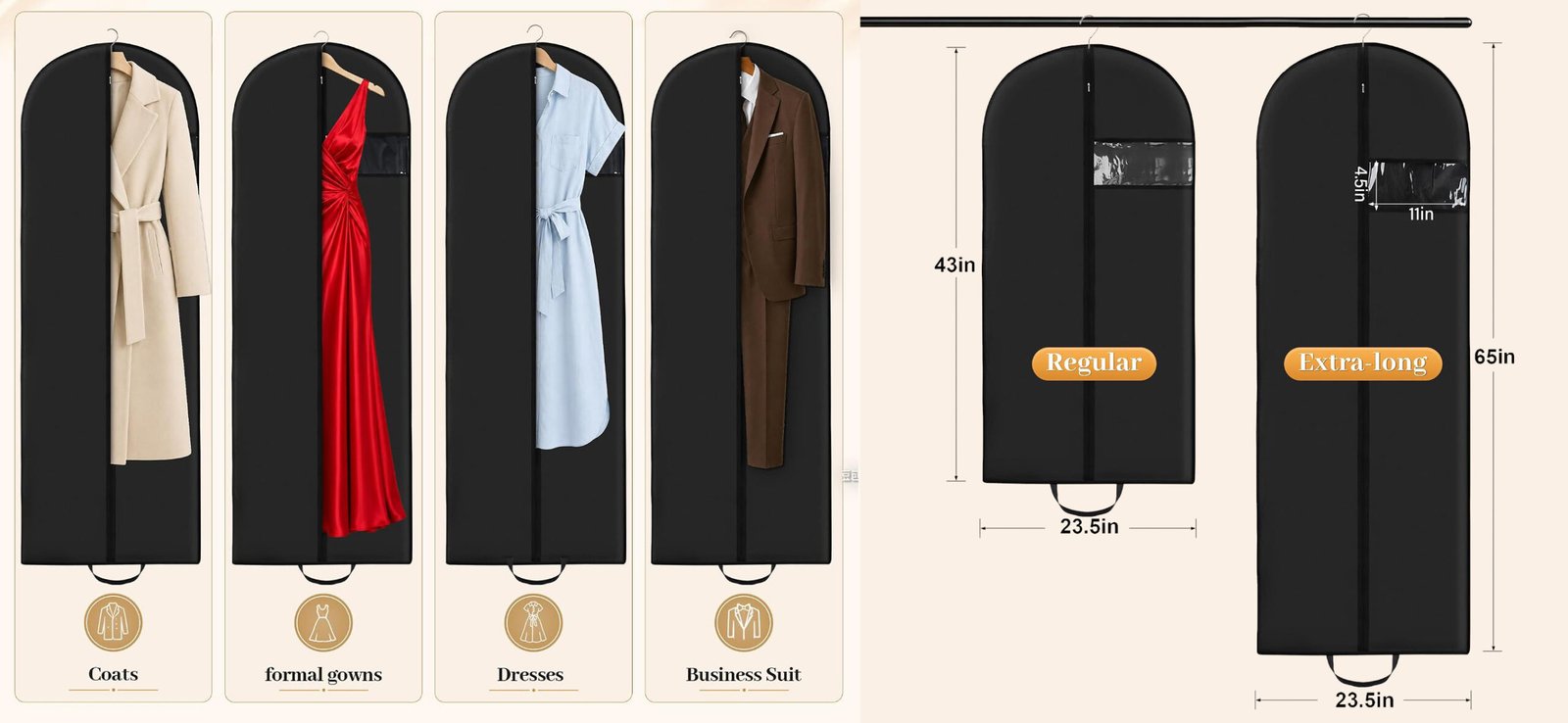
I treat hanger fit in custom garment bags as a pre-order compatibility decision, not just a length check. A bag can meet its stated dimensions while its upper section does not accommodate the intended hanger. I reduce that uncertainty by reviewing the actual hanger, garment, and sample together before approving bulk production.
I confirm hanger fit by reviewing the intended hanger’s dimensions and shape, preferably with a physical sample, alongside the garment and proposed bag. Before bulk approval, I check loading, shoulder fit, closure, and intended hanging or carrying use. Bag length alone does not establish compatibility.1

I have participated in garment-bag sampling where the hanger shoulders did not match the bag’s upper section, and I took part in modification. That experience shapes how I connect sample approval with production quantities, shipment dates, storage arrangements, costs, and release responsibilities.
Which Dates and Quantities Belong in a Release Plan for Custom Garment Bags?
I see a purchasing risk when a delivery schedule becomes firm before hanger compatibility is clear. Buyers may know their launch date and total quantity but still lack an approved sample. I separate development milestones from shipment commitments so an unresolved fit question does not become an assumed approval.
I include the hanger-information deadline, sample-review date, written approval milestone, production window, inspection timing, and shipment quantities in the release plan. For custom garment bags, I make production commitments conditional on the agreed compatibility review, rather than treating the required delivery date as permission to proceed.
I establish the development inputs first
I ask buyers to define the hanger before the development team finalizes the bag. A description such as “standard clothing hanger” leaves too much open to interpretation.
My development brief includes:
- Hanger dimensions: overall width, height, and other relevant dimensions.
- Hanger shape: shoulder profile, hook arrangement, and any clips or additional features.
- A physical hanger sample: preferably the actual model intended for use.
- Garment information: garment type, size range, and whether multiple pieces will share one bag.
- Intended use: retail presentation, wardrobe storage, delivery, or another defined use.
- Reference material: drawings, photographs, or an existing garment-bag sample.
I treat these details as inputs for development review, not as a universal sizing formula. The development team should confirm which dimensions and construction details matter for the particular design.
I give approval its own place in the schedule
I use a release plan that distinguishes an expected date from an approved milestone.
| Planning item | What I record | Why I include it |
|---|---|---|
| Hanger submission | Intended model and sample-arrival date | The team needs a defined reference |
| Garment submission | Representative garments or agreed specifications | The hanger alone does not show the complete fit |
| Sample review | Review date and responsible buyer | Compatibility needs a decision owner |
| Sample approval | Approved revision and written approval date | Production needs an identifiable reference |
| Production quantity | Quantity by approved style and version | Similar-looking versions may differ |
| Shipment release | Quantity and required dispatch date | Each release needs a clear scope |
I also separate sample approval, production authorization, and shipment release.2 I do not assume that approving the appearance of a sample authorizes every later batch. If hanger details remain incomplete, I record that uncertainty and ask the buyer and supplier to agree on the next step before committing to quantity.
How Should Production and Storage Be Coordinated for Custom Garment Bags?
I find that an approved sample is only useful when the production team can identify exactly what was approved. If the hanger reference, bag revision, or garment assumptions become unclear, storage can preserve the wrong stock just as efficiently as the right stock. I therefore connect production records with inventory identification.
I coordinate production and storage through an approved reference sample, a controlled specification, identifiable batches, and agreed holding conditions.3 I also clarify whether hangers are supplied with the bags, packed separately, or provided by the buyer. Those arrangements affect handling and shipment planning, but they do not replace compatibility approval.

I preserve the approved combination
My confirmed sampling experience is limited but relevant: a mismatch occurred between hanger shoulders and the bag’s upper section, and I participated in modification. I do not use that experience to claim a particular correction, measurement, or verified result.
Instead, I use it to explain why nominal bag dimensions are not a complete approval record. My production reference should identify the combination that the buyer reviewed:
- The approved garment-bag sample and revision.
- The intended hanger model or clearly identified reference.
- The garment or agreed garment specifications.
- The approved construction, materials, and customization.
- Any remaining limitations or unresolved questions.
For custom garment bags, I ask the development team to confirm how the upper section, hanger exit area, closure, and other relevant features relate to that combination. I do not prescribe standard clearances that supposedly work for every design.
I separate compatibility checks from storage controls
I ask the supplier to propose suitable packing and storage arrangements for the selected materials and finished construction. I then confirm those arrangements in the purchase documentation.
My coordination checklist includes:
- Whether finished bags will be folded, flat-packed, or otherwise packed.
- Whether hangers will be included in the same carton.
- How approved and unapproved batches will be distinguished.
- How carton labels will identify the style, revision, and quantity.
- Who will authorize shipment from stored inventory.
- What happens if the buyer changes the hanger after production.
I do not assume that a sample that accommodates a hanger has proven garment protection or transport durability.4 Those are separate questions. Where a specific application requires technical performance evidence, I recommend that the buyer involve qualified packaging, testing, or other relevant professionals.
Which Costs Should Be Confirmed for Each Shipment of Custom Garment Bags?
I avoid comparing quotations only by the finished bag’s unit price. A low headline price can be difficult to interpret when hanger supply, sample revisions, storage, packing, or split shipments remain undefined.5 I clarify those items early so the buyer can compare equivalent commercial scopes.
I confirm the bag price, hanger responsibility, sampling charges, packaging, inspection arrangements, storage terms, and shipment-related charges in writing. For custom garment bags, I also ask which costs could change if the hanger, garment requirements, approved construction, or delivery schedule changes after quotation or approval.

I distinguish included items from assumptions
I begin with a simple question: What exactly does the quoted unit include? A garment-bag quotation does not automatically establish that a hanger is included, that the hanger has been sourced, or that a particular hanger-and-garment combination has been reviewed.
I use a comparison table to make those differences visible.
| Cost item | What I ask the supplier to clarify |
|---|---|
| Finished bag | Which material, construction, dimensions, and revision does the price cover? |
| Hanger | Is it buyer-supplied, supplier-sourced, included, or excluded? |
| Sampling | What is included, and how are additional revisions charged? |
| Branding | Does the price include the agreed printing, embroidery, labels, or setup? |
| Packaging | Which individual packing and carton arrangements are included? |
| Inspection | Which checks are included, and who pays for any independent inspection? |
| Storage | Is there a holding period, and what terms apply afterward? |
| Shipment | Which delivery term, named location, and transport charges apply?6 |
I ask for a revised quotation when the specification changes materially. I do not assume that a change to the upper section, closure, material, or packing method will leave the original price and schedule unchanged.7
I keep commercial approval separate from fit approval
I treat cost acceptance and compatibility approval as different decisions. A buyer may accept the quotation while the sample still needs review. Equally, an approved sample does not settle freight arrangements or storage charges.
For a split order, I ask the supplier to show the quantities and charges associated with each planned dispatch. I also clarify responsibility for buyer-requested schedule changes and any handling needed to separate stored stock.
According to CoraggioBag’s supplied business information, some products can have minimum order quantities as low as 100 pieces, depending on materials, construction, and customization. I would confirm the applicable MOQ for the specific garment-bag project rather than present that figure as a promise for every design.
Who Approves Each Batch of Custom Garment Bags for Release?
I see confusion when “approved” means one thing to the buyer and another to the factory. A designer may approve the logo while a purchasing manager assumes hanger fit is settled. I prevent that ambiguity by naming the people responsible for sample acceptance, production checks, and shipment authorization.
I assign sample compatibility approval to the buyer’s authorized representative and manufacturing checks to the supplier’s designated quality team. I then identify who can authorize shipment. I record these responsibilities separately because design acceptance, production conformity, and commercial release answer different questions.

I make sample review a practical checkpoint
I recommend reviewing the sample with the intended hanger and garment together. My proposed checks are practical approval activities, not certified performance tests.
During the review, I ask:
- Loading: Can I place the intended hanger and garment inside using the planned loading method?
- Upper-section fit: Do I see an obvious mismatch between the hanger shoulders and the bag’s upper section?
- Closure: Can I operate the closure with the intended contents in place?
- Garment arrangement: Does the sample accommodate the agreed garment configuration?
- Hanging use: Does the sample support the intended hanging arrangement without an obvious compatibility concern?
- Carrying use: If carrying is part of the brief, can I review that arrangement with the actual contents?
If a concern appears, I ask the development team to assess it. I do not convert an informal observation into an engineering conclusion.
I define what a production inspection establishes
I expect production checks to compare the batch against the agreed specification and approved reference. Depending on the order, those checks may address measurements, sewing, closures, branding, appearance, and packing.
I ask the buyer and supplier to agree on the inspection scope, sampling approach, defect definitions, and acceptance criteria before production. I do not imply that checking a few finished units proves every unit is defect-free.8
I also keep supplier documentation in context. CoraggioBag’s supplied business information lists ISO 9001, BSCI, and Sedex/SMETA documentation among potentially available records. I would verify current documents, their scope, and the relevant factory identity. I would not treat a management-system certificate or social-audit report as proof of hanger compatibility.9
For application-specific performance or compliance decisions, I recommend qualified professional evaluation. My role in sample development does not make me a laboratory or engineering authority.
How Should Changes to the Delivery Plan Be Recorded?
I treat an informal delivery change as a possible specification risk, not just an administrative update. A new shipment date may arrive alongside a different hanger, garment assortment, or packing request. I document those changes together so the team can see whether the original approval still applies.
I record each change with a revision number, request date, affected quantities, revised delivery dates, cost implications, and named approvers.10 If the change affects the hanger, garment, or bag construction, I ask the development team whether compatibility needs another review before the affected quantity proceeds.

I use one traceable change record
I prefer a shared change log over scattered messages. Email can provide approval evidence, but I still want an identifiable record that connects the decision to the order.
My change record includes:
| Field | What I document |
|---|---|
| Change reference | A unique number or revision identifier |
| Original requirement | The previously agreed date, quantity, or specification |
| Requested change | The new requirement and its reason |
| Affected stock | Materials, work in progress, or finished quantities involved |
| Compatibility impact | Whether the hanger-and-garment review may be affected |
| Commercial impact | Any proposed price, storage, packing, or freight adjustment |
| Approval | The authorized people and approval dates |
| Effective scope | The exact batches or shipments covered |
I ask the supplier to confirm feasibility before I treat a requested delivery date as an agreed commitment. I also ask whether materials have been ordered or production has started, because those facts influence the available options.
I reopen compatibility review when the reference changes
I do not assume that a replacement hanger is equivalent simply because its stated width matches the original.11 Shape and other relevant features may differ. I ask the development team to assess whether the existing approval remains appropriate.
The same principle applies when the buyer changes the garment assortment, bag construction, or intended use. I link the new information to the approved sample record and request another sample review when the team considers it necessary.
For custom garment bags, I make the effective version clear on the purchase order, production documents, and shipment instructions. If two approved versions will ship under one project, I ask for distinct identification.
I also document what has not changed. That simple step helps prevent a revised shipping date from being interpreted as authorization to alter materials, construction, or packing.
Frequently Asked Questions
Does a longer garment bag automatically fit a wider hanger?
I do not assume that it does. Extra length does not establish compatibility between the hanger shoulders and the bag’s upper section. I ask the development team to review the intended hanger’s dimensions and shape, then assess the sample with the actual hanger and garment together.
What should I send a supplier before sampling?
I recommend sending the intended hanger’s dimensions, photographs, and preferably a physical sample. I also provide garment details, intended use, branding requirements, and any reference bag. I ask the supplier to identify missing information before development rather than fill those gaps with unconfirmed assumptions.
Can I approve custom garment bags from photographs alone?
I use photographs for communication, but I do not treat them as a substitute for a practical compatibility review. Images may not show loading difficulties, closure interference, or upper-section mismatch clearly.12 I recommend reviewing a physical sample with the intended hanger and garment before authorizing bulk production.
Does successful hanger fitting prove transport durability?
I keep those decisions separate. A practical fit review can help identify compatibility concerns, but it does not establish transport durability or garment protection. If the intended application needs performance evidence, I recommend agreeing on suitable evaluation with qualified testing or packaging professionals.
What happens if I change hangers after sample approval?
I notify the supplier and identify the replacement hanger before the affected production proceeds. I ask the development team to assess whether the change affects compatibility and whether another sample review is needed. I then document any revised approval, quantity, price, or schedule.
Conclusion
I approach hanger fit in custom garment bags as a defined approval decision, not a bag-length assumption. I start with the intended hanger and garment, review them together in the sample, and connect that approval to quantities, production records, costs, and shipment authorization. I keep fit checks separate from claims about protection or durability. For a CoraggioBag B2B development inquiry, I invite you to share your hanger sample, garment details, design references, quantities, and delivery requirements so our team can review the project before bulk approval.
"NASA Systems Engineering Handbook", https://www.nasa.gov/wp-content/uploads/2018/09/nasa_systems_engineering_handbook_0.pdf. Engineering guidance on physical interfaces treats compatibility as a relationship among relevant dimensions, geometry, and interface requirements; this supports considering more than bag length, although it does not establish garment-bag-specific clearances. Evidence role: mechanism; source type: government. Supports: Physical compatibility requires assessment of relevant interface geometry rather than a single overall dimension.. Scope note: General interface-engineering principles provide contextual support, not direct validation of a particular hanger-and-bag combination. ↩
"NASA Systems Engineering Processes and Requirements", https://nodis3.gsfc.nasa.gov/OPD_docs/NID_7123_69_.pdf. Quality-management frameworks distinguish design and development controls from production controls and product release, providing a basis for recording these decisions separately. Evidence role: general_support; source type: institution. Supports: Quality-management frameworks distinguish development review, production controls, and release of products.. Scope note: These frameworks do not prescribe the article's exact three-stage approval workflow for garment bags. ↩
"NPR 8735.2C - Chapter4 - NODIS Library - NASA", https://nodis3.gsfc.nasa.gov/displayDir.cfm?Internal_ID=N_PR_8735_002C_&page_name=Chapter4. Quality-management guidance identifies controlled production information, product identification, traceability where required, and preservation as measures for maintaining conformity during production and subsequent handling. Evidence role: general_support; source type: institution. Supports: Document control, identification, traceability, and preservation are recognized elements of managing product conformity.. Scope note: The appropriate batch identifiers and storage conditions depend on the materials, construction, and contractual requirements. ↩
"Recognized Consensus Standards: Medical Devices - FDA", https://www.accessdata.fda.gov/scripts/cdrh/cfdocs/cfstandards/detail.cfm?standard__identification_no=43297. Distribution-testing frameworks evaluate packaged products against hazards such as shock, vibration, and compression; accommodation of a hanger alone does not demonstrate performance under those conditions. Evidence role: general_support; source type: institution. Supports: Transport performance evaluation addresses distribution hazards not covered by a static fit review.. Scope note: The applicable tests depend on the distribution system and package configuration, and no specific garment bag is validated by this distinction. ↩
"Procurement Regulations for IPF Borrowers - Public Documents", https://thedocs.worldbank.org/en/doc/178331533065871195-0290022020/original/ProcurementRegulations.pdf. Procurement guidance on total cost of ownership distinguishes purchase price from other acquisition and operating costs, supporting comparison of offers on a consistently defined cost basis. Evidence role: general_support; source type: institution. Supports: Procurement comparisons should account for relevant costs beyond the quoted unit purchase price.. Scope note: The guidance does not establish that every listed charge applies to every garment-bag order. ↩
"Know Your Incoterms", https://www.trade.gov/know-your-incoterms. International trade guidance explains that Incoterms rules allocate specified delivery obligations, costs, and risks between seller and buyer, with the named place or port forming an important part of their application. Evidence role: definition; source type: government. Supports: Incoterms rules and the specified location help define delivery responsibilities, costs, and transfer of risk.. Scope note: Incoterms do not determine all contractual matters, including payment terms or product conformity. ↩
"NASA Systems Engineering Handbook", https://www.nasa.gov/wp-content/uploads/2018/09/nasa_systems_engineering_handbook_0.pdf. Configuration-management guidance calls for evaluating proposed changes for their technical, cost, and schedule effects before approval, supporting reassessment when an agreed product specification changes. Evidence role: mechanism; source type: government. Supports: Requirement and configuration changes should be assessed for technical, cost, and schedule consequences.. Scope note: General change-control guidance does not quantify the price or lead-time effect of a particular garment-bag modification. ↩
"What kinds of Lot Acceptance Sampling Plans (LASPs) are ...", https://www.itl.nist.gov/div898/handbook/pmc/section2/pmc22.htm. NIST's treatment of acceptance sampling describes lot-acceptance decisions in terms of sampling plans and operating-characteristic probabilities; acceptance of a sampled lot is therefore not proof that every unit is defect-free. Evidence role: mechanism; source type: government. Supports: Acceptance sampling makes probabilistic lot-acceptance decisions and carries a risk of accepting lots containing defects.. ↩
"ISO - International Organization for Standardization", https://www.iso.org/. ISO 9001 addresses quality-management systems, while SMETA addresses workplace and ethical-trade audit topics; neither form of documentation, by its scope alone, establishes compatibility between a particular hanger and garment bag. Evidence role: definition; source type: institution. Supports: ISO 9001 concerns quality-management systems, while SMETA concerns workplace and ethical-trade audit topics rather than product fit testing.. Scope note: These scope definitions do not verify the existence, currency, or factory coverage of any documentation attributed to CoraggioBag. ↩
"6.5 Configuration Management", https://www.nasa.gov/reference/6-5-configuration-management/. Configuration-management guidance links baseline identification, change authorization, and status accounting so that approved changes can be traced to the configurations they affect. Evidence role: general_support; source type: government. Supports: Configuration management uses identified revisions, authorized changes, and status records to maintain a traceable product baseline.. Scope note: The article's particular record fields are an implementation choice rather than a universally mandated garment-bag form. ↩
"6.5 Configuration Management", https://www.nasa.gov/reference/6-5-configuration-management/. Interface and configuration-management guidance evaluates changes in terms of relevant physical and functional characteristics, supporting the distinction between matching one stated dimension and establishing interchangeability. Evidence role: mechanism; source type: government. Supports: Replacement-component compatibility depends on relevant form, fit, and function rather than one matching dimension.. Scope note: This is contextual engineering support; it does not demonstrate that any particular replacement hanger will cause a fit problem. ↩
"5.3 Product Verification", https://www.nasa.gov/reference/5-3-product-verification/. Verification guidance distinguishes inspection from demonstration and testing, recognizing that observing physical characteristics is not equivalent to establishing performance during operation. Evidence role: general_support; source type: government. Supports: Inspection, demonstration, and testing provide different kinds of evidence, and operational requirements may require observation of actual use.. Scope note: This distinction supports caution about photograph-only approval but does not measure how frequently photographs miss garment-bag compatibility problems. ↩