Reusable paper shopping bags can look ready for repeat use without giving buyers enough evidence to approve them. A handle description or kilogram rating leaves important questions unanswered, which can create uncertainty before a bulk order. I start with the carrying task, then agree on whole-bag sample checks and acceptance criteria.
I evaluate reusable paper shopping bags by considering the handles, their attachments, the surrounding paper, and the bag bottom as one system. Before ordering, I recommend separate checks for holding the intended load and repeated lifting or carrying, followed by inspection against written buyer–supplier acceptance criteria.
In sample checks I followed, I watched more than the handles. I also observed attachment areas, openings, bag bodies, and bases during loading and repeated carrying. That experience shapes my purchasing approach: I want the intended use defined before anyone recommends a particular handle.
What Does Repeat Use Mean for Your Reusable Paper Shopping Bags?
I find “repeat use” too vague to serve as a purchasing specification. A clothing purchase, a supermarket trip, and a promotional gift involve different contents and carrying conditions. Without a shared definition, I cannot tell whether the supplier’s sample check answers the buyer’s actual question.
I define repeat use through the intended contents, load distribution, carrying method, exposure conditions, and expected pattern of reuse. I then ask the supplier to translate that description into an agreed sample-check procedure. I do not treat “reusable” as a construction specification or an automatic environmental benefit.
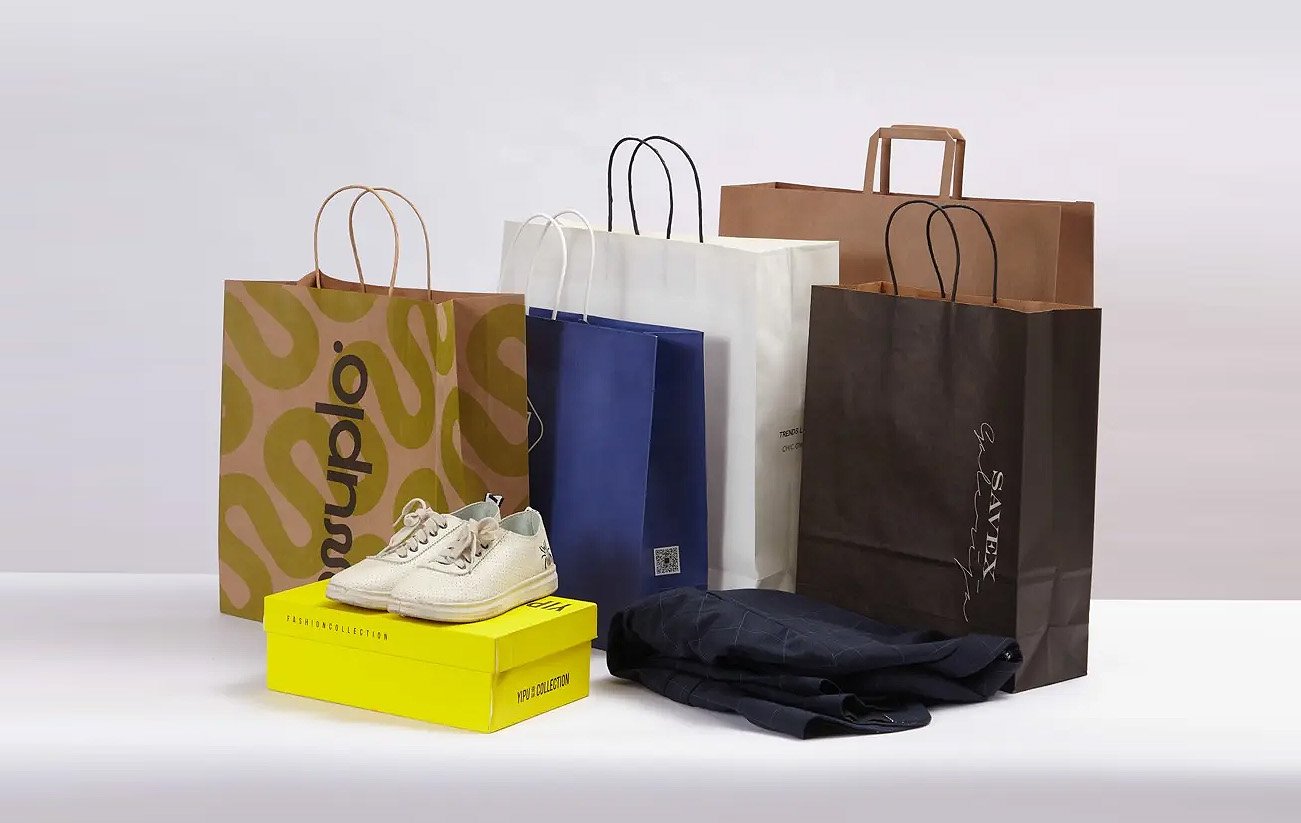
I turn the use scenario into a purchasing requirement
My first question is simple: What will the bag carry? The answer needs more detail than a product category.
A folded garment distributes its weight differently from several packaged products. A rigid box can contact the base and sidewalls differently from soft clothing. A collection of small items can shift during carrying.1 I account for those differences when discussing sample contents and loading arrangements.
I use a short scenario sheet before comparing quotations:
| Purchasing question | Information I ask the buyer to provide |
|---|---|
| What will the bag contain? | Product types, packaging, dimensions, and arrangement |
| What load should the sample represent? | Intended contents and agreed total weight |
| How will the customer carry it? | One-hand carrying, normal walking, and foreseeable handling |
| What does another use involve? | Reloading, another journey, or another defined carrying task |
| What conditions matter? | Expected storage and foreseeable moisture exposure |
| What makes the bag unacceptable? | Agreed functional and appearance changes |
I keep ordinary kraft paper bags and other common paper shopping-bag constructions within this discussion. I do not transfer claims about washable paper, coated textiles, or other bag categories to an ordinary paper carrier.
I separate repeat-use intent from environmental claims
I also ask whether the intended reuse is practical for the customer. A bag may be retained for another shopping trip, but the buyer should not assume that every recipient will reuse it.
For reusable paper shopping bags, I therefore keep two questions separate:
- My functional question is: Can the approved construction complete the agreed carrying task?
- My claims question is: What evidence supports the wording printed on the bag or used in marketing?
A sample check can contribute evidence about a defined task. It does not, by itself, establish an environmental advantage or justify a broad sustainability claim.2
Which Handle Designs Suit Reusable Paper Shopping Bags and Their Intended Product Weight?
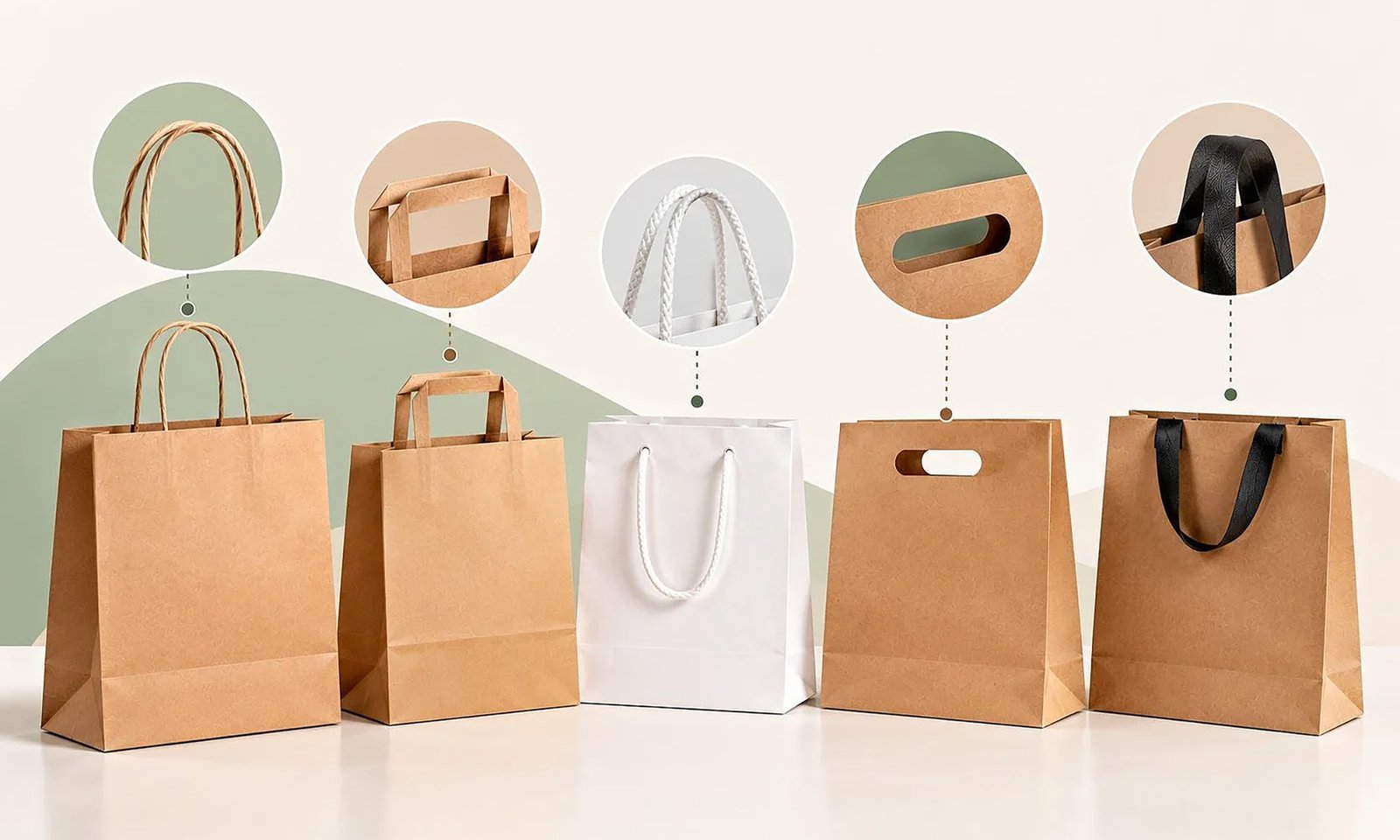
I understand why buyers start by comparing twisted paper, flat paper, cord, or ribbon handles. Those choices are visible and easy to discuss. However, appearance alone leaves out the attachment method and surrounding construction, so I compare complete handle systems rather than choosing from photographs.
I select handle candidates by reviewing grip, attachment design, reinforcement, bag dimensions, and the intended contents together. I do not assign a universal strength ranking to paper, cord, and ribbon handles. I ask the supplier to submit representative finished samples and explain the construction proposed for bulk production.
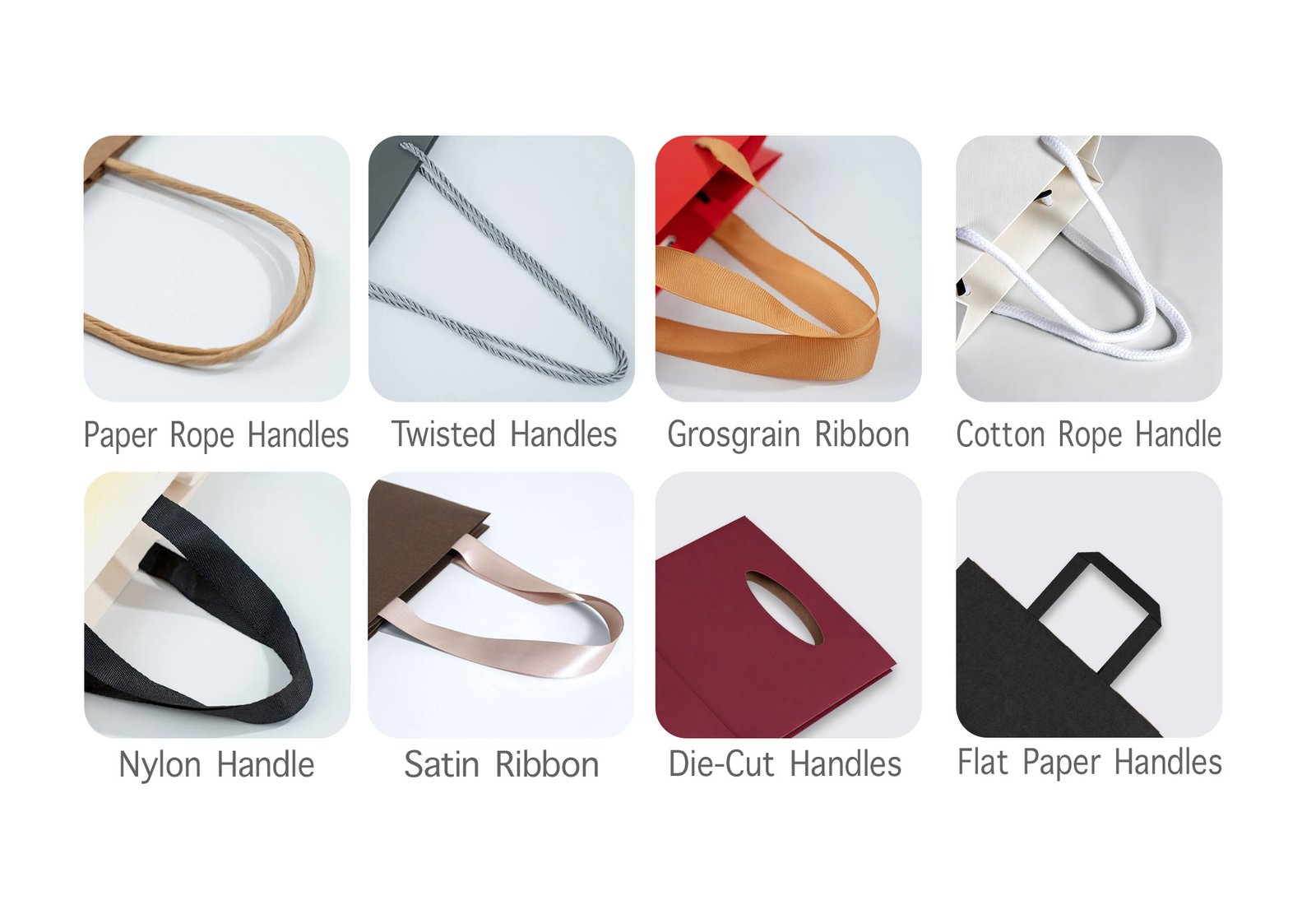
I compare construction details, not material names alone
My comparison starts with the handle, but it does not stop there.
| Handle option | Construction details I examine | Purchasing consideration |
|---|---|---|
| Twisted paper | Handle ends, fixing patches, adhesive areas, and top construction | I check the complete attachment arrangement rather than the twist alone. |
| Flat paper | Handle width, folded sections, bonding area, and reinforcement | I consider grip and attachment consistency together. |
| Cord | Cord specification, knots or other fixings, holes, and reinforcement | I examine how the fixing transfers load into the bag. |
| Ribbon | Ribbon specification, fixing method, top fold, and backing details | I compare presentation requirements with the agreed carrying task. |
I treat these as comparison points, not performance rankings. Different suppliers can use the same handle name for noticeably different constructions.
For example, a quotation that says “cord handle with reinforcement” still leaves unanswered questions. I want to know what reinforcement is included, where it sits, and whether the approved sample represents the quoted production method.
I include grip and product fit in the review
I also check whether the handle opening and handle length suit the intended use. A handle that looks appropriate on an empty sample may feel different when the actual products are inside.3
My review includes these questions:
- I ask whether the loaded contents interfere with the hand opening.
- I check whether the buyer expects customers to carry the bag with one hand.
- I compare the bag dimensions with the product packaging.
- I ask whether handle placement affects how the loaded bag hangs.
- I record any comfort or presentation requirements separately from structural acceptance.
For reusable paper shopping bags, thicker handles or heavier paper are not substitutes for this review. Those specifications may describe part of the construction, but they do not demonstrate how the finished bag will behave during repeated handling.4
I prefer a supplier who explains the proposed system and its limitations over one who simply labels a handle “heavy duty.”
Why Must Buyers Check the Handle Area and Bag Bottom Together on Reusable Paper Shopping Bags?
I cannot approve a carrying bag by watching its handles alone. The load also involves the attachment areas, upper edges, body, folds, and bottom construction. If my inspection excludes those areas, I may miss changes that matter to the bag’s next use.
I inspect the handle area and bottom together because the finished bag must carry the contents as a connected structure.5 During sample checks, I observe attachment movement, opening distortion, body changes, and base condition. I agree beforehand which changes are unacceptable and which appearance changes the buyer will tolerate.
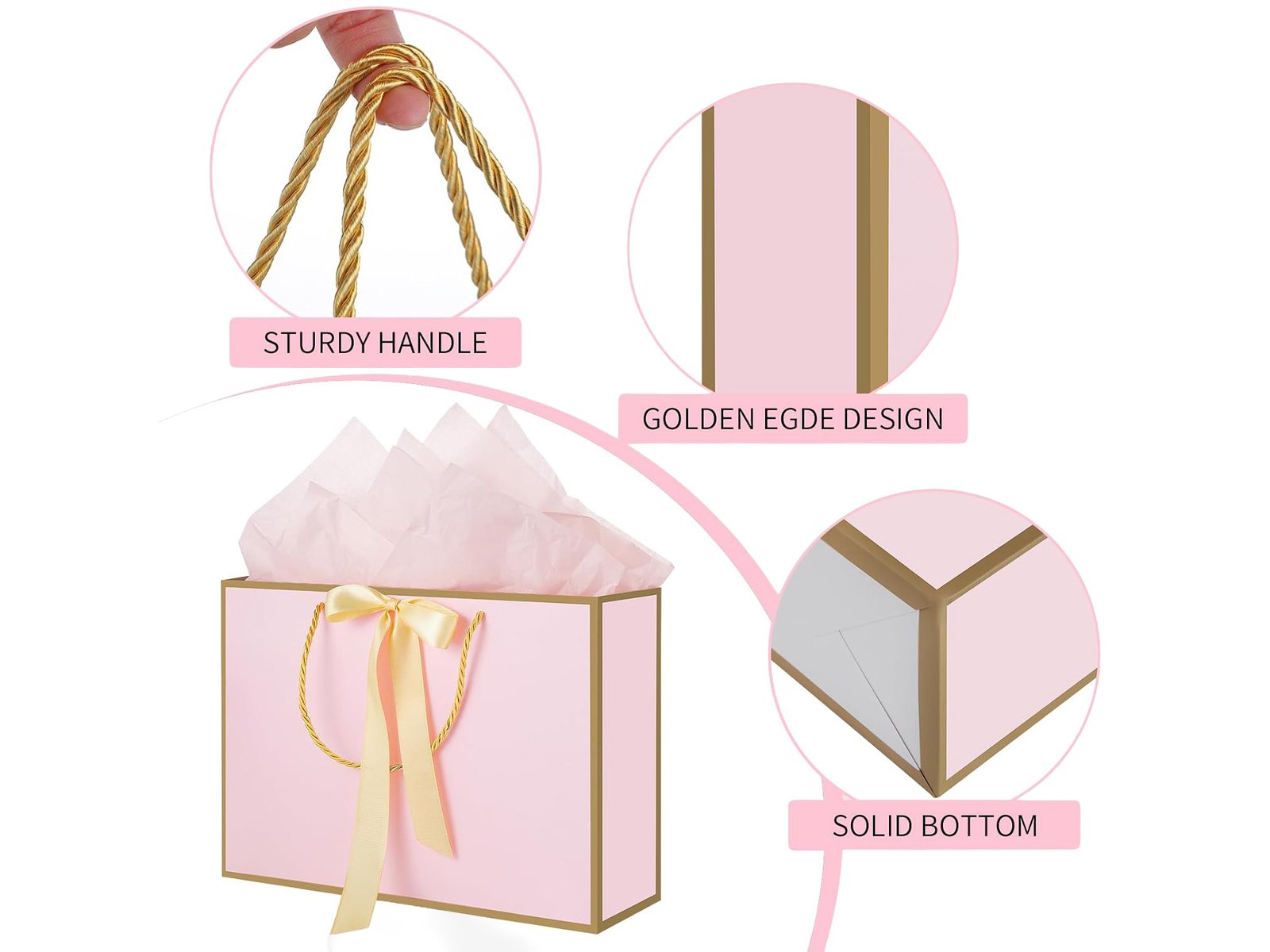
I inspect the same areas before and after handling
In sample checks I followed, I paid attention to how the bag changed during loading and repeated carrying. I do not present those observations as laboratory validation or documented comparisons between handle types. My practical lesson is narrower: I need a whole-bag inspection plan.
I organize that plan around consistent observation points:
| Inspection area | What I look for |
|---|---|
| Handle material | Visible damage, slipping, or changes in shape |
| Attachment area | Lifting edges, movement, separation, or local paper damage |
| Bag opening | Changes around the top fold, holes, or reinforced areas |
| Bag body | Tears, marked distortion, or damage around folds and seams |
| Bag bottom | Separation, opening, deformation, or damage near product contact points |
| Product contact areas | Changes where corners, edges, or concentrated contents contact the paper |
These are inspection categories, not claims that any particular defect occurred.
I photograph the unloaded sample first. I then use comparable views during the agreed review and afterward. This approach makes discussions clearer than relying on a general statement that the bag “still looks fine.”
I define acceptable change before the check
Paper bags can show cosmetic changes during handling. I do not assume that every crease means failure, and I do not assume that every visible change is harmless.
Instead, I ask the buyer and supplier to distinguish between:
- Functional rejection criteria, such as tearing, attachment separation, or bottom opening.
- Appearance rejection criteria, such as an agreed degree of distortion that conflicts with the brand’s presentation requirements.
- Acceptable changes, such as specific cosmetic changes both parties have reviewed and accepted.
The wording needs to be sufficiently clear for another inspector to apply it. When appearance matters, I prefer annotated photographs or agreed reference samples.6
For reusable paper shopping bags, this agreement helps prevent a familiar purchasing problem: the supplier and buyer using different definitions of an acceptable result.
What Should a Reusable Paper Shopping Bags Load-Test Brief Include?
I treat an unexplained “load test passed” statement as incomplete information. Without the contents, handling method, sample construction, and acceptance criteria, I cannot judge its relevance. A written brief helps me separate a one-time load check from evidence about repeated lifting and carrying.
I include sample identification, intended contents, load arrangement, handling conditions, duration or cycles, inspection points, and acceptance criteria in the brief. I specify holding and repeated-handling checks separately.7 I treat these procedures as buyer–supplier agreements unless a verified, applicable test method has explicitly been selected.
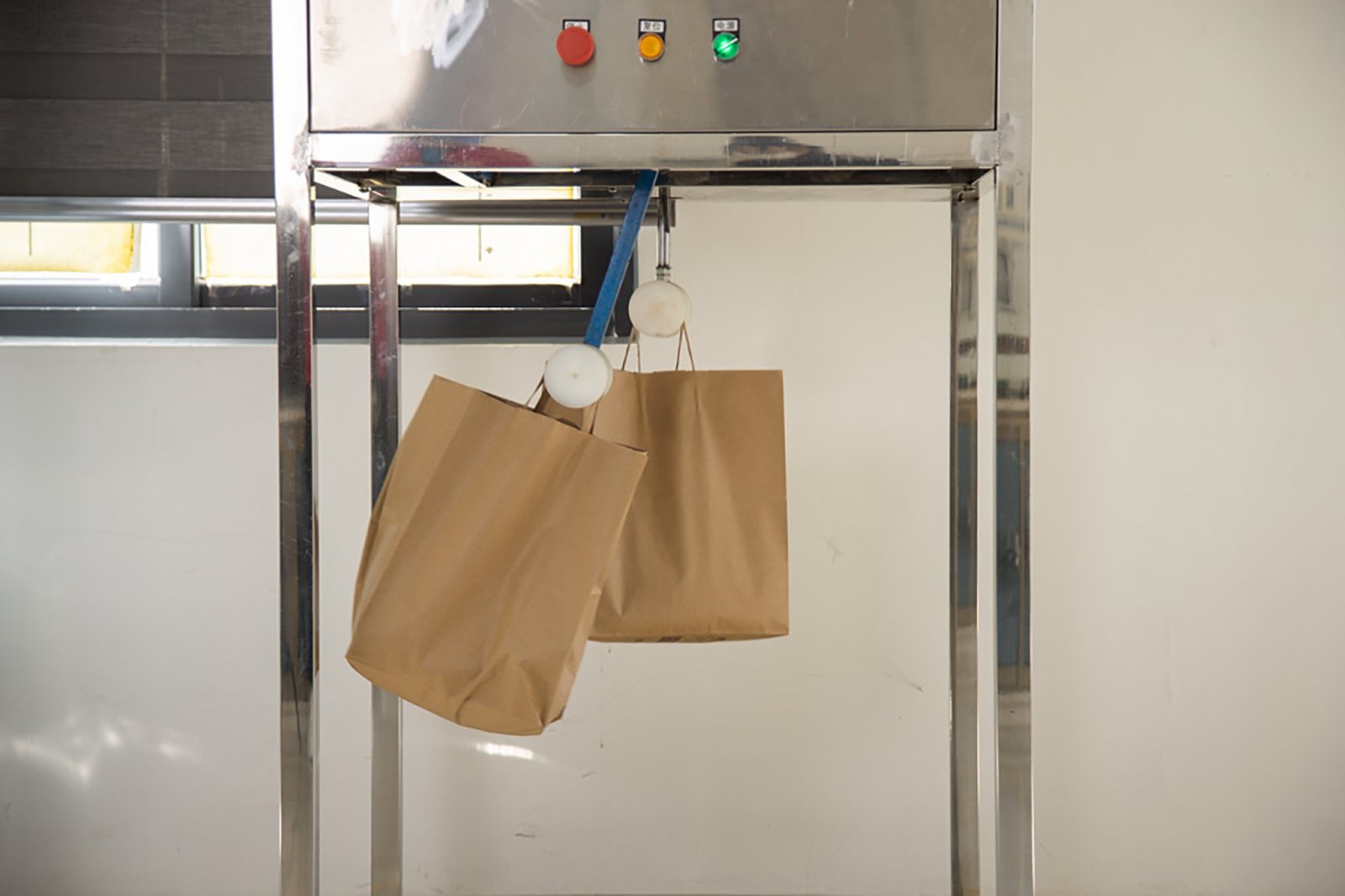
I separate the checks by purpose
My brief distinguishes three activities because they answer different questions.
-
I use a holding check to review the agreed loaded condition.
I specify how the bag is supported, what it contains, and how long that condition is maintained. -
I use repeated lifting or carrying to review the agreed handling task.
I define the movement, carrying arrangement, rest periods if relevant, and the agreed duration or repetition count. -
I use a post-check inspection to record the resulting condition.
I compare the bag with its starting condition and apply the written acceptance criteria.
I do not invent a universal weight, duration, or cycle count. Those choices need to match the purchasing requirement. If the application requires a formal performance assessment, I recommend that a qualified testing professional review the method and its suitability.
I make the record reproducible
My working brief includes the following fields:
| Brief item | Information I record |
|---|---|
| Sample identity | Sample code, revision, date, and supplier |
| Construction | Paper specification, finish, dimensions, handles, attachments, and reinforcement |
| Contents | Item descriptions, packaging, total weight, and arrangement |
| Sample quantity | Number of samples agreed for the evaluation |
| Conditioning | Storage or preparation conditions before checking |
| Holding procedure | Support method, load, and agreed duration |
| Repeated handling | Lifting method, carrying conditions, and agreed repetitions or duration |
| Inspection | Observation points, intervals, photographs, and final condition |
| Acceptance | Written functional and appearance criteria |
| Reporting | Results for each sample, deviations, and reviewer identification |
Conditioning reference: Humidity fixed points of binary saturated aqueous solutions8
For reusable paper shopping bags, I also ask whether the same contents will remain in place throughout the procedure or whether unloading and reloading form part of the intended reuse. That distinction can change what the check represents.
I request results for every evaluated sample rather than only selected photographs. If a sample is replaced, a procedure changes, or the contents shift unexpectedly, I want that recorded. A transparent account of limitations is more useful to me than an unexplained pass label.
Which Evidence Should Support Reuse Claims and Supplier Approval?
I see sample approval and supplier approval as related but separate decisions. A suitable development sample does not automatically establish production consistency.9 Likewise, a factory audit document does not prove that a particular paper carrier meets an agreed repeat-use requirement. I ask for evidence that answers each question directly.
I look for an identified approved sample, a complete construction specification, recorded sample-check conditions and results, and a production quality plan. I also verify any relevant supplier documents and marketing claims. I want clear links between the evidence, the quoted construction, and the bags that will actually be delivered.
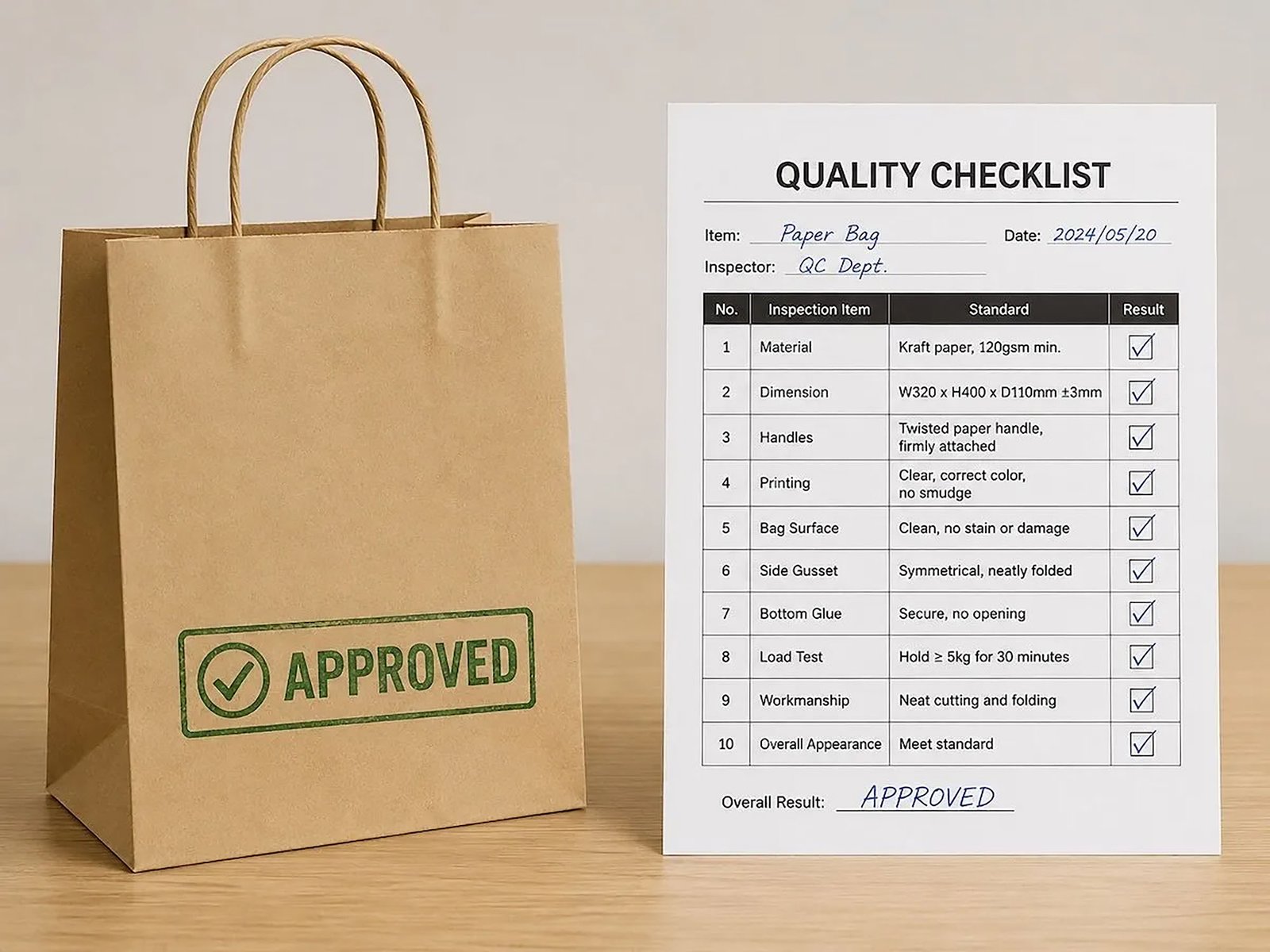
I connect the approved sample to the purchase order
My approval record identifies what the supplier must reproduce. Without that connection, a useful sample check can become detached from the bulk order.
I request a specification covering the relevant details, including:
- I record the bag dimensions and agreed tolerances.
- I identify the paper specification and common paper-based finish.
- I document the handle material, dimensions, and fixing arrangement.
- I include reinforcement and bottom-construction details.
- I attach approved artwork and any relevant print or finish requirements.
- I reference the accepted sample and its evaluation record.
I also ask how the supplier controls changes. A substitution in paper, adhesive, handle material, or reinforcement should not disappear into a general statement that the replacement is “equivalent.” I want the supplier to disclose proposed changes and agree whether further sample evaluation is needed.
I review production controls separately from claims
For supplier approval, I ask how incoming materials, attachment work, folding, bonding, and final inspection are controlled. I also ask which production-stage samples will be compared with the approved reference.
My document review follows the same principle: Each document must support the specific statement being made.
A quality-management certificate or social-audit report may inform supplier due diligence, but I verify its scope, validity, facility identity, and relevance. I do not treat it as proof of finished-bag carrying performance.10
If a supplier provides a test report, I check the sample description, method, conditions, results, and issuing organization. If a named standard appears, I verify that it applies to the construction and claim under review.
For reusable paper shopping bags, I keep marketing approval within the evidence boundary. A defined sample result should not become an unrestricted “reusable under all conditions” promise.11 I ask the buyer’s relevant compliance or legal adviser to review market-specific claims when necessary.
Frequently Asked Questions
Are twisted paper handles stronger than flat paper handles?
I do not assume that either design is universally stronger. I compare the handle specification, attachment area, reinforcement, paper construction, and bag dimensions together. I then request finished-sample checks under the same agreed conditions so that the comparison addresses the intended purchase rather than appearance alone.
Does heavier kraft paper prove that a shopping bag is reusable?
I treat paper weight as one specification, not proof of reuse performance. The attachments, folds, seams, base, product arrangement, and handling conditions also matter. I ask for evidence from the finished construction and a clearly defined repeat-use procedure before accepting a reusability claim.
Can I approve a bag from a video showing one successful lift?
I use such a video only as limited supporting information. One lift does not show repeated handling or explain the full sample conditions. I request sample identification, contents, weight, procedure, inspection results, and acceptance criteria before deciding whether the evidence supports approval.
Should moisture exposure be included in the sample checks?
I include it when foreseeable use makes it relevant, and I ask a qualified testing professional to advise on appropriate conditions when necessary. I do not assume that ordinary paper bags tolerate wet handling.12 I also avoid transferring performance claims from another finish or material to the proposed construction.
How do I keep bulk production aligned with the approved sample?
I link the purchase order to an identified reference sample, construction specification, and inspection requirements. I also require disclosure of material or construction changes. Where the purchasing risk warrants it, I arrange production-stage checks and review representative finished bags against the agreed acceptance criteria.
Conclusion
I choose reusable paper shopping bags by defining the carrying task first, then evaluating handles, attachments, bodies, and bottoms together. I separate a one-time load check from repeated-handling evidence, and I connect sample approval to production specifications. I do not treat a kilogram rating or thicker paper as proof of reusability. For your next B2B bag project, contact CoraggioBag with your products, dimensions, intended use, and customization needs so we can discuss the sourcing requirements and agree on sample acceptance before you order.
"Sustainable Paper-Based Packaging: A Consumer's Perspective", https://pmc.ncbi.nlm.nih.gov/articles/PMC8151435/. Packaging mechanics relates local stresses to load distribution and contact geometry, providing a basis for specifying the arrangement and physical form of test contents. Evidence role: mechanism; source type: paper. Supports: Contents geometry, contact area, and movement influence local loading in packaging.. Scope note: General packaging mechanics does not quantify the effects of particular garments, boxes, or loose items in the bag described here. ↩
"Life Cycle Assessment of Grocery Bags in Common Use in the ...", https://open.clemson.edu/cgi/viewcontent.cgi?article=1006&context=cudp_environment. Life-cycle assessments of shopping bags evaluate production, reuse, and disposal assumptions when comparing environmental impacts; a carrying test alone does not establish comparative environmental performance. Evidence role: general_support; source type: institution. Supports: Environmental comparisons require consideration of production, actual reuse, and end-of-life assumptions rather than carrying performance alone.. Scope note: Life-cycle findings depend on the bag designs, impact categories, and use scenarios assessed and do not establish the footprint of the proposed bag. ↩
"Development and experimental verification of an ...", https://pubmed.ncbi.nlm.nih.gov/30223419/. Ergonomic studies of carrying tasks relate hand loading and discomfort to both the carried load and the geometry of the hand–handle interface. Evidence role: mechanism; source type: paper. Supports: Carried load and handle contact geometry influence hand pressure and perceived discomfort.. Scope note: Results from particular handles, participants, and carrying tasks do not establish comfort for every paper-bag design. ↩
"Micromechanical Modelling of Tear Strength in Kraft and ...", https://bioresources.cnr.ncsu.edu/wp-content/uploads/2024/03/1997.2.1249.pdf. Paper mechanics research distinguishes grammage from strength properties influenced by fiber characteristics, bonding, and structure; grammage alone therefore does not establish finished-bag durability. Evidence role: mechanism; source type: paper. Supports: Paper strength depends on properties beyond grammage, while finished-bag behavior also depends on construction.. Scope note: Material-level findings do not directly predict repeated-use performance for a particular bag or handle assembly. ↩
"Paper bag", https://en.wikipedia.org/wiki/Paper_bag. Carrier-bag performance methods assess the loaded finished article, supporting evaluation of the bag as an assembled structure rather than of its handles in isolation. Evidence role: general_support; source type: institution. Supports: Finished-carrier testing evaluates carrying performance at the bag level rather than inferring it from handle material alone.. Scope note: A method's applicability to the proposed construction and its coverage of repeated use must be established separately. ↩
"Visual Inspection: A Review of the Literature", https://www.osti.gov/servlets/purl/1055636. Research on visual inspection identifies defect definitions, reference standards, and inspector agreement as relevant to the consistency of acceptance decisions. Evidence role: general_support; source type: paper. Supports: Defined defect categories and reference materials can support more consistent visual inspection judgments.. Scope note: Reference photographs do not eliminate subjective judgment, and their effectiveness for a particular bag requires assessment. ↩
"Static failure vs fatigue in design: sizing for cyclic loads", https://www.infinitiaresearch.com/en/news/fatigue-design-cyclic-loads/. Mechanical testing distinguishes sustained loading from cyclic loading because repeated load application can produce damage not characterized by a single held-load condition. Evidence role: mechanism; source type: education. Supports: Sustained and repeated loading impose different mechanical histories and are not interchangeable evidence.. Scope note: This general distinction does not specify an appropriate cycle count, motion, or failure threshold for paper shopping bags. ↩
"Humidity fixed points of binary saturated aqueous solutions", https://nvlpubs.nist.gov/nistpubs/jres/81a/jresv81an1p89_a1b.pdf. Standard paper-testing practice specifies conditioning atmospheres to improve comparability of measurements affected by temperature and relative humidity. Evidence role: general_support; source type: institution. Supports: Paper testing uses controlled or documented conditioning because environmental conditions can affect measured properties.. Scope note: A paper-material conditioning standard does not by itself define a finished-bag reuse test or realistic exposure conditions. ↩
"6.2.1. What is Acceptance Sampling?", https://www.itl.nist.gov/div898/handbook/pmc/section2/pmc21.htm. Statistical quality-control guidance distinguishes evaluation of sampled units from evidence about process behavior and lot conformity; approval of one development sample does not establish production consistency. Evidence role: general_support; source type: government. Supports: Production consistency requires evidence about process variation and production output beyond a single approved sample.. Scope note: The appropriate sampling and control arrangements depend on production conditions and the buyer's acceptable risks. ↩
"Auditing for Child Labor Guide", https://www.dol.gov/agencies/ilab/sourcingstrong/steps-to-a-social-compliance-system/step-5-monitor-compliance/key-topic-auditing-for-child-labor-guide. Management-system certification addresses organizational systems, while social auditing concerns labor-related practices; neither constitutes a test of a particular bag's carrying performance. Evidence role: definition; source type: institution. Supports: Management-system certification and social auditing concern different subjects from finished-product performance testing.. Scope note: The assurance provided by any individual certificate or report remains limited to its stated scope and assessment conditions. ↩
"FTC Policy Statement Regarding Advertising Substantiation", https://www.ftc.gov/legal-library/browse/ftc-policy-statement-regarding-advertising-substantiation. Regulatory guidance on advertising substantiation and environmental claims requires evidence relevant to the claim made and clear qualifications where necessary to avoid misleading broader implications. Evidence role: general_support; source type: government. Supports: Claims require relevant substantiation and qualifications that prevent limited evidence from implying broader performance.. Scope note: These principles are jurisdiction-specific and do not independently determine whether particular reuse wording is lawful in every market. ↩
"The relative moisture sensitivity of compression as ...", https://bioresources.cnr.ncsu.edu/wp-content/uploads/2022/04/1985.2.497.pdf. Research on paper wet strength documents the loss of mechanical strength upon wetting and the role of treatments designed to retain strength under wet conditions. Evidence role: mechanism; source type: paper. Supports: Water exposure can reduce paper strength, and retained wet strength depends on material formulation and treatment.. Scope note: The magnitude of strength loss depends on the paper, treatment, and exposure and cannot be assigned to the proposed bag without testing. ↩