Many buyers worry that a 30% deposit feels risky. I understand that fear. If the supplier fails, the buyer loses money, time, and often the whole selling season.
A 30% deposit is usually used to buy materials1, reserve production capacity2, and confirm that a bulk bag order3 is real. In most cases, it is standard practice4 in the bag industry5, and the remaining 70% is paid before shipment or against shipping documents6.
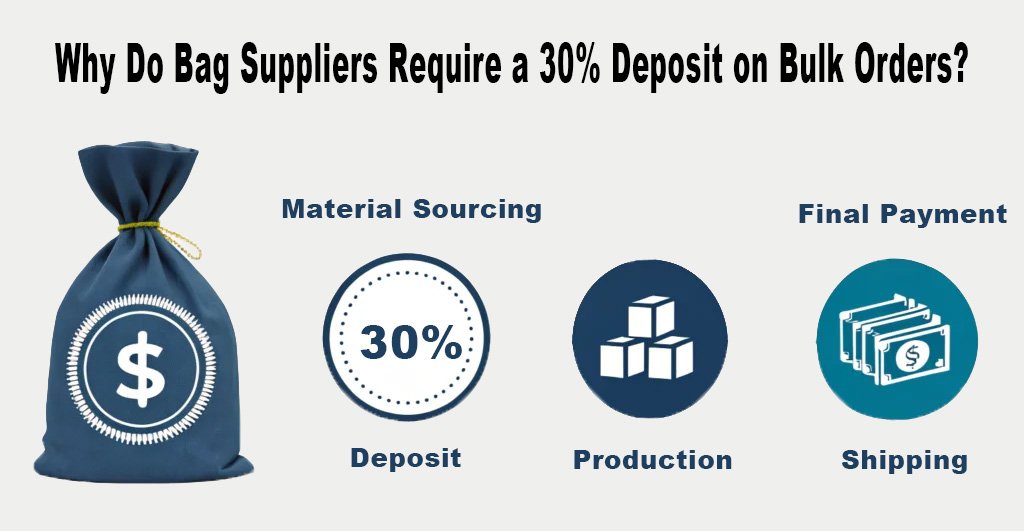
I have worked with many bulk bag order3s, and I have seen this question come up again and again. Buyers want safety. Factories want commitment. That is why the 30% deposit exists. It is not only about cash flow. It is also about trust, planning, and shared responsibility7. If you understand what the deposit is for, you can judge suppliers more clearly and avoid the wrong kind of partner.
What Does the 30% Deposit Actually Cover in Bag Production?
A buyer may think the factory asks for 30% just to hold money early. I used to hear this a lot. But real production starts long before the bags are finished.
The 30% deposit usually covers early production costs8 such as fabric, lining, zippers, buckles, webbing, logo materials, sample approval changes, labor planning, and production slot reservation9. It helps the factory start the order without carrying all the financial risk10 alone.
When I look at a bulk bag order3, I never see only one finished product. I see many small cost points that begin at the same time. A factory has to prepare fabric rolls, hardware, zipper colors, pullers, labels, hangtags, cartons, and sometimes custom packaging. If the order is OEM or ODM11, the factory may also need to make mold changes, source special trims, or test a new fabric. All of this costs money before a single bag is packed.
I have seen buyers think production begins only when sewing starts. That is not how it works. The real work starts much earlier. The factory must lock material suppliers, book incoming stock, and reserve line time. Workers must be arranged. Machines may need setup changes. If the order is large, one delay can affect several other orders.
Here is a simple breakdown:
| Cost Area | What It Includes | Why It Starts Early |
|---|---|---|
| Materials | Fabric, lining, foam, zipper, buckle, webbing | Suppliers often require advance payment |
| Branding | Logo patch, printing, embroidery, labels | Custom parts need lead time |
| Production planning | Line booking, labor arrangement, scheduling | Capacity must be reserved |
| Packaging | Polybags, export cartons, barcode labels | Packaging is often customized |
| Pre-production work | Sample revision, approval updates, BOM check | Errors must be fixed before bulk |
In my experience, the deposit is not a bonus for the factory. It is the fuel that lets the order move. Without it, the factory carries all the early cost while the buyer still has the option to walk away. That is not balanced business.
Is a 30% Deposit Standard Practice in the Bag Industry?
Some buyers ask me if the 30% deposit is just something one factory made up. I always say no. In most cases, it is a normal rule in this business.
Yes, a 30% deposit is standard practice4 for many bag factories, especially for OEM and ODM bulk orders. It is common because factories must buy materials1 and schedule production before shipment, while buyers pay the balance later for added protection.
I have worked in bag manufacturing long enough to see that payment terms often follow a simple structure. The buyer pays 30% deposit after order confirmation. The factory begins material sourcing12 and production. The buyer pays the remaining 70% before shipment, or sometimes after seeing a copy of the bill of lading13, depending on the agreement. This is not unusual. It is one of the most common ways to share risk.
This is even more true in B2B bag manufacturing14. Bulk orders are not like buying ready stock from a shelf. Many orders are custom. The color is custom. The size is custom. The logo is custom. The packaging is custom. Once production begins, much of that material cannot be sold easily to another customer. That is why the factory needs the deposit as a sign of serious commitment.
I would actually be more careful if a supplier never asks for a deposit at all. That can sound attractive at first. But it may also mean the supplier is a trader with weak control, a workshop with unstable finances, or someone who does not plan production in a professional way.
Here is a quick view:
| Payment Term | Is It Common? | Typical Use |
|---|---|---|
| 30% deposit + 70% before shipment | Very common | Standard bulk OEM/ODM orders |
| 50% deposit + 50% before shipment | Common | New developments or high-cost materials |
| Full payment in advance | Less common | Small orders or high-risk transactions |
| No deposit | Uncommon | Ready stock or unusual supplier policy |
In my view, 30% is not a red flag. It is often a sign that the supplier understands normal factory operations.
What Happens If a Buyer Refuses to Pay the Deposit?
Some buyers want the factory to start first and get paid later. I understand the reason. They want to reduce risk. But if they refuse the deposit, the order often stops before it starts.
If a buyer refuses to pay the deposit, the factory will usually not buy materials1, reserve production time, or begin bulk production. In many cases, the order will be delayed, rejected, or treated as low priority because the supplier sees no confirmed commitment.
I have seen this happen more than once. A buyer says the order is urgent. The factory sends the PI. The buyer keeps asking for production updates but does not pay the deposit. At that point, the factory is stuck. It cannot order all materials. It cannot lock the line. It cannot promise a safe shipping date. Everything becomes uncertain.
From the buyer side, refusal to pay the deposit may feel like caution. From the factory side, it feels like risk with no protection. The factory may think the buyer is still comparing prices, still not sure, or not financially ready. That changes the whole relationship. The supplier may move other confirmed orders first.
This does not mean every buyer who asks questions is a bad buyer. Good buyers should ask questions. I always encourage that. But once the order details are settled, the deposit is the point where discussion becomes action.
Here is what usually happens if the deposit is not paid:
| Buyer Action | Factory Response | Result |
|---|---|---|
| Delays deposit | Holds order | Production date slips |
| Refuses deposit | Does not buy materials1 | No bulk start |
| Asks for credit without history | Rejects request or asks for trade assurance15 | Terms become stricter |
| Keeps negotiating after PI | Lowers priority | Communication gets slower |
In my own work, I have found that the strongest buyer-supplier relationships are clear from the start. If both sides agree on terms and follow them, the project moves much faster and with fewer mistakes.
When Is the Remaining 70% Payment Due for Bag Orders?
Many buyers accept the 30% deposit but still worry about the last 70%. They want to know exactly when that payment happens and what they should check before sending it.
The remaining 70% payment is usually due before shipment after production is completed and inspection is passed. In some cases, it is paid against a copy of the bill of lading13, depending on the agreement between buyer and supplier.

I always tell buyers that the second payment matters just as much as the first one. Good factories do not ask for the balance at random. There is usually a clear point in the process. Bulk production is done. Packing is done. Final inspection is done. Then the supplier sends photos, packing list16, invoice, and sometimes inspection reports. After that, the balance is arranged.
In many standard export orders, the balance is paid before the goods leave the factory or before the container is released. In some deals, especially with trusted long-term buyers, the payment can be made against the bill of lading13 copy. This gives the buyer a little more comfort because the goods have already shipped.
The exact timing depends on order size, trust level, payment method, and country rules. New customers usually have stricter terms. Old customers may get better flexibility.
A simple timing table helps:
| Stage | What Happens | Payment Status |
|---|---|---|
| Order confirmed | PI issued, specs fixed | 30% deposit paid |
| Material sourcing | Fabric and trims ordered | No further payment yet |
| Bulk production | Cutting, sewing, finishing | No further payment yet |
| Final inspection | Goods checked and packed | Balance requested soon |
| Pre-shipment / shipping docs | Invoice, packing list16, inspection records shared | 70% paid |
| Shipment release | Container or documents released | Payment completed |
I think buyers should ask one direct question before placing any order: “At what exact point is the 70% due?” A professional factory should answer that clearly in writing.
How Can Buyers Protect Themselves When Paying a Deposit to Bag Factories?
Paying a deposit does involve risk. I never deny that. But buyers are not powerless. There are practical ways to reduce risk and still move business forward.
Buyers can protect themselves by checking the factory background, confirming specifications in writing, using secure payment terms17, requesting samples, setting inspection rules, and matching payment timing with clear production milestones18 and shipping documents6.

When I speak with buyers, I often say that the goal is not to avoid all risk. The goal is to control risk. A good supplier should welcome this. A real factory should be able to show business licenses, production photos, audit records, material details, and a clear process. If a supplier becomes vague when you ask basic questions, that is already a warning sign.
I also think buyers should treat the PI and specification sheet as protection tools, not just paperwork. Every key detail should be written down. Bag size. Material. GSM if needed. Color code. Logo method. Zipper brand or grade. Carton marks. Packing quantity. Delivery date. Inspection standard. Payment terms. If these points are not clear, the deposit becomes much riskier.
Third-party inspection is also useful. Many buyers know sales well but not technical bag details. That is fine. An inspection company can help fill that gap. A pre-production sample and final inspection19 reduce surprises.
Here is a simple checklist I would use:
| Protection Step | Why It Matters |
|---|---|
| Verify factory identity | Confirms you are dealing with a real supplier |
| Ask for samples | Checks workmanship before bulk |
| Confirm specs in writing | Prevents disputes later |
| Use clear PI and contract | Sets payment and delivery rules |
| Request production updates | Keeps the order visible |
| Arrange inspection | Finds quality issues before shipment |
| Match payment with documents | Adds control before release |
| Start with a test order | Reduces exposure on first cooperation |
In my experience, deposits become dangerous mostly when buyers skip due diligence20. A 30% deposit to a verified, organized, transparent factory is very different from a 30% deposit to an unknown supplier with no system. The payment term is not the whole story. The supplier behind it matters even more.
Conclusion
A 30% deposit is usually a normal and necessary step in bulk bag production. It helps factories start work, and smart buyers reduce risk by checking suppliers and setting clear terms.
Learn how upfront material purchasing affects lead times, pricing, and supplier commitment before your bulk bag order begins. ↩
Understand why factories block line time early and how this protects delivery schedules for custom bag orders. ↩
Get practical guidance on planning, pricing, timelines, and risk control before committing to large bag purchases. ↩
See how common payment terms are used to balance risk fairly between buyers and manufacturers in real transactions. ↩
Compare common industry rules so you can judge whether a supplier’s payment request is normal or risky. ↩
Reviewing the right documents helps buyers confirm shipment readiness and avoid costly payment mistakes. ↩
Discover how strong payment structures improve cooperation, reduce disputes, and keep production moving smoothly. ↩
This helps buyers see where deposit money goes and why factories need support before sewing even starts. ↩
Learn how booking factory capacity early can prevent delays and secure faster turnaround for your order. ↩
A deeper look at risk sharing can help you negotiate fairer terms and choose more reliable suppliers. ↩
Knowing the difference helps buyers understand customization levels, development costs, and deposit expectations. ↩
Explore how sourcing fabrics and trims impacts schedules, costs, and the need for advance payment. ↩
This can help buyers use shipping proof more confidently when arranging final payment on export orders. ↩
Find expert insights on managing suppliers, quality, payment terms, and timelines in business-to-business orders. ↩
Learn whether trade assurance can reduce deposit risk and add protection if problems happen during production. ↩
Understanding the packing list helps verify quantities, carton details, and shipment accuracy before payment. ↩
Compare safer options that can lower fraud risk while still keeping the supplier relationship workable. ↩
Milestone-based payments give buyers more control and create clearer accountability throughout production. ↩
A solid inspection process can uncover quality issues early and protect your money before shipment release. ↩
A strong due diligence checklist can help you spot warning signs early and avoid unreliable suppliers. ↩