Many buyers rush to ask for price first. Then they get a nice sample, place a bulk order, and later face weak function, uneven quality, and market complaints.
Buyers should ask pickleball bag suppliers about user needs, bag function, bulk consistency, branding method, and production control before asking for price. A good supplier should explain how the bag will be made, checked, and repeated in mass production.
I have handled many buyer inquiries about custom bags, and I see the same gap again and again. Many first-time buyers ask for a fast quote, but they do not ask the questions that protect the order later. I think the better way is simple. I should first define who will use the pickleball bag, where they will use it, what they will carry, and what level of quality the market expects. Then I should test whether the supplier can make that result at scale, not just in one good sample.
What Compartments Should a Pickleball Bag Include?
Many buyers copy a sports bag layout from another category. Then the bag looks fine, but real users find it awkward, messy, or too small for actual play needs.
A pickleball bag should include compartments based on how the user plays. Most buyers should ask for paddle storage, ball space, shoe or wet item separation, small accessory pockets, and easy-access sections for daily use.
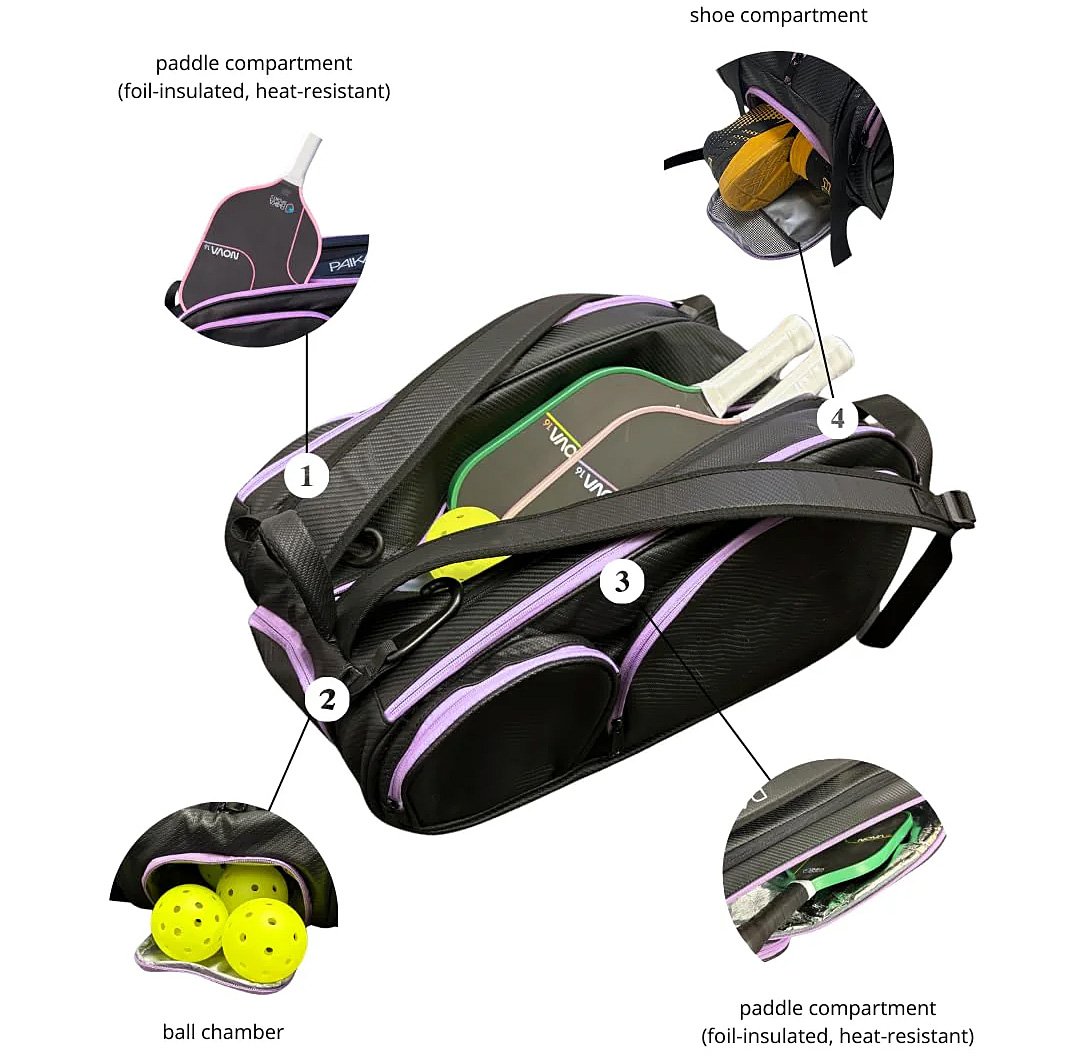
When buyers ask me about compartments, I do not start with a generic list. I start with use. A casual player, a club member, and a tournament player do not pack the same way. This is where many sourcing mistakes begin. The buyer asks for “more pockets,” but does not define what each pocket is for. Then the factory gives a layout that looks busy, but does not help the user.
I think a better question is: what must the bag separate, protect, and let the player reach fast? In factory communication, this is where risk usually appears. If the compartment purpose is vague, the bag becomes a generic sports backpack with a pickleball logo.
| Compartment | Main use | Why it matters |
|---|---|---|
| Paddle section | Holds paddles flat and secure | Helps avoid pressure and shape damage1 |
| Ball pocket | Stores balls in one fixed area | Stops balls from rolling into main space |
| Shoe or wet section | Keeps dirty or damp items apart | Improves hygiene and user comfort2 |
| Small accessory pocket | Holds keys, tape, grips, phone | Makes daily use easier |
| Main compartment | Carries towel, clothes, water, extras | Supports both play and travel needs |
I usually suggest that buyers ask the supplier how each compartment will be built. Will the paddle area have padding? Will the shoe section use lining that is easy to clean? Will the zipper opening be wide enough for fast access? These are better questions than “Can you add one more pocket?” A useful compartment plan should serve the player, not just decorate the product page.
How Many Paddles Should a Club-Level Bag Hold?
Buyers often guess capacity from photos. Then the finished bag either wastes space or fails club users who carry more gear than expected.
A club-level pickleball bag should usually hold 2 to 4 paddles3, with room for balls, shoes, and personal items. Buyers should match paddle capacity to the target player, selling channel, and bag size.
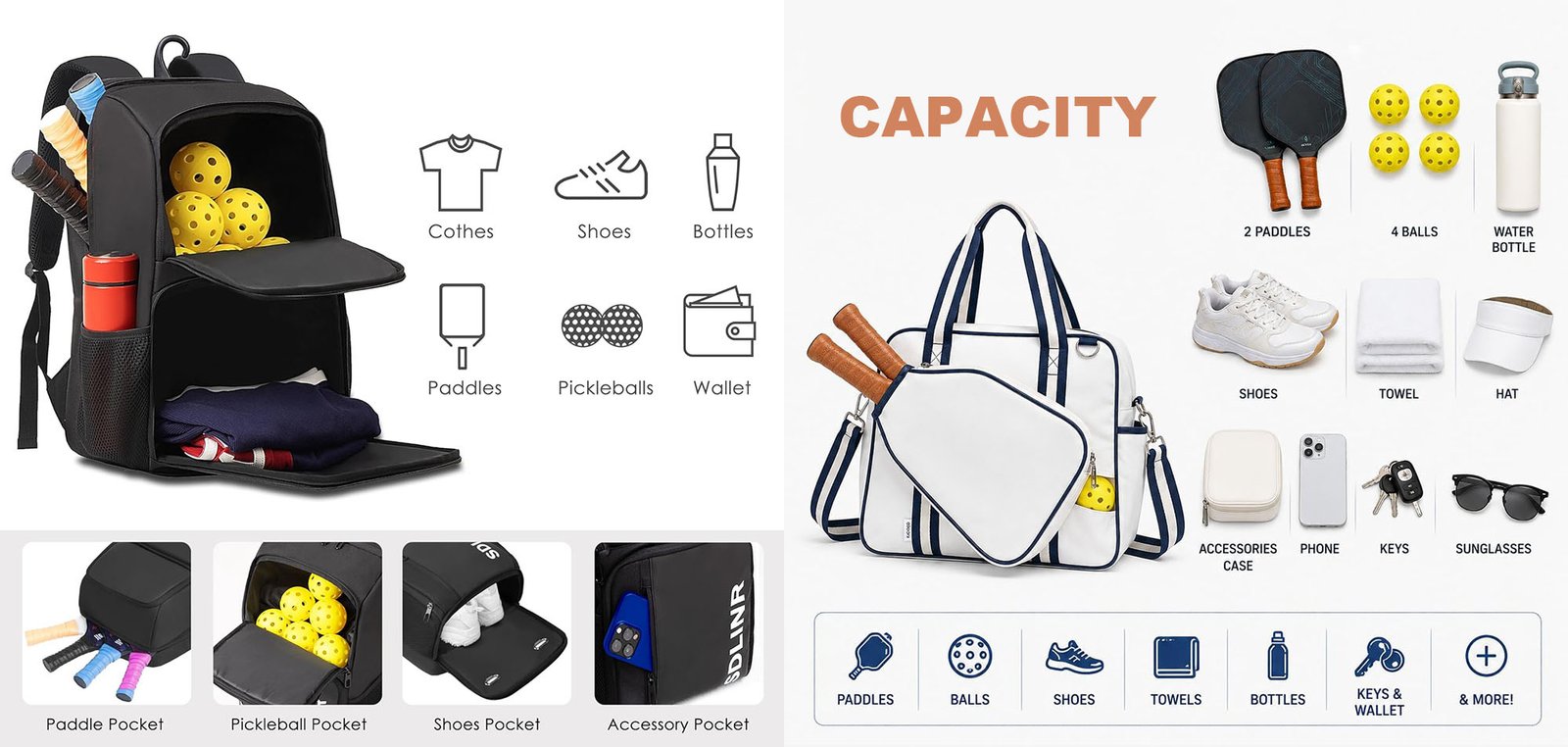
This question sounds simple, but it is often asked too late. I have seen buyers approve a design because it looks slim and modern. Then they test it with real users and find that it only works for one paddle and a few small items. That may fit a casual player, but it misses the club market.
Based on buyer inquiries we often receive, club-level users want more than paddle storage. They want enough space for repeat weekly use. They may carry backup paddles, balls, a towel, grip tape, water, and sometimes shoes or a light jacket. So I think buyers should ask not only “How many paddles can it hold?” but also “Can it still feel balanced and easy to carry when loaded?”
| User type | Typical paddle need | Suggested bag direction |
|---|---|---|
| Casual player | 1 to 2 paddles | Compact sling or small backpack |
| Club player | 2 to 4 paddles | Medium backpack or structured tote |
| Tournament user | 3 to 6 paddles | Larger backpack or duffle style |
I also ask buyers to check how the supplier defines capacity. Some factories count total space loosely. I prefer to ask for real loading examples. How many standard paddles fit without forcing the zipper? Does the divider keep paddles from rubbing together? Can the bag still hold balls and extras after paddles are packed? A good supplier should answer with practical details, not only a yes. That answer shows whether they understand the bag category or are only treating it like a standard sports item.
Which Bag Styles Work for Tournaments and Retail?
Buyers sometimes choose one style for every market. Then the bag fits neither retail display needs nor serious player use.
Backpacks usually work best for tournaments because they carry well and organize gear.4 Totes and sling bags can work for retail if the target buyer wants lighter use, fashion appeal, or entry-level pricing.5
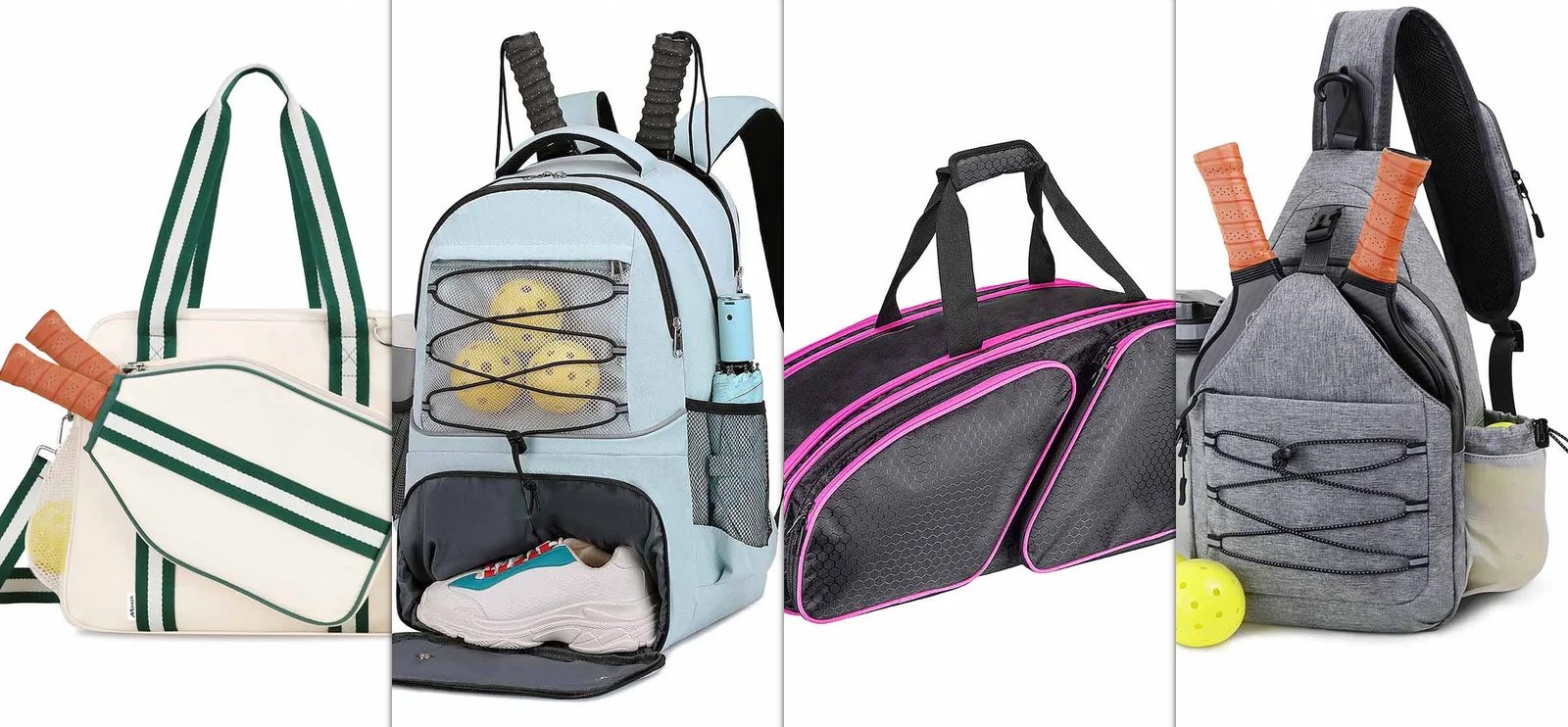
I often tell buyers that style choice is not just about appearance. It is about where the bag will be sold and how it will be used. A tournament player usually values carry comfort, balance, storage logic, and fast access. A retail buyer in a store may respond first to shape, color, and shelf appeal. These are not the same buying moments.
This is why I do not like the question, “Which style is most popular?” Popular for whom? In what country? In what price band? Under what brand position? A style that sells well in a gift channel may fail in a club channel.
| Style | Best for | Strength | Risk |
|---|---|---|---|
| Backpack | Clubs, tournaments, active players | Balanced carry, more organization | Can cost more to make well |
| Tote bag | Lifestyle retail, women’s market, gifting | Easy look, simple shape, branding area | May lack structure for heavy gear |
| Sling bag | Entry market, casual use | Light, compact, lower material use | Limited capacity |
| Duffle | Travel, team use, larger load | Big storage volume | Less convenient for court movement |
In my experience, buyers should ask suppliers how the style affects construction. A backpack needs better shoulder strap control and back panel support. A tote needs shape stability if it must hold paddles upright. A sling bag needs clear load limits. These are execution questions. If the supplier only says, “We can do all styles,” I still need more. I want to know how they will adapt structure, padding, and pocket placement to the actual use case. That is how I judge real ability.
How Can Sponsors Brand Pickleball Bags in Bulk?
Many buyers focus only on putting a logo on the bag. Then the branding looks cheap, peels off, or does not match the event or retail image.
Sponsors can brand pickleball bags in bulk with screen printing, embroidery, heat transfer, woven labels, or patches6. Buyers should choose the method based on bag material, logo detail, order volume, and the image they want to present.7
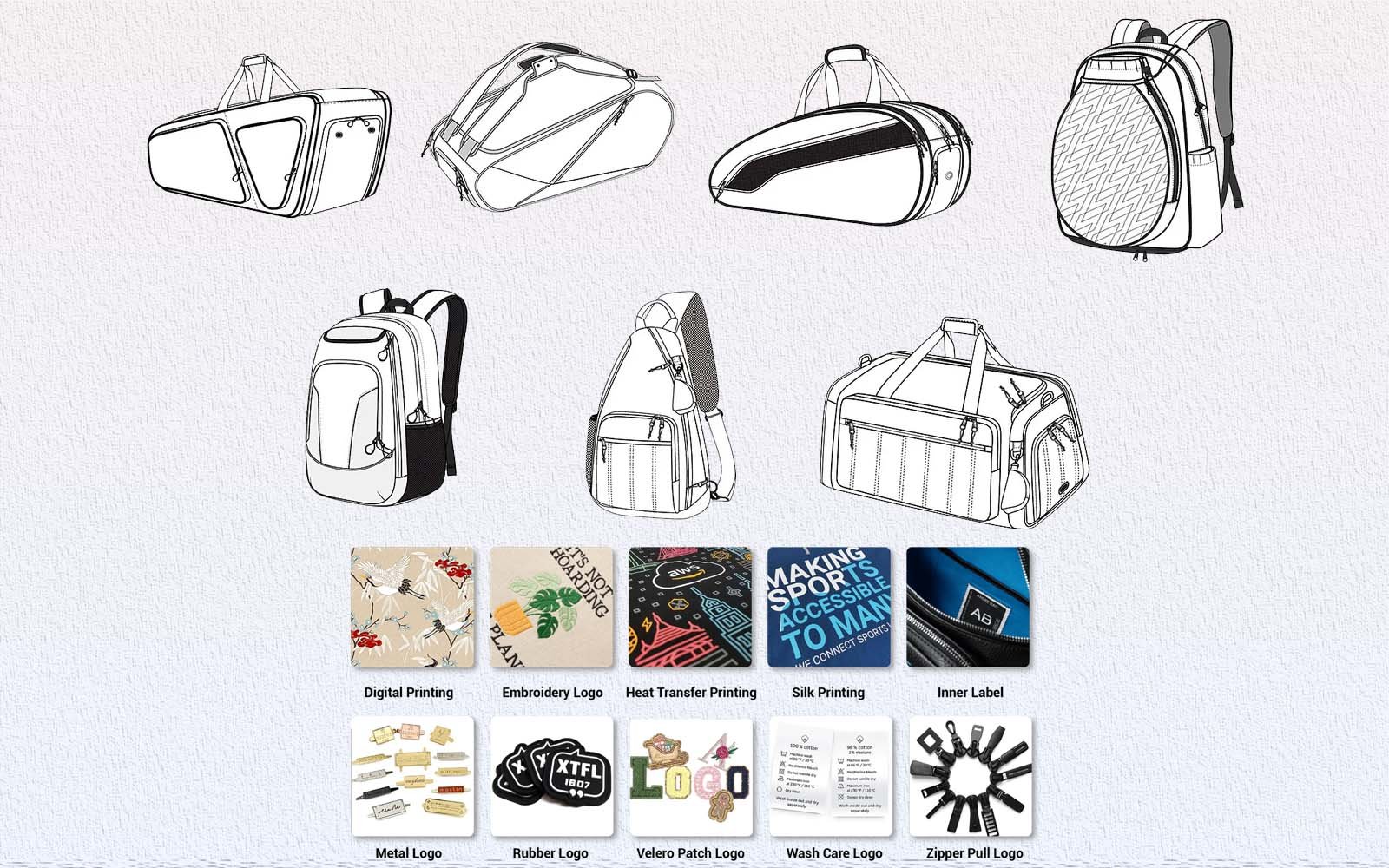
Branding looks easy on paper, but it creates many problems in production if the buyer does not ask enough early. I have seen buyers approve artwork on a flat mockup and later feel disappointed because the real logo sits across seams, curves, or rough fabric texture. The logo is there, but the bag still does not look premium.
I think the first question should be about brand purpose. Is this bag for event giveaway, club identity, sponsor promotion, or retail sale? The answer changes the branding method. A giveaway bag may need low-cost visibility. A retail bag may need a cleaner and more durable finish.
| Branding method | Best use | Good point | Watch point |
|---|---|---|---|
| Screen print | Simple logos, large quantity | Cost-effective | Less ideal on textured surfaces8 |
| Embroidery | Premium look, simple marks | Strong brand feel | Can affect light fabric shape9 |
| Heat transfer | Detailed logo, color-rich art | Good image clarity | Needs material compatibility10 |
| Woven label | Subtle branding | Clean and professional | Smaller visual impact |
| Rubber or stitched patch | Sporty look, club identity | Distinct style | Extra step in production |
I always suggest asking where the logo will be placed and how that area is built. Is there a stable panel for printing? Will stitching interfere with the mark? Can the method stay consistent in bulk production? A sample with one beautiful logo is not enough proof. I need to know if the supplier can repeat placement, color, and finish across the whole order. That is where many bulk branding complaints come from.
What Should Buyers Check Before Ordering Custom Pickleball Bags?
A sample can look great and still hide bulk risks. Then the real shipment arrives with shape problems, weak stitching, and uneven materials.
Before ordering custom pickleball bags, buyers should check target use, material choice, compartment logic, sample-to-bulk consistency, workmanship standards, branding method, packaging, and delivery control. Sample approval alone is not enough.11

This is the part I care about most. Many buyers think the job is done once the sample is approved. I do not agree. A sample proves that one unit can be made. It does not prove that hundreds or thousands of units will stay the same.12 Based on repeated buyer inquiries, this is where first-time buyers often have a blind spot.
I think buyers should ask the supplier to explain how quality will stay stable after sampling. What material lot will be used? How will color differences be controlled? What workmanship points will be checked during production? How will shape be kept during packing and shipping? These are not technical extras. These are basic bulk order questions.
| Check point | What I should ask | Why it matters |
|---|---|---|
| Material | Is the same material used in bulk as in sample? | Stops quality drop after approval |
| Structure | How is the bag shape supported? | Affects real use and shelf look |
| Stitching | What are the key stress points? | Helps avoid breakage complaints |
| Compartments | Are sizes based on actual pickleball gear? | Prevents poor function |
| Branding | Can logo quality stay stable in bulk? | Protects brand image |
| Packing | How will bags be packed to keep shape? | Reduces arrival damage |
| Timeline | What controls help on-time delivery? | Helps planning and sales launch |
When I speak with a supplier, I listen closely to how they answer. A weak supplier says yes to everything. A strong supplier explains process, limits, and control points. That difference matters more than a quick quote. In the end, I should not buy a pickleball bag as if it were a generic sports bag. I should buy a product that matches the player, the market, and the brand promise I need to deliver.
Conclusion
I should ask pickleball bag suppliers about fit, function, and bulk control first, because the right questions reduce sourcing risk far better than chasing the lowest price.
"Pickleball - Wikipedia", https://en.wikipedia.org/wiki/Pickleball. Descriptions of pickleball paddle construction indicate that paddles commonly use polymer or composite cores with bonded face materials, so storage that limits compressive stress and abrasion is consistent with general protection against transport-related damage, although the source may not test bag compartments directly. Evidence role: mechanism; source type: encyclopedia. Supports: Background sources should explain that pickleball paddles are built from polymer or composite structures that can be affected by impact or deformation, making protective storage reasonable.. Scope note: Support is contextual because general information on paddle construction implies the value of protection but may not directly measure the effect of a specific bag compartment design. ↩
"Sweat and odor in sportswear – A review - PMC - NIH", https://pmc.ncbi.nlm.nih.gov/articles/PMC10391722/. Studies of damp textiles and footwear report that retained moisture can promote odor-associated microbial growth and user discomfort, which supports the practice of isolating wet or dirty items from other contents in a sports bag. Evidence role: mechanism; source type: research. Supports: Research should show that moisture retained in shoes or damp textiles promotes odor formation and microbial growth, supporting separation in storage.. ↩
"Paddle Guide - Pickleball Central", https://pickleballcentral.com/paddle-guide/?srsltid=AfmBOoraeWnxnuuckqVV0oHwEX4z-K7QQHBlSBT90xNRZGv2VzVo30pN. Pickleball equipment guidance commonly notes that players may carry more than one paddle along with balls and personal gear, supporting the rationale for a club-oriented bag sized for multiple paddles, though the exact 2-to-4 range may reflect market positioning rather than a formal standard. Evidence role: general_support; source type: institution. Supports: Player equipment guides or institutional materials should indicate that active players often carry multiple paddles plus balls and accessories, making moderate multi-paddle capacity reasonable.. Scope note: Support is contextual because institutional guidance may describe common gear needs without prescribing a precise paddle-capacity range for bag design. ↩
"Impact of Backpacks on Ergonomics: Biomechanical and ... - PMC", https://pmc.ncbi.nlm.nih.gov/articles/PMC9180465/. Load-carriage research generally finds that backpacks distribute weight across both shoulders and the torso more evenly than single-shoulder carrying methods, which supports their use for transporting organized sports gear over repeated movement, although tournament-specific bag preference may still depend on user habits and rules. Evidence role: mechanism; source type: paper. Supports: Ergonomic studies should show that backpacks generally distribute loads more evenly than single-shoulder bags, supporting their suitability for carrying sports equipment.. Scope note: Support is contextual because ergonomic studies compare carrying methods broadly rather than evaluating pickleball tournament bags specifically. ↩
"A latent approach in the fashion retailing context: segmenting co ...", https://pmc.ncbi.nlm.nih.gov/articles/PMC10038700/. Retail segmentation literature commonly distinguishes performance-oriented equipment from lighter, style-driven entry products, which provides general support for positioning tote and sling formats toward casual or fashion-led buyers rather than maximum gear-carrying needs. Evidence role: general_support; source type: other. Supports: Retail and consumer-behavior sources should support the distinction between performance-oriented products and lighter, style-driven entry segments.. Scope note: Support is contextual because consumer segmentation sources address category positioning broadly and may not analyze pickleball bags as a standalone product class. ↩
"[PDF] 03-apparel-and-textile-production-and-design.pdf", https://www.nysed.gov/sites/default/files/programs/career-technical-education/03-apparel-and-textile-production-and-design.pdf. Textile and apparel production references identify screen printing, embroidery, heat-applied transfers, woven labels, and applied patches among the standard embellishment methods used to add branding to fabric products, including bags and related accessories. Evidence role: definition; source type: education. Supports: Textile-production sources should identify screen printing, embroidery, heat transfer, labels, and patches as established decoration methods for fabric goods.. ↩
"[PDF] Textile Design: A Suggested Program Guide. - ERIC", https://files.eric.ed.gov/fulltext/ED102409.pdf. Technical guides to textile decoration explain that method selection depends on the substrate’s surface and heat tolerance, the level of graphic detail required, the economics of production volume, and the desired visual or tactile finish, which together determine whether printing, embroidery, transfer, or label application is appropriate. Evidence role: mechanism; source type: education. Supports: Technical guidance should explain that decoration-method selection is constrained by substrate compatibility, visual detail, production scale, and aesthetic goals.. ↩
"Investigating the Significance of Surface Roughness for Screen ...", https://researchconnect.suny.edu/en/publications/investigating-the-significance-of-surface-roughness-for-screen-pr/. Screen-printing studies and technical references indicate that rough or highly textured textile surfaces can reduce ink uniformity and edge definition compared with smoother substrates, supporting the caution that this method may be less suitable where crisp graphics are required. Evidence role: mechanism; source type: research. Supports: Printing research should show that surface texture affects ink transfer, edge definition, or uniformity in screen printing.. ↩
"impact of the seam angles on the drape behaviour of textile fabrics", https://www.academia.edu/41993899/IMPACT_OF_THE_SEAM_ANGLES_ON_THE_DRAPE_BEHAVIOUR_OF_TEXTILE_FABRICS. Textile engineering literature on embroidery notes that stitch density, thread tension, and stabilizer choice can cause puckering or alter drape in lightweight fabrics, which supports the warning that embroidered logos may affect fabric shape on lighter bag materials. Evidence role: mechanism; source type: paper. Supports: Textile engineering sources should document that stitch density and thread tension can distort lightweight fabrics.. ↩
"What to Consider With Hot Melts for Heat Transfer Textile Printing", https://www.bostik.com/us/en_US/blog/post/2021/9/what-to-consider-with-hot-melts-for-heat-transfer-textile-printi/. Heat-transfer application guides explain that successful bonding depends on substrate-specific factors such as heat tolerance, surface composition, and adhesion characteristics; materials like nylon and polyester may require different temperatures, adhesives, or pretreatments to avoid weak bonding or surface damage. Evidence role: mechanism; source type: education. Supports: Technical sources should explain that heat-transfer application depends on substrate heat tolerance, surface chemistry, and adhesion behavior.. ↩
"6.1.6. What is Process Capability?", https://www.itl.nist.gov/div898/handbook/pmc/section1/pmc16.htm. Manufacturing quality guidance explains that approval of a prototype or pre-production sample verifies a design instance, whereas consistent output in mass production depends on process capability, in-process controls, and lot inspection rather than on a single approved unit alone. Evidence role: general_support; source type: government. Supports: Quality-control literature should show that conformity of a prototype or pre-production sample does not by itself demonstrate stable mass-production performance; process control and inspection are also required.. ↩
"Revisiting Self-Consistency from Dynamic Distributional Alignment ...", https://arxiv.org/html/2502.19830v2. Statistical process control literature notes that a conforming sample confirms only that one unit met specifications at one point in time; repeatability across hundreds or thousands of units requires evidence that the production process remains stable within defined tolerances. Evidence role: mechanism; source type: education. Supports: Industrial engineering sources should explain how common-cause and special-cause variation can cause differences between a pilot sample and full production lots.. ↩