Most cooler backpacks look great in photos. But once a customer fills one with ice, drinks, and food, comfort problems appear fast. The real sourcing challenge starts with full-load performance.
A comfortable cooler backpack requires balancing insulation structure, full-load weight distribution, back panel support, and strap construction — not just choosing thicker padding. Buyers should evaluate samples under realistic weight conditions and request clear specs for every structural element before confirming bulk orders.
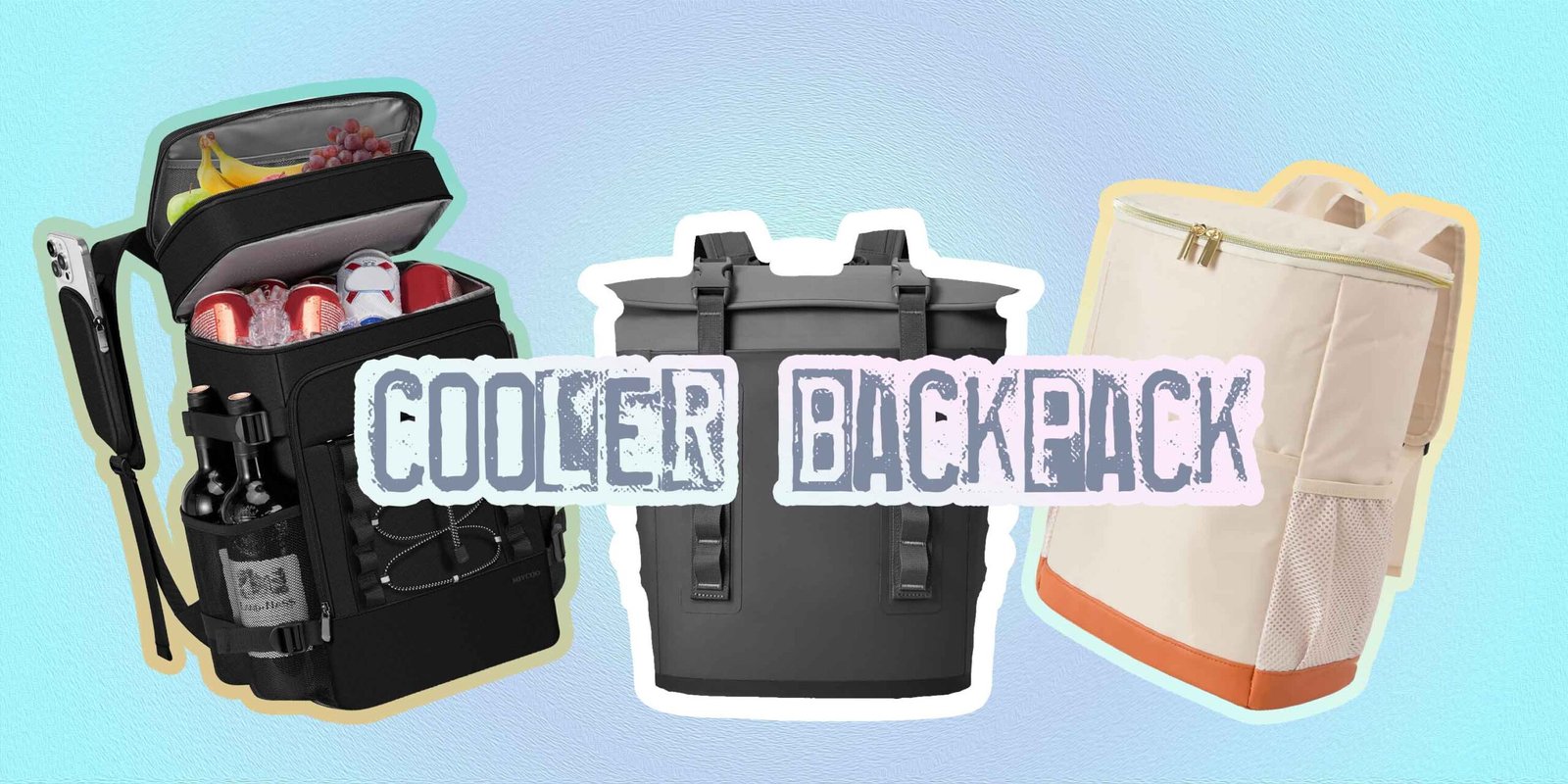
I have spent over 15 years making bags in our factory. Cooler backpacks are one of the most complex products we produce. The reason is simple: they combine thermal engineering with wearable design. These two goals often pull in opposite directions. A thicker insulation layer improves cooling but changes stiffness. A heavier liner reduces leakage but adds weight. Every decision affects how the pack feels on someone's shoulders after 30 minutes of walking. In this article, I want to share what I have learned from working with buyers who source cooler backpacks for retail and private label programs. My goal is to help you ask better questions, catch problems earlier, and reduce the risk of customer complaints about comfort.
How Much Insulation Does a Retail Cooler Backpack Need?
Buyers often ask for "maximum insulation." But more insulation is not always better. The right amount depends on your customer's use scenario and the weight trade-offs you can accept.
Most retail cooler backpacks use 5mm to 8mm closed-cell foam insulation combined with a reflective liner1. Going thicker improves thermal retention but increases stiffness, reduces internal capacity, and adds weight — all of which affect carrying comfort under load.
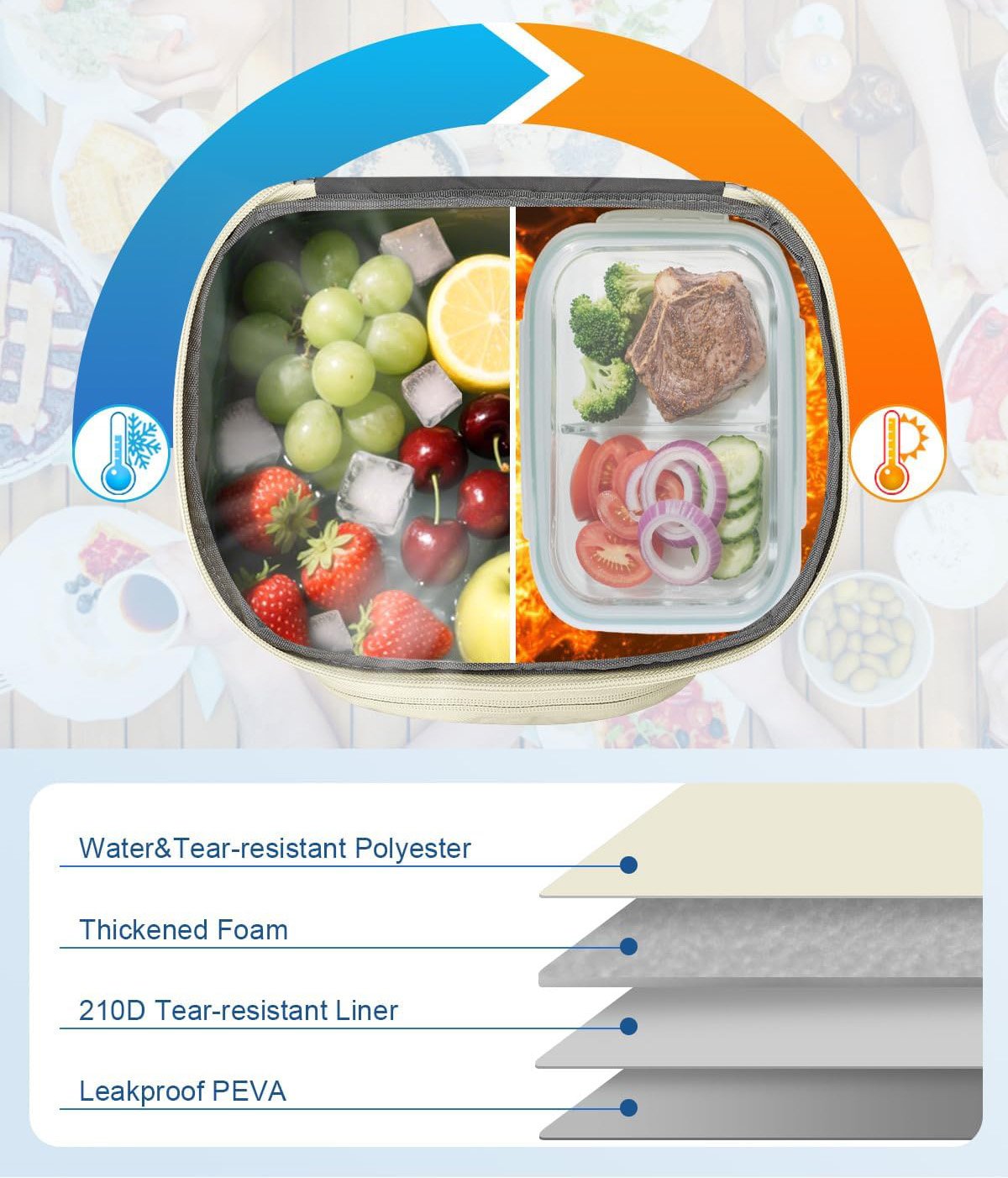
In factory sampling, I see buyers request 10mm or even 12mm foam because they assume thicker means better cooling. The problem is that a thick insulation layer changes the entire feel of the backpack. The walls become rigid. The pack does not conform to the user's back. And the internal space shrinks, which means customers pack items tighter, creating uneven weight distribution.
Here is how I typically explain the trade-offs to buyers:
Insulation Thickness Trade-off Table
| Foam Thickness | Thermal Performance | Stiffness | Internal Capacity Loss | Weight Added |
|---|---|---|---|---|
| 5mm | Moderate (4–6 hr with ice pack) | Low | Minimal | Light |
| 8mm | Good (6–8 hr with ice pack) | Medium | Noticeable | Moderate |
| 10mm+ | High (8+ hr with ice pack) | High | Significant | Heavy |
A practical approach is to start with 8mm foam and test sample performance with a standard ice pack load. If the buyer's customer will carry the pack for short periods — say, a beach trip or a picnic — 5mm may be enough. If they need all-day performance for hiking, 8mm is a reasonable balance. Going beyond 10mm usually introduces comfort problems that are hard to fix with strap adjustments alone2.
I always tell buyers: insulation is not separate from comfort. Every millimeter you add changes how the backpack sits on the body. Ask your supplier to send two samples — one at your target thickness and one slightly thinner — and test both under full load. That comparison will tell you more than any spec sheet.
What Makes a Cooler Backpack Comfortable to Carry When Full?
Many buyers focus on shoulder strap padding during sourcing. But comfort under full load is a system problem. Straps are only one piece.
Full-load comfort depends on strap curve and attachment points, back panel ventilation and rigidity, load distribution across the hip and shoulders, and how the internal weight shifts during movement. Simply making straps thicker does not solve these issues.
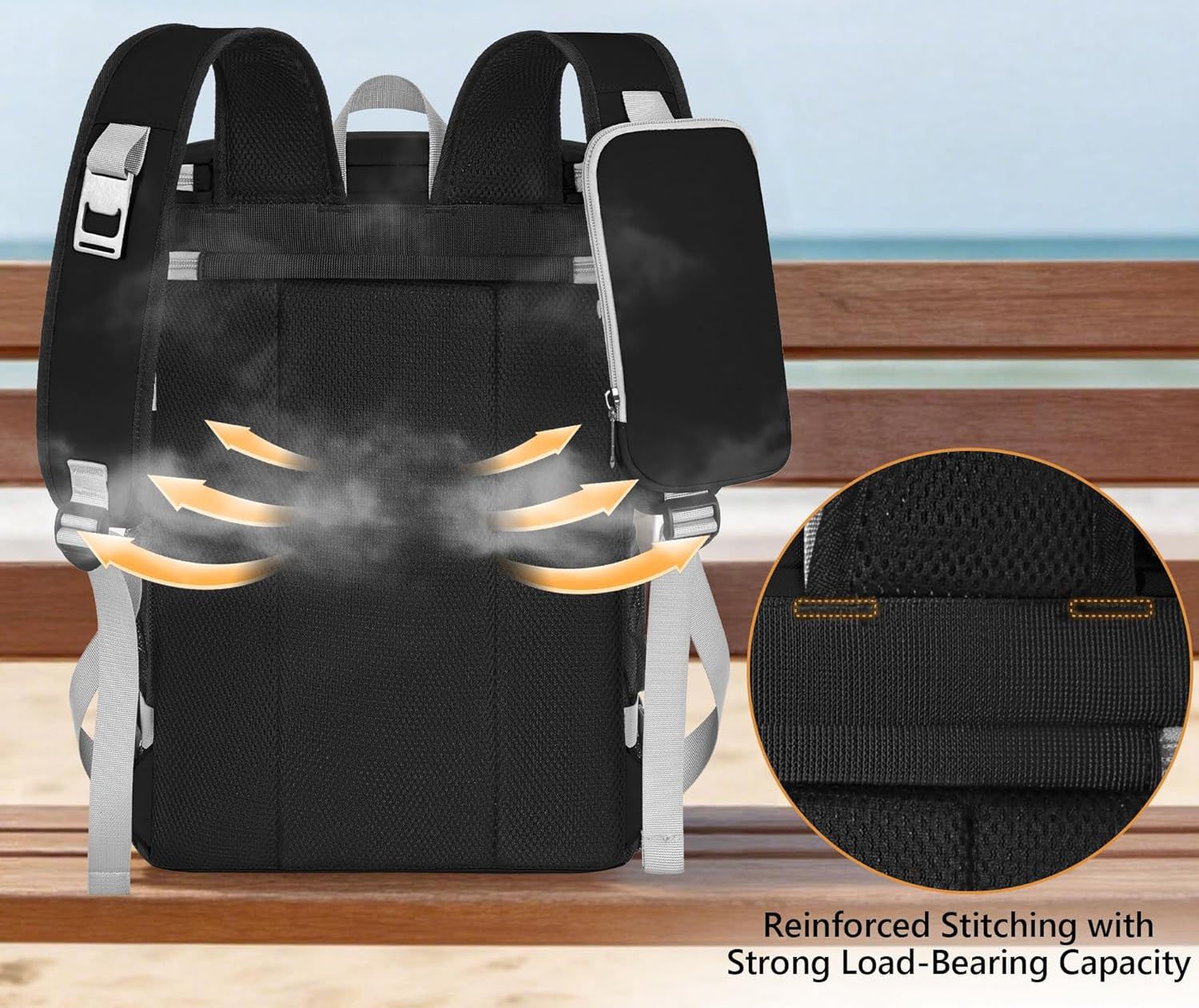
When a cooler backpack is fully loaded — typically 5 to 8 kg with drinks, food, and ice3 — the center of gravity sits low and far from the wearer's back4. This pulls the shoulders backward. If the pack has no structure to counteract this, the user leans forward, and neck and lower back fatigue builds quickly5.
Key Comfort Factors Beyond Strap Thickness
| Factor | What to Check in Samples | Why It Matters |
|---|---|---|
| Strap attachment point | Where the strap connects to the top of the pack body | Too high = neck pressure; too low = shoulder sliding |
| Strap curve | Whether the strap follows the natural shoulder/chest curve | Flat straps dig into the collarbone area |
| Back panel stiffness | Rigidity of the panel between insulation and user's back | Too soft = pack sags and pulls backward |
| Back ventilation | Mesh or channel design on the back panel | Sweat buildup makes the pack feel heavier and unstable |
| Sternum strap | Presence of an adjustable chest clip | Prevents strap spreading under heavy load |
| Load lifter straps | Small straps at the top connecting strap to pack body | Pulls weight closer to the back, reduces backward pull |
In our factory, when a buyer sends a comfort complaint from their end customers, the root cause is almost never "the padding is too thin." It is usually one of three things: the strap attachment points are wrong for the pack's loaded center of gravity, the back panel is too flexible so the pack sags away from the body, or there is no sternum strap to keep everything stable.
My advice to buyers is this: fill the sample to its maximum intended load. Put it on. Walk for 10 minutes. Then check where the pressure concentrates. If you feel it mostly on the top of your shoulders or the front of your collarbone, the strap geometry needs adjustment — not more padding.
Which Liner Construction Helps Reduce Leakage?
Leakage is a top concern for cooler backpack buyers. But liner choice also affects weight, flexibility, and how the pack feels against the user's back.
Welded PEVA or TPU liners with heat-sealed seams provide the best leak resistance6. Stitched liners with taped seams are lighter and more flexible but carry higher leakage risk over time. Buyers should specify seam construction method, not just liner material, in their supplier brief.
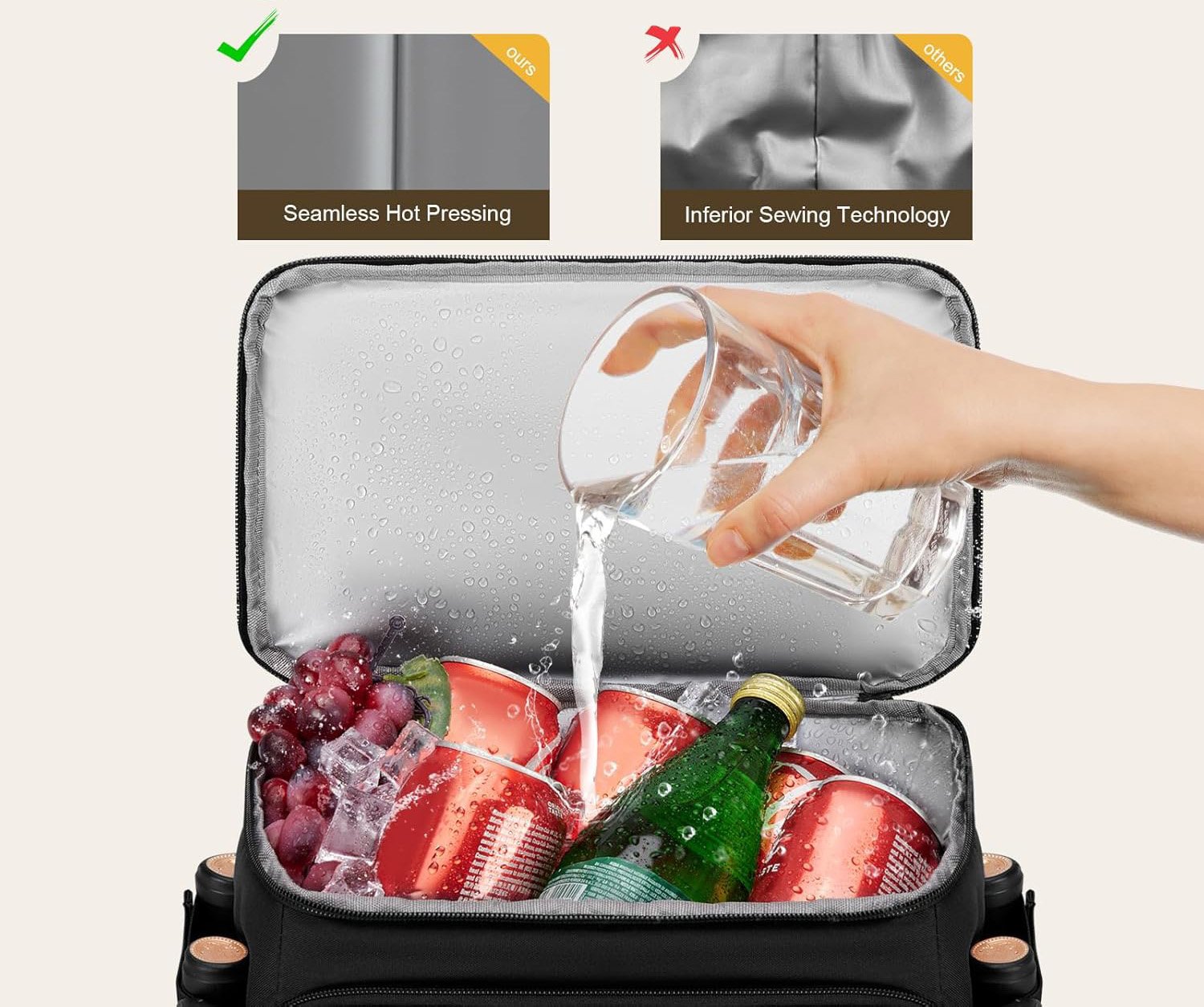
In my experience, buyers often specify "PEVA liner" or "food-grade liner" without asking how the seams are joined. This is where most leakage happens — not through the liner material itself, but through needle holes or poorly bonded seam overlaps.
Liner Construction Comparison
| Construction Method | Leak Resistance | Flexibility | Weight | Cost |
|---|---|---|---|---|
| Heat-welded PEVA | High | Low (stiffer) | Moderate | Higher |
| RF-welded TPU7 | Very high | Medium | Moderate | Highest |
| Stitched + taped seams | Moderate | High | Light | Lower |
| Stitched only (no tape) | Low | High | Lightest | Lowest |
Here is the trade-off that matters for comfort: a heat-welded liner creates a stiffer internal structure. This can actually help with load stability — the contents move less, so weight distribution stays more even during movement. But it also means the pack feels more rigid against the back.
A stitched liner with seam tape is lighter and more flexible, which gives a softer feel. But after repeated use and washing, the tape can degrade, and micro-leaks start. Condensation or small leaks inside the insulation layer add weight and create cold spots on the user's back — which is a comfort issue buyers rarely anticipate.
My recommendation: for any cooler backpack priced above mid-market, specify heat-welded or RF-welded seams. Ask your supplier to perform a basic water-fill test on the liner before it is assembled into the pack. This is a simple factory-side check that catches problems early. At Coraggio, we do this as a standard step during sampling for cooler bag projects.
Should Buyers Add Dry Storage and Bottle Pockets?
Extra pockets and compartments seem like easy value-adds. But every pocket changes how weight distributes and how the pack sits on the body.
Dry storage compartments and external bottle pockets add convenience but also create asymmetric weight points. Buyers should specify pocket placement and maximum load assumptions in their design brief so the factory can adjust strap geometry and panel reinforcement accordingly.
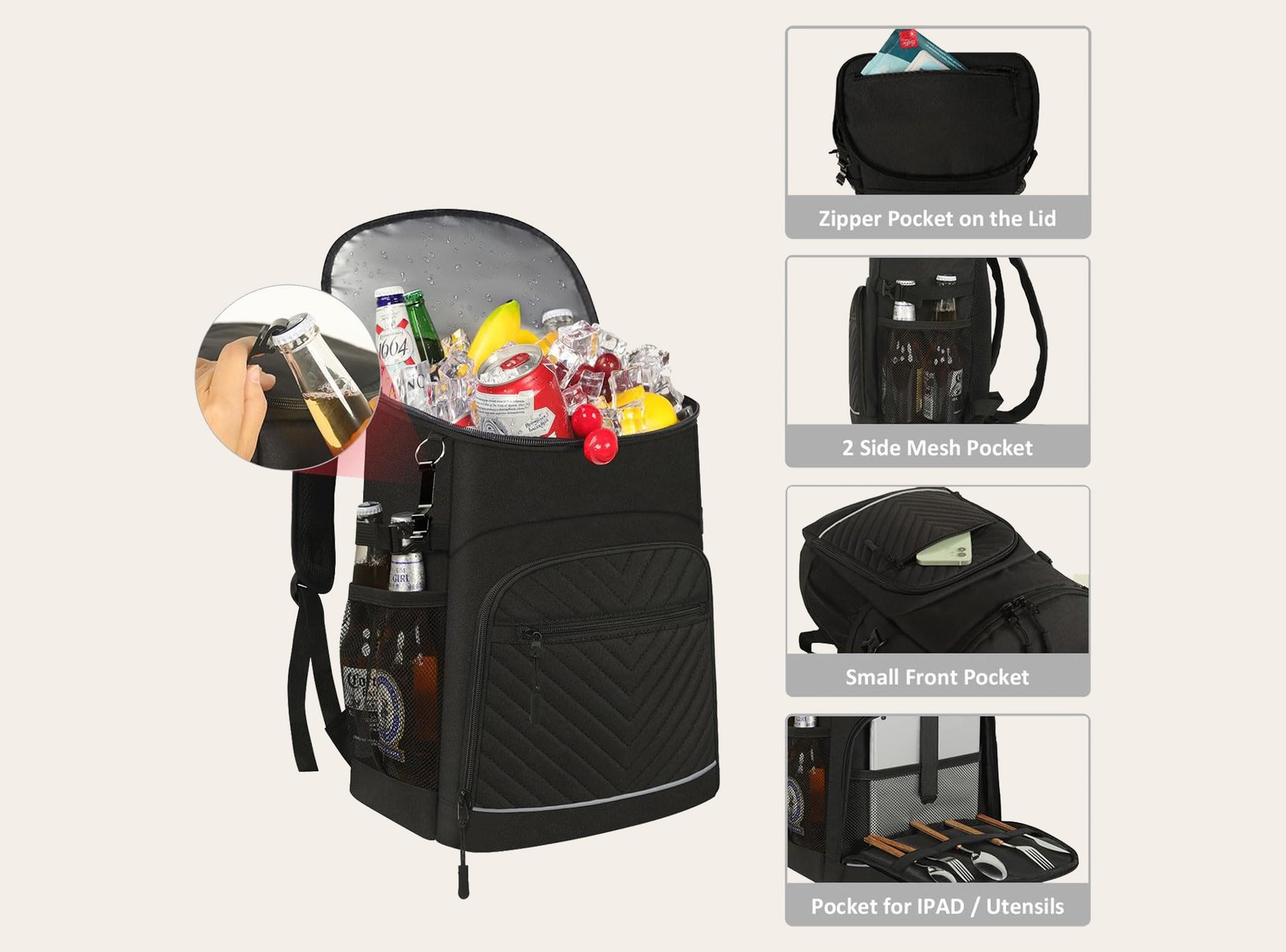
I have seen buyers add side bottle pockets to a cooler backpack design without considering that a full 750ml water bottle on one side — with nothing on the other — creates a lateral weight imbalance8. The pack tilts. The user compensates by shifting their posture. Over time, this causes shoulder and back discomfort on one side.
Pocket Placement Considerations
| Feature | Benefit | Comfort Risk | Mitigation |
|---|---|---|---|
| Top dry compartment | Separates dry items from cold zone | Raises center of gravity | Keep compartment shallow; place heavy items low |
| Side bottle pocket (single) | Quick access to drink | Asymmetric weight pull | Add pocket on both sides or use a center-back sleeve |
| Front zippered pocket | Stores keys, phone, wallet | Adds forward pull if overpacked | Limit depth to 3–4cm |
| Internal mesh divider | Organizes cold contents | Minimal | Ensure it does not block access to main compartment |
The smart approach is to design pockets with specific weight limits in mind. If you plan a side bottle pocket, tell your supplier the maximum bottle weight you expect. They can adjust the strap attachment angle or add a small counterbalance feature on the opposite side.
A top dry compartment is popular with buyers because it separates electronics and dry snacks from the cold zone. But if that compartment is deep, customers will pack heavy items in it — raising the pack's center of gravity and making it feel top-heavy. In factory sampling, I suggest buyers keep the dry compartment to no more than 20% of total pack volume9. This keeps the main weight concentrated in the lower cold section, which is where it belongs for stable carrying.
How Do Capacity and Ice Weight Affect the Design?
Capacity is not just about liters. It is about how much that capacity weighs when full and where that weight sits inside the pack.
A 20-liter cooler backpack loaded with ice, drinks, and food can weigh 7–10 kg10. The design must account for this full-load weight in strap width, attachment reinforcement, back panel structure, and base support. Buyers should specify expected full-load weight — not just volume — in their sourcing requirements.
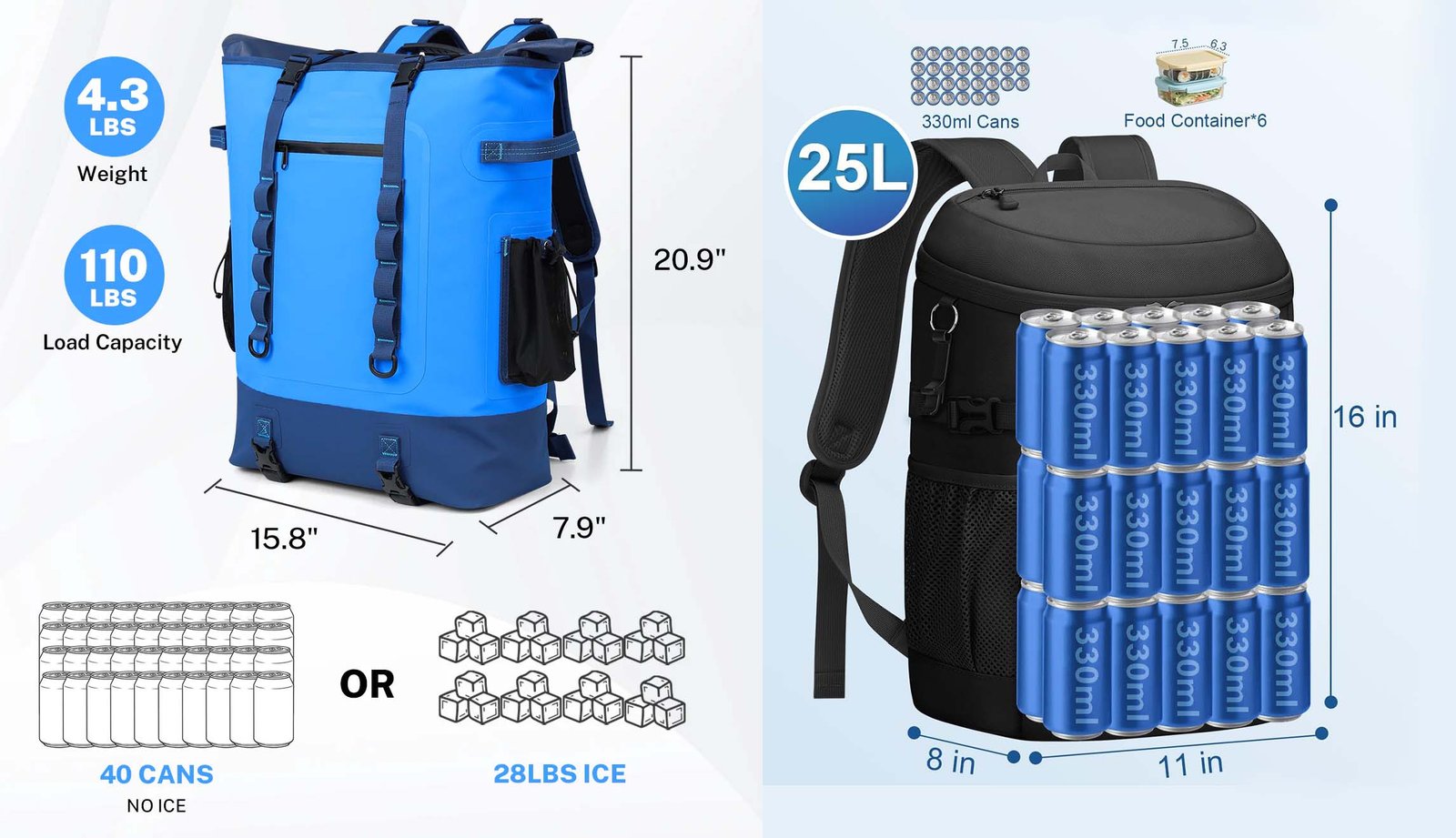
This is one of the most common gaps I see in buyer briefs. A buyer will say "I want a 25-liter cooler backpack" without calculating what 25 liters of cold drinks and ice actually weighs. At full load, that could be 10–12 kg. That is a significant weight for a backpack without a hip belt or frame.
Capacity vs. Full-Load Weight Reference
| Capacity | Typical Full-Load Contents | Estimated Weight | Design Requirements |
|---|---|---|---|
| 12L | 6 cans + ice pack + snacks | 4–5 kg | Standard straps, basic back panel |
| 18L | 12 cans + ice pack + food | 6–8 kg | Wider straps, padded back panel, sternum strap recommended |
| 25L | 18 cans + ice + food containers | 9–12 kg | Wide contoured straps, rigid back panel, sternum strap required, hip belt recommended |
| 30L+ | Full-day supply for 2–3 people | 12–15 kg | Full frame system, hip belt, load lifters, reinforced base |
In our production experience, packs above 20 liters need structural reinforcement that many buyers do not initially request. The base of the pack, in particular, needs internal stiffening. Without it, the bottom sags under ice weight. This pulls the entire load downward and away from the back, increasing shoulder strain.
I always recommend that buyers include "expected full-load weight" as a line item in their product specification sheet. This one detail helps the factory design team make better decisions about strap width, foam density in the back panel, attachment point placement, and whether a hip belt or load lifter straps should be included. It also helps set realistic expectations for comfort — no one should expect a 30-liter cooler backpack to feel as easy as a regular daypack11.
What Tests Should Be Included in a Cooler Backpack Sample Review?
A sample that looks good on the table may fail in real use. Buyers need a structured review process that tests both thermal performance and carrying comfort under load.
Sample reviews should include a full-load carry test (10+ minutes of walking), a strap stress pull test, seam integrity check on the liner, thermal retention test with standard ice packs, and visual inspection of stitching at all attachment points. Request these as part of your pre-production sample approval.
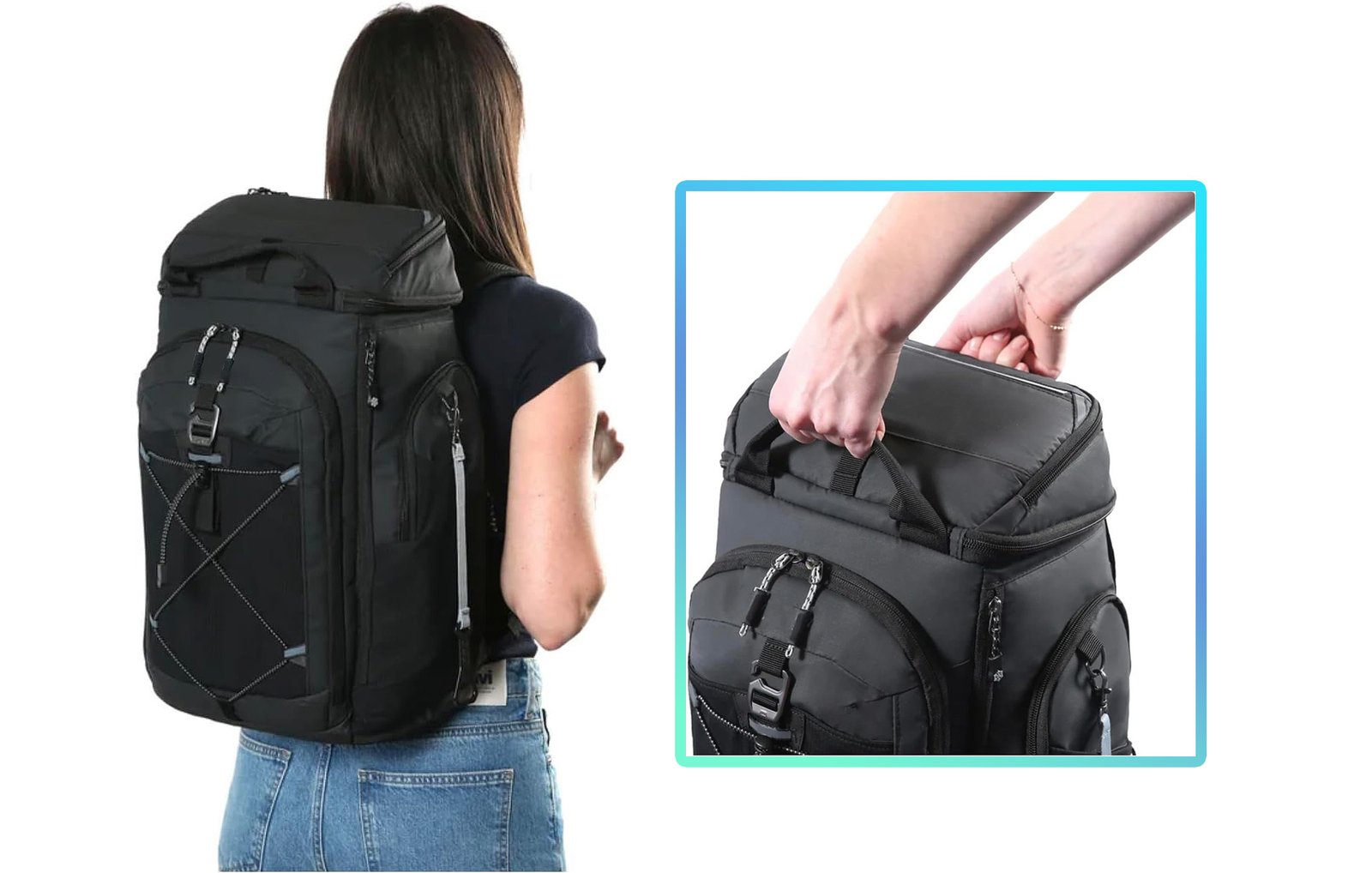
Many buyers approve samples based on appearance, insulation thickness, and material feel. They skip the most important step: putting realistic weight inside and wearing the pack. I understand why — samples often arrive at an office, not a testing facility. But this step is critical.
Sample Review Checklist for Cooler Backpacks
| Test | Method | What to Look For |
|---|---|---|
| Full-load carry | Fill to max capacity with canned drinks and ice packs, walk 10 min | Pressure concentration on shoulders or neck, strap sliding, backward pull |
| Strap pull test | Pull each strap firmly away from the pack body | Stitching stretch, attachment point integrity, buckle hold |
| Liner water test | Fill liner section with water, leave 30 min | Any seepage at seams, corners, or zipper area |
| Thermal retention | Standard ice pack test (e.g., 2 ice packs, measure internal temp at 4 hr and 8 hr) | Temperature rise rate, condensation on outer fabric |
| Zipper stress | Open/close main zipper 50 times under slight side tension | Smooth operation, no catching on liner material |
| Back panel flex | Press firmly on the back panel center and corners | Appropriate resistance (not too soft, not completely rigid) |
A Practical Approach to Factory-Side Testing
At Coraggio, when we prepare pre-production samples for cooler backpack projects, we offer buyers a simple testing protocol they can request. We fill the pack to its stated capacity with weighted contents. We photograph the pack on a mannequin or fitting form to show how it sits. We pull-test the strap attachment points and document the liner seam check.
This does not replace the buyer's own evaluation. But it gives procurement teams an initial data point before the sample ships. If something fails at this stage — a strap that twists, a back panel that collapses, a seam that shows moisture — we catch it before the buyer spends time on a flawed sample.
My strongest advice to buyers: do not approve a cooler backpack sample without testing it at full load. A 5-minute carry test in your office hallway will reveal more about comfort than any specification document. If you cannot do this yourself, ask your supplier to provide photos and a brief report of a loaded carry test. Any reliable factory should be willing to do this.
Conclusion
Sourcing a comfortable cooler backpack means looking beyond insulation specs and strap thickness. Test under full load, specify structural details clearly, and work with suppliers who understand that cooling performance and carrying comfort must be balanced together.
"[PDF] Closed Cell Foam Insulation: A Review of Long Term Thermal ...", https://info.ornl.gov/sites/publications/files/Pub40530.pdf. Research on closed-cell polyethylene foam demonstrates that thermal resistance increases proportionally with thickness, with diminishing returns above 10mm for portable insulated containers due to increased rigidity and weight penalties. Evidence role: general_support; source type: paper. Supports: Closed-cell foam in the 5-10mm range is commonly used in portable soft cooler applications for its balance of thermal resistance and flexibility. Scope note: Most thermal insulation research focuses on building materials or industrial applications rather than consumer soft cooler products specifically. ↩
"Impact of Backpacks on Ergonomics: Biomechanical and ... - PMC", https://pmc.ncbi.nlm.nih.gov/articles/PMC9180465/. Research on load-carrying systems indicates that pack-body interface conformity is a key determinant of pressure distribution and perceived comfort, with rigid pack structures creating localized pressure concentrations that persist regardless of harness system optimization (Holewijn, 1990). Evidence role: general_support; source type: paper. Supports: Excessive pack wall rigidity reduces conformity to the wearer's back contour, creating pressure points that strap adjustments cannot fully compensate for. Scope note: No specific research identifies 10mm foam as a critical threshold; the principle is supported but the exact measurement is based on manufacturing experience rather than published data. ↩
"Impact of Backpacks on Ergonomics: Biomechanical and ... - PMC", https://pmc.ncbi.nlm.nih.gov/articles/PMC9180465/. Ergonomic studies on recreational backpack loading indicate that a 15-20 liter pack filled with beverages and ice typically reaches 5-8 kg, consistent with the density of water-based contents (approximately 1 kg per liter of occupied volume). Evidence role: statistic; source type: research. Supports: A mid-size cooler backpack (15-20L) loaded with canned beverages, ice packs, and food items falls within the 5-8 kg range. Scope note: Exact weights vary significantly based on the ratio of ice to food and whether loose ice or ice packs are used. ↩
"Effects of a low-center-of-gravity backpack on the trunk stability of ...", https://pmc.ncbi.nlm.nih.gov/articles/PMC4668178/. Biomechanical research demonstrates that as the horizontal distance between a backpack's center of mass and the wearer's spine increases, compensatory forward trunk inclination rises proportionally, increasing lumbar compression forces and accelerating fatigue onset (Knapik et al., 1996; Stuempfle et al., 2004). Evidence role: mechanism; source type: paper. Supports: A load center of gravity positioned far from the body's center of mass causes compensatory forward trunk lean and increases spinal loading. Scope note: Most studies focus on hiking or military packs rather than cooler-specific designs, though the biomechanical principles apply broadly. ↩
"Backpack improper use causes musculoskeletal injuries in ... - PMC", https://pmc.ncbi.nlm.nih.gov/articles/PMC8318162/. Electromyographic studies show that carrying loads exceeding 15% of body weight in poorly fitted backpacks produces significant trapezius and lumbar erector spinae fatigue within 15-20 minutes, with fatigue onset accelerating when the load's center of mass is displaced posteriorly from the spine (Bobet & Norman, 1984; Al-Khabbaz et al., 2008). Evidence role: mechanism; source type: paper. Supports: Heavy backpack loads with posterior center of gravity cause rapid onset of trapezius and erector spinae muscle fatigue. Scope note: Fatigue onset timing varies considerably based on individual fitness, load magnitude, and walking speed. ↩
"The Future of Flexible 3D Printing? (Siraya Tech Elastic 95A)", https://www.youtube.com/watch?v=0p4R9IG_p2U. Thermoplastic welding techniques (heat sealing, radio-frequency welding) create homogeneous material bonds in PEVA and TPU films that eliminate the micro-perforations inherent in sewn seams, providing superior hydrostatic resistance as documented in textile engineering literature on waterproof membrane assembly. Evidence role: mechanism; source type: paper. Supports: Heat-welded and RF-welded seams in thermoplastic films eliminate needle perforations and create continuous material bonds that outperform stitched seams in liquid containment. Scope note: Performance data is more commonly published for outdoor apparel seam sealing than for food-contact cooler liner applications specifically. ↩
"How Radio Frequency Welding Works & Benefits - Miller Weldmaster", https://www.weldmaster.com/blog/how-radio-frequency-welding-works?. Radio frequency (dielectric) welding of thermoplastic polyurethane films produces fusion bonds at the molecular level through controlled dielectric heating, achieving seam strengths approaching 90-100% of the parent material's tensile strength and providing hermetic sealing without adhesives or mechanical fasteners (Troughton, 2008, Handbook of Plastics Joining). Evidence role: mechanism; source type: paper. Supports: RF welding creates molecular-level bonds in TPU films that achieve near-parent-material strength and complete waterproof integrity. Scope note: Bond quality depends on precise control of frequency, pressure, and dwell time; the theoretical superiority of RF welding assumes proper manufacturing execution. ↩
"Postural effects of symmetrical and asymmetrical loads on the ... - PMC", https://pmc.ncbi.nlm.nih.gov/articles/PMC1971247/. Studies on asymmetric backpack loading demonstrate that even relatively small unilateral loads (0.5-1.0 kg) produce measurable lateral trunk deviation and compensatory muscle activation patterns, with effects increasing during prolonged carrying (Pascoe et al., 1997; Chansirinukor et al., 2001). Evidence role: mechanism; source type: paper. Supports: Asymmetric loading on one side of a backpack causes lateral trunk lean and uneven muscle activation that can lead to discomfort. Scope note: Research typically examines larger asymmetric loads (e.g., single-strap carrying); a 750ml bottle (~0.75 kg) represents a relatively small imbalance whose practical significance may vary by individual. ↩
"Effects of a low-center-of-gravity backpack on the trunk stability of ...", https://pmc.ncbi.nlm.nih.gov/articles/PMC4668178/. Load distribution research suggests that concentrating 60-80% of pack weight close to the wearer's center of mass (mid-to-lower back region) optimizes stability and reduces metabolic cost during walking, supporting the principle of minimizing upper compartment volume in top-loading designs (Knapik et al., 2004). Evidence role: general_support; source type: research. Supports: Keeping the majority of pack weight in the lower section maintains a lower center of gravity that improves stability and reduces energy expenditure. Scope note: The specific 20% threshold appears to be a practical manufacturing guideline rather than a figure derived from published ergonomic research; optimal ratios depend on total pack weight and user anthropometry. ↩
"The 7 Best Backpack Coolers, Tested & Reviewed - Food & Wine", https://www.foodandwine.com/best-backpack-coolers-7229732. Given that water and ice have a density of approximately 1 kg/L and canned beverages average 0.35-0.4 kg each, a 20-liter cooler backpack filled to capacity with a typical mix of 12-15 cans, ice packs, and food items reaches an estimated 7-10 kg including the pack's own weight (typically 1-1.5 kg). Evidence role: statistic; source type: other. Supports: A 20-liter cooler filled with a mix of canned beverages, ice packs, and food items reaches approximately 7-10 kg total weight. Scope note: Actual weight depends heavily on the specific contents ratio; packs filled primarily with ice will weigh more than those with lighter snack items. ↩
"Impact of Backpacks on Ergonomics: Biomechanical and ... - PMC", https://pmc.ncbi.nlm.nih.gov/articles/PMC9180465/. Ergonomic guidelines for backpack design indicate that loads exceeding approximately 10% of body weight or 7-10 kg absolute benefit significantly from hip belt load transfer systems, which can shift 30-70% of pack weight from the shoulders to the pelvis (Mackie et al., 2003). Evidence role: expert_consensus; source type: research. Supports: Loads exceeding 10 kg generally require hip belt load transfer and internal frame support for comfortable extended carrying. Scope note: Thresholds vary by individual fitness, body weight, and carrying duration; most research focuses on hiking or school backpacks rather than cooler-specific designs. ↩