A summer GWP makeup bag can look perfect on paper, then fail when heat, sunscreen, humidity, and a fixed launch date meet weak sourcing choices.
A great Summer GWP makeup bag fits the real use case, material, packaging, price tier, and delivery timeline. I look at climate, fabric behavior, logo method, carton packing, MOQ, and campaign date before I judge color or style.
I have seen many summer GWP briefs start with a cute reference photo. I understand why. Marketing needs a visual idea first. But in factory work, I need to know where the bag will be used, how it will be packed, how fast it must ship, and what the buyer can accept at bulk volume. A beach gift, a pool-side set, a travel retail gift, and a supermarket beauty bundle do not need the same makeup bag. If I treat them as the same product, I create risk before sampling even starts.
What Materials Are Best for Summer GWP Makeup Bags?
A wrong fabric can turn a simple summer gift into a complaint risk. Heat, sweat, sunscreen, and chlorine often expose problems that a desk sample hides.
The best materials for Summer GWP makeup bags are RPET polyester, coated nylon, washable PU, canvas, and TPU, when each material matches the use case. I choose based on moisture contact, cleaning needs, logo method, budget, and certification needs.
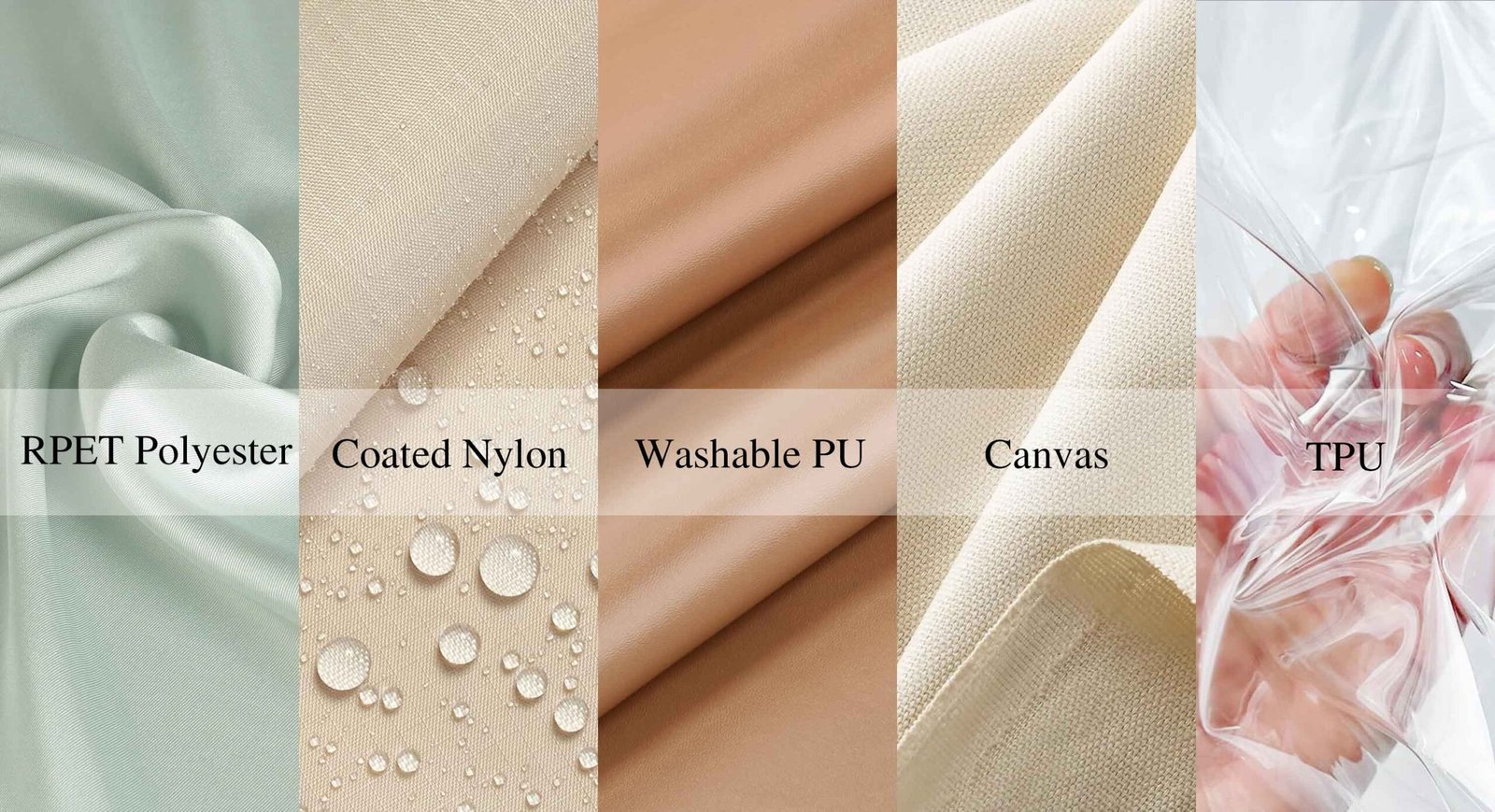
In our quoting experience, summer GWP problems often start when a winter material is reused. Felt can hold odor1. Thick PU can deform when packed under pressure. Dark dyes can transfer if the lining is soft and humid. Cotton lining can feel premium, but it can also hold moisture after sunscreen or sweat contact2. I do not say one material is always best. I first ask where the bag will be used.
| Summer use case | Material I usually review first | Why it can work | Risk I check before quoting |
|---|---|---|---|
| Beach or pool promo | TPU, coated nylon, RPET with coating3 | Better for moisture contact | Seams, zipper tape, odor, print adhesion |
| Travel retail GWP | RPET polyester, nylon, washable PU | Light, packable, easy to brand | Shape recovery after carton packing |
| Daily humid commute | Canvas, RPET, washable PU | Balanced cost and feel | Color transfer and lining choice |
| Natural beauty campaign | Organic cotton, hemp blend, canvas | Strong material story | Shrinkage, stains, higher cost |
I also separate “eco” into real material choices. RPET needs recycled content proof, and buyers can ask for GRS-related documents from the supplier4. Organic cotton needs organic proof5. Paper tags or FSC packaging are different from the bag fabric itself6. I prefer clear wording because vague eco claims create risk in Europe and North America7.
Which Colors Make a Makeup Bag Feel More Seasonal?
A summer color can look fresh in a mockup and look wrong after bulk dyeing, heat, or sunscreen contact. Color is not only a design choice.
Seasonal summer colors usually include light neutrals, soft pastels, aqua tones, coral, citrus, and clean white accents. I still check fabric base color, dye stability, logo contrast, lining color, and dirt visibility before I approve a direction.
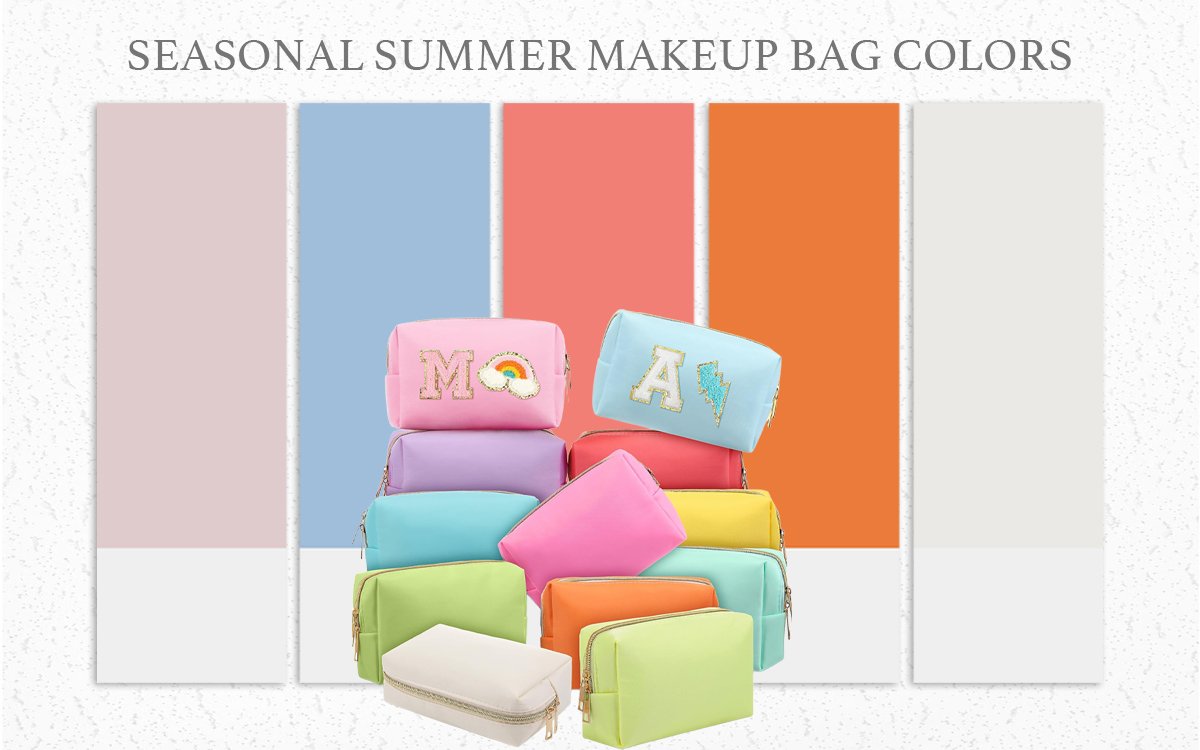
What I typically see on summer GWP briefs is a pastel mood board with many tones. The idea is clear, but production needs a smaller and safer palette. Light colors feel seasonal, but they show glue marks, dirt, and carton dust more easily8. White looks clean, but it needs better handling during sewing and packing. Bright coral and citrus colors can lift the summer feeling, but they must work with the logo method. A fine gold logo on textured canvas may not show well. A white print on TPU may need careful ink review.
| Color direction | Best use | Factory concern I check |
|---|---|---|
| Sand, cream, warm beige | Clean beauty, natural campaign | Dirt marks, shade difference |
| Aqua, mint, light blue | Pool, travel, hydration theme | Logo contrast, zipper matching |
| Coral, peach, citrus | Summer launch, gift set impact | Color consistency across materials |
| White with trim color | Premium clean look | Handling marks, packaging protection |
| Dark navy or green | More practical daily use | Less seasonal, possible heat feel |
I also ask if the color must match primary packaging, lipstick shade, or campaign display. A makeup bag may sit next to boxes, testers, and paper inserts. If the bag color is slightly off, the full set can look inconsistent. This is why I ask for physical color references when possible, not only screen images.
What Bag Styles Work Best for Beauty Gift Promotions?
A beauty GWP bag can fail when the style looks attractive but cannot hold the actual products. The shape must support the gift set.
The best styles for beauty gift promotions are flat pouches, boxy cosmetic bags, clear travel pouches, drawstring bags, and small train cases. I choose by product size, shelf display, packing method, and how the customer will receive the gift.
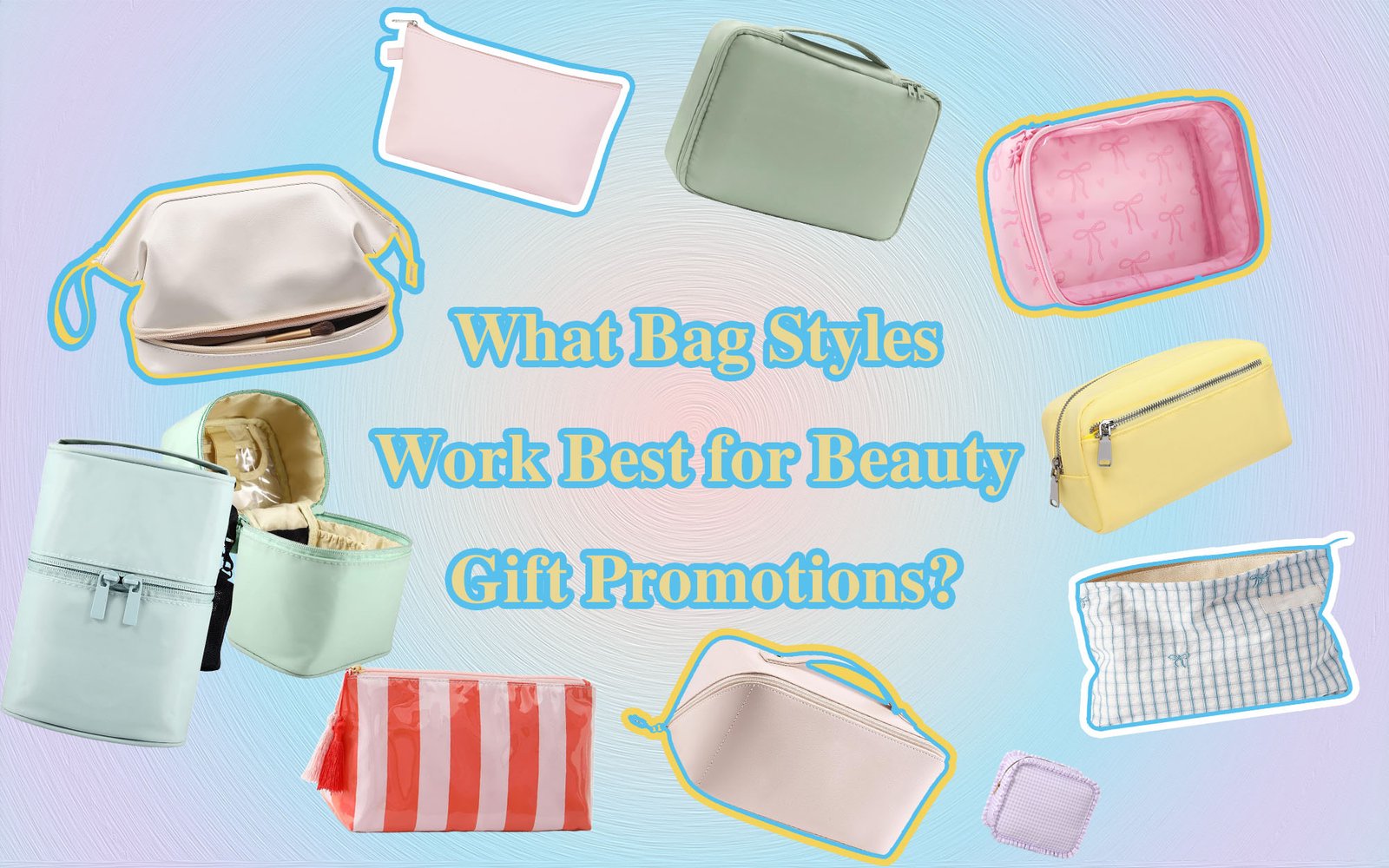
In factory sampling, I always want the product list. A mascara, a small fragrance, a sunscreen tube, and a compact powder all behave differently inside a bag. If marketing chooses a flat pouch, but sourcing later adds a round jar, the bag may bulge and look cheap. If the buyer needs the GWP packed as a full set, the bag may need a wider base or a gusset. If the GWP ships empty and sits beside the product, a flatter style may save carton space.
| Style | Strong point | Best for | Common problem |
|---|---|---|---|
| Flat zipper pouch | Low cost, easy logo | Samples, sheet masks, small items | Limited depth |
| Boxy cosmetic bag | Better capacity | Multi-item gift sets | Higher sewing and packing volume |
| Clear TPU pouch9 | Summer and travel feel | Pool, beach, security-friendly look | Scratches, odor control |
| Drawstring bag | Light and soft | Natural or casual campaign | Less product protection |
| Mini train case | Premium look | Higher value sets | Higher cost, more structure needed |
GWP is not a normal retail bag. It often travels inside a promotion system. It may need a belly band, a hangtag, a barcode label, a paper insert, or a display carton. A structured bag looks better in photos, but it can create bigger carton cube. A soft pouch can reduce freight cost, but it may arrive wrinkled if the material is too thin. I often ask buyers if they need the bag to stand on shelf, hang on a display hook, or fit inside a beauty box. This answer changes the pattern more than the trend reference does.
How Can Brands Customize GWP Makeup Bags for Retail Campaigns?
Customization can make a GWP bag feel on-brand, but too many late changes can break the sampling schedule and increase setup cost.
Brands can customize GWP makeup bags through fabric, color, logo printing, embroidery, zipper pullers, lining, labels, hangtags, packaging, and inserts. I recommend locking the use case, artwork, MOQ tier, and delivery date before confirming decoration.
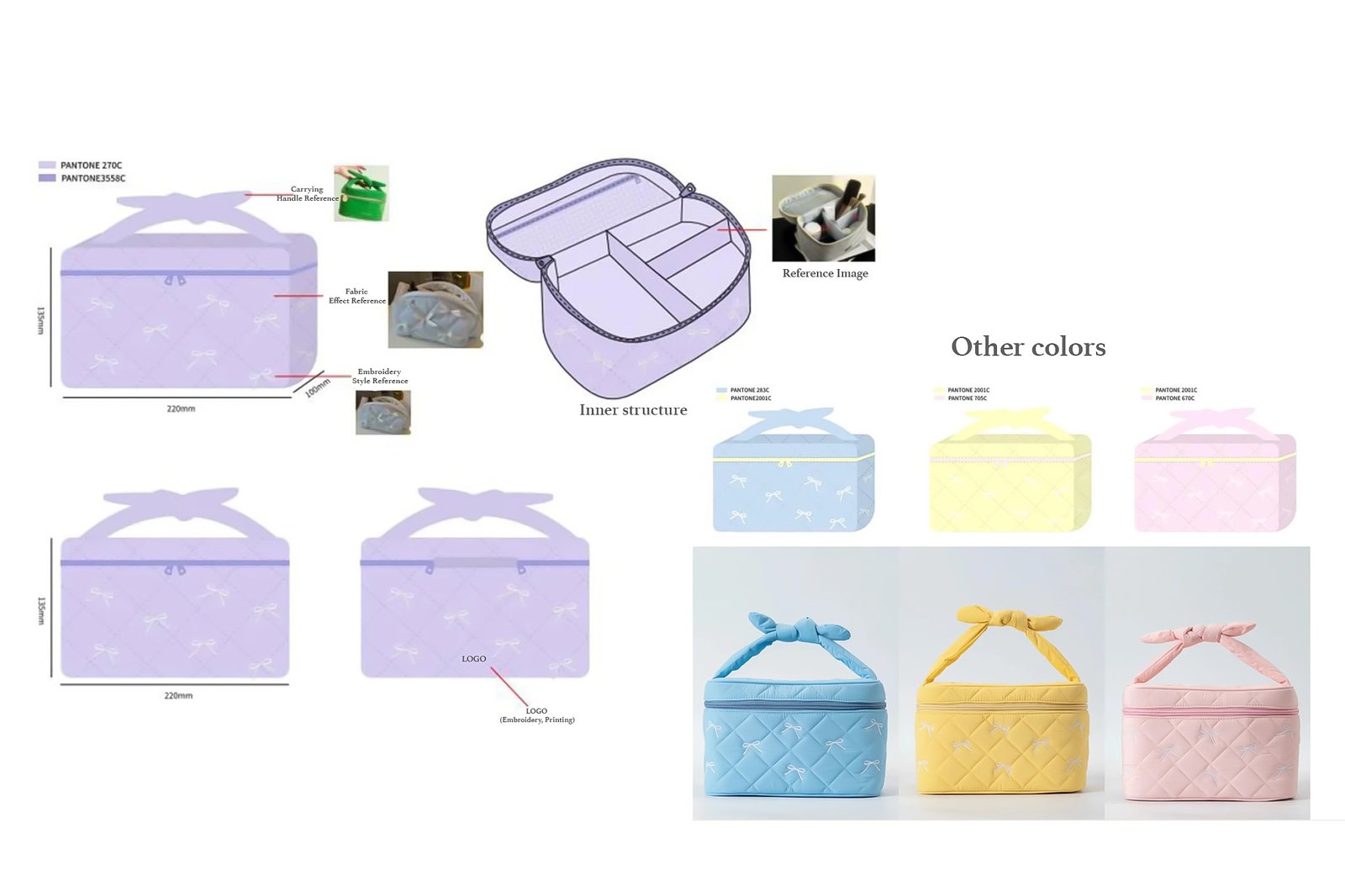
Many buyers ask for full customization, but that phrase can mean many things. A logo print on an existing pouch pattern is different from a new mold puller, a custom zipper color, a printed lining, and a gift box. Each choice adds time, setup, and approval steps. In our quoting experience, the best briefs show the must-have items and the optional items. That helps me protect the launch date.
| Custom item | Usually easier | Usually needs more time or cost |
|---|---|---|
| Logo | Silk screen, heat transfer, woven label | Embroidery on difficult fabric, metal plate |
| Fabric | Existing RPET, nylon, PU color | Custom dye, special coating |
| Trim | Standard zipper, standard puller | Custom metal puller, custom molded puller |
| Lining | Stock lining color | Printed lining, special color match |
| Packaging | Polybag, simple hangtag | Box, belly band, display-ready packing |
I see many PP-sample problems come from small details. A logo is too thin for the fabric texture. A zipper puller scratches the PU. A hangtag string leaves marks on a white bag. A belly band is too tight and bends the pouch. These are not big design errors, but they can slow approval. I prefer to review the full retail campaign system early. I ask about barcode placement, warning labels, recycling marks, carton marks, and whether each bag is packed empty or filled with products. If a buyer tells me only the bag size and logo, I can quote the bag. I cannot fully protect the campaign. Retail GWP needs the bag, the packing, and the delivery plan to work together.
What Should Buyers Consider When Sourcing GWP Makeup Bags?
A low unit price can become expensive if the bag misses the launch date, arrives with defects, or needs a full resample after approval.
Buyers should consider use case, climate, material, certification needs, MOQ, sample lead time, decoration method, packaging, carton volume, QC plan, payment terms, and final delivery date before sourcing GWP makeup bags.

The buyer-side mistake pattern is common. Marketing selects the look. Sourcing receives a brief with a tight date and a fixed target price. The factory then finds that the material, logo, packaging, and MOQ do not match the budget. This creates pressure at the worst time. I prefer to ask basic questions before the first quote because simple answers can prevent late changes.
| Question I ask buyers | Why it matters |
|---|---|
| Where will the bag be used? | It guides material and lining choice |
| What products go inside? | It decides size, gusset, and structure |
| What is the launch date? | It controls sample and bulk schedule |
| What is the target MOQ? | It affects fabric sourcing and unit cost |
| What certification proof is needed? | It affects material choice and documents |
| How will the bag be packed? | It affects labor, carton size, and freight |
| What is the logo method? | It affects artwork limits and approval time |
GWP is a volume product, but it still has setup costs. Printing screens, custom colors, labels, and packaging all need preparation. A very small order with many custom details can become expensive. A larger order can support better customization, but it needs clearer planning. I also look at carton cube because air freight for bulky structured bags can damage the budget10. Sea freight needs more time11, so a fixed Q2 campaign should not start sourcing too late. In my factory work, the real loss is often not the difference between two unit prices. The real loss is a missed promotion window. If a bag arrives in Q3 for a summer launch, the low price does not help the buyer. I always tell buyers to lock the final spec before the PP sample. After that point, changes can affect cost, lead time, and quality control.
Conclusion
I see a great Summer GWP makeup bag as a sourced system: right material, right style, clear customization, safe packing, and on-time delivery.
"A novel method for textile odor removal using engineered water ...", https://pmc.ncbi.nlm.nih.gov/articles/PMC9064573/. Studies on textile odor adsorption show that wool and dense fibrous materials retain volatile organic compounds more readily than smooth synthetic fabrics. Evidence role: mechanism; source type: paper. Supports: Porous wool-based textiles such as felt absorb and retain volatile odor compounds. Scope note: Odor retention varies with fiber treatment and environmental conditions. ↩
"Factors Influencing Textile Moisture Regain | PDF - Scribd", https://www.scribd.com/presentation/479989631/Factors-Affecting-the-Regain-of-Textile-Fiber-pptx. Standard textile references report cotton's moisture regain at approximately 8.5%, significantly higher than polyester or nylon, explaining its tendency to retain perspiration and topical product residues. Evidence role: mechanism; source type: encyclopedia. Supports: Cotton fibers exhibit high moisture regain relative to common synthetic fibers. ↩
"Water Repellent Coating in Textile, Paper and Bioplastic Polymers", https://pmc.ncbi.nlm.nih.gov/articles/PMC11479018/. Thermoplastic polyurethane (TPU) is described as a flexible, water-resistant polymer commonly used in waterproof film and fabric coatings. Evidence role: mechanism; source type: encyclopedia. Supports: TPU and coated nylon fabrics provide water resistance suitable for wet environments. Scope note: General material descriptions; not specific to cosmetic bag applications. ↩
"Recycled Claim Standard (RCS) + Global Recycled Standard (GRS)", https://textileexchange.org/recycled-claim-global-recycled-standard/. Textile Exchange's Global Recycled Standard (GRS) sets requirements for third-party certification of recycled input and chain-of-custody for products containing recycled materials. Evidence role: definition; source type: institution. Supports: GRS is the standard used to verify recycled content in RPET textiles. Scope note: Standard documents describe certification scope but do not address GWP-specific use cases. ↩
"Global Organic Textile Standard: Home - GOTS", https://global-standard.org/. The Global Organic Textile Standard (GOTS) and Organic Content Standard (OCS) define third-party certification frameworks for verifying organic fiber content in textile products. Evidence role: definition; source type: institution. Supports: Organic cotton claims are verified through standards like GOTS or OCS. ↩
"Paper & Packaging | Forest Stewardship Council", https://fsc.org/en/businesses/paper-packaging. The Forest Stewardship Council (FSC) certifies products derived from responsibly managed forests, primarily wood and paper-based materials, separate from textile certification schemes. Evidence role: definition; source type: institution. Supports: FSC certifies forest-based products such as paper and wood, distinct from textile certification. ↩
"Green Guides | Federal Trade Commission", https://www.ftc.gov/news-events/topics/truth-advertising/green-guides. The European Commission's proposed Green Claims Directive and the US FTC Green Guides both require substantiation of environmental marketing claims and target generic or vague eco terminology. Evidence role: expert_consensus; source type: government. Supports: Regulators in the EU and US restrict unsubstantiated environmental marketing claims. Scope note: Regulations are evolving and may not apply uniformly to promotional gift products. ↩
"Investigation of the properties of polyester blended knitted fabric ...", https://pmc.ncbi.nlm.nih.gov/articles/PMC12034787/. Textile soiling and stain visibility studies indicate that contrast between soil particles and substrate color increases perceived soiling on lighter fabrics. Evidence role: general_support; source type: paper. Supports: Textile soiling is more visually perceptible on light-colored substrates. Scope note: Findings depend on fabric type, soil composition, and lighting conditions. ↩
"Liquids, Aerosols, and Gels Rule - TSA", https://www.tsa.gov/travel/frequently-asked-questions/liquids-aerosols-and-gels-rule. The US Transportation Security Administration's 3-1-1 liquids rule requires carry-on liquids to be placed in a single clear, quart-sized bag, motivating the use of transparent pouches in travel cosmetic sets. Evidence role: case_reference; source type: government. Supports: Aviation security rules require liquids in carry-on to be placed in a clear bag. Scope note: Rules vary by jurisdiction; bag dimensions and material specifics differ. ↩
"Air Cargo Tariffs and Rules: What You Need to Know - IATA", https://www.iata.org/en/publications/newsletters/iata-knowledge-hub/air-cargo-tariffs-and-rules-what-you-need-to-know/. IATA's chargeable weight rules apply a volumetric weight calculation to air cargo, so low-density shipments are billed based on cubic dimensions rather than actual weight. Evidence role: mechanism; source type: institution. Supports: Air freight uses volumetric (dimensional) weight, increasing cost for bulky low-density shipments. ↩
"Air Freight vs Ocean Freight: Cost, Transit Time, and Decision ...", https://www.exfreight.com/air-freight-vs-ocean-freight-cost-transit-decision-framework/. UNCTAD and major carrier schedules report that container sea freight transit between Asia and Europe or North America commonly takes 25–45 days, substantially longer than air freight equivalents. Evidence role: statistic; source type: institution. Supports: Ocean freight transit times typically far exceed air freight on the same lane. Scope note: Transit times vary by port, route, and current shipping conditions. ↩